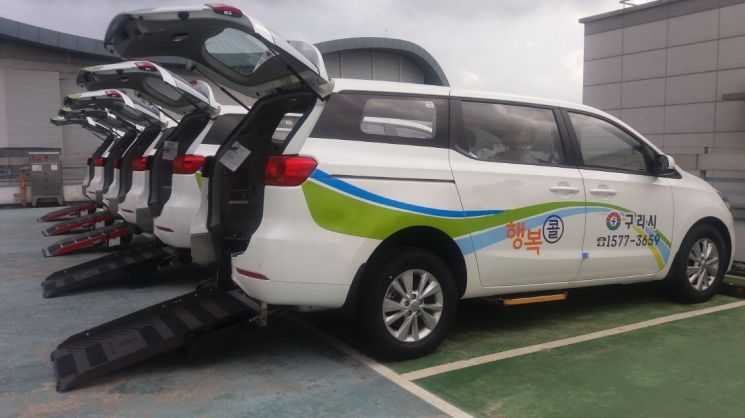
 Guri City is expanding and operating transportation support vehicles for transportation-vulnerable groups such as people with disabilities and pregnant women who have difficulty using public transportation to ensure their smooth right to mobility.
 The city of Guri, Gyeonggi Province (Mayor Baek Kyung-hyun) announced on the 17th that it has expanded transportation support vehicles for transportation-vulnerable groups such as people with disabilities and pregnant women who have difficulty using public transportation to ensure their smooth right to mobility.
Since September 2017, the Guri City Transportation Vulnerable Mobility Support Center, operated under the management of Guri Urban Corporation, has been integrated with the Gyeonggi Province Metropolitan Mobility Support Center from July 1 of this year. As a result, the 22 special transportation vehicles previously used together with non-wheelchair users are now operated exclusively for severely walking-disabled and wheelchair users.
Additionally, for non-wheelchair users (▲severely walking-disabled persons who do not use wheelchairs ▲mildly walking-disabled persons who do not use wheelchairs ▲seniors aged 65 and over ▲pregnant women who have difficulty using public transportation), eight alternative vehicles separate from the special transportation vehicles have been secured and operated to strengthen support.
Consequently, the number of uses of mobility support vehicles increased by 25.8%, from 2,497 cases per month (as of June 2024) to 3,141 cases per month (as of September 2024), and the average waiting time for special transportation vehicles was significantly reduced from 93.3 minutes (as of June 2024) to 35.6 minutes (as of September 2024).
Mayor Baek Kyung-hyun of Guri stated, “We will continue to make steady efforts to facilitate the mobility of transportation-vulnerable groups, and we will actively improve users’ inconveniences by conducting regular surveys.”
© The Asia Business Daily(www.asiae.co.kr). All rights reserved.

















