At the Central Disaster and Safety Countermeasures Headquarters Meeting, Medical Community Urged Again to "Engage in Dialogue"
"Transition of Tertiary Hospitals Not a Reduction in Opportunities for Returning Residents"
The government announced that the emergency medical system is being maintained, with a decrease in the number of mild patients leading to a reduction in the time to first specialist consultation after visiting the emergency room. However, it urged renewed dialogue with the medical community, noting that the prolonged medical service gap has made the situation challenging on the ground.
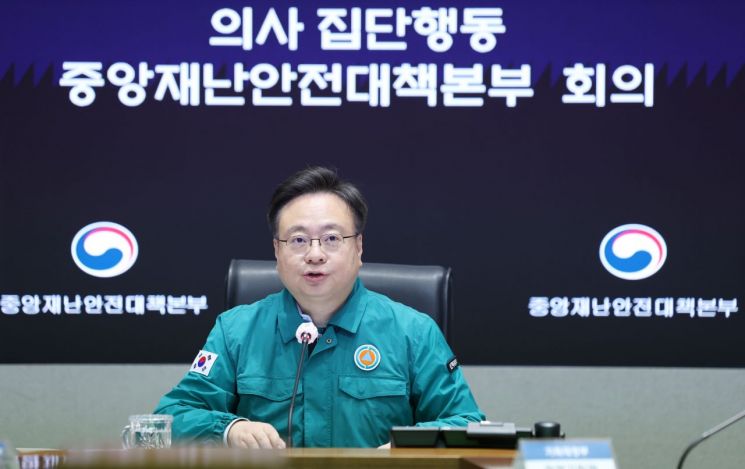
On the 17th, Cho Kyu-hong, Minister of Health and Welfare, held a meeting of the Central Disaster and Safety Countermeasures Headquarters on doctors' collective action at the Government Seoul Office and stated, "On the 10th, there was a medical reform discussion between the government and the Seoul National University College of Medicine Emergency Response Committee. Although we could not narrow the differences in positions, it is meaningful that we have started a dialogue to solve the problem. I hope these efforts continue so that we can open the door to dialogue with the medical community."
Minister Cho further urged the medical community, saying, "I once again ask you to participate in the ruling and opposition parliamentary council and the Special Committee on Medical Reform," adding, "You may also propose a separate format like the recent medical reform forum. The government is ready to engage in dialogue at any time with sincerity."
He requested the recommendation of expert members to the 'Manpower Supply and Demand Forecast Committee,' which is ongoing until the 18th, and also asked for applications to the 'Support Project for the Structural Transformation of Tertiary Hospitals.'
Minister Cho said, "The Manpower Supply and Demand Forecast Committee is composed so that experts recommended by provider organizations constitute the majority, allowing sufficient consideration of the specialties and stakeholders' opinions of the relevant professions during discussions," and added, "Since the supply and demand forecast results derived through expert discussions across various fields form the basis for manpower policy establishment, we ask for active participation from medical associations, provider organizations, consumer organizations, and related research institutions."
He also emphasized, "Contrary to concerns raised by some regarding the pilot project for structural transformation of tertiary hospitals, the number of residency positions will not be reduced, nor will opportunities for residents wishing to return decrease," and stated, "Tertiary hospitals will focus on severe care and strengthen cooperation with regional hospitals and clinics, while ensuring residents can train under better conditions."
According to the Ministry of Health and Welfare, currently, due to the decrease in mild patients, the time to first specialist consultation after visiting the emergency room has decreased by 6.8 minutes from normal times to 17.9 minutes. The time from onset to emergency room arrival is under 2 hours for about 33% and under 1 hour for about 18%, maintaining levels similar to previous years.
As of the end of September, the volume of inpatient care at tertiary and general hospitals is about 97% of normal levels, and surgeries are about 93%. In emergency medical care, the number of mild patients visiting emergency rooms is about 73% of normal, while severe and emergency patients are maintained at about 92%.
Cancer surgeries at tertiary hospitals decreased by 16% from March to June compared to the same period last year, but patients are moving to general hospitals and switching to other treatments such as chemotherapy. The government operates 70 cancer treatment cooperative hospitals.
Minister Cho said, "Despite difficult conditions, the emergency medical system is being maintained thanks to the cooperation of the public and the dedication of frontline medical staff," and added, "However, there are difficulties in maintaining emergency medical capacity due to increased fatigue among medical personnel, so we are extending fee support and operating a rotation duty system and disease networks."
© The Asia Business Daily(www.asiae.co.kr). All rights reserved.

















