Confusion and Dilemma Over 'Unification' Removal... Promotion of 'Prior Fortification'
Rodong Sinmun Disclosure, Persuading Residents Through Gradual Realization
'Military Aid in Emergencies' North Korea-Russia Treaty Likely to Be Activated
North Korea has begun steps to turn the South and the North into 'separate states.' It revealed to residents the fact of blowing up the inter-Korean connecting roads and partially disclosed the constitutional amendment content that 'defines the Republic of Korea as a hostile state.'
On the 17th, North Korea announced through domestic and foreign media the news of the destruction of the inter-Korean connecting roads on the Gyeongui Line and Donghae Line, stating that it was "a requirement of the Republic's constitution that strictly regulates the Republic of Korea as a hostile state." This content appeared not only in the Korean Central News Agency but also on the front page of the Rodong Sinmun obtained by this paper. Three photos showing the explosion scenes were also released.
'Prior Fortification' Promotion, Gradual Realization to Persuade Residents
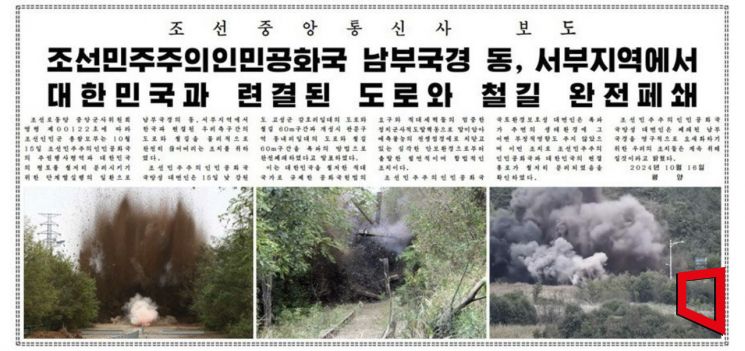 Report on the demolition of the inter-Korean connecting road, published at the bottom of the front page of the North Korean Rodong Sinmun on the 17th.
In particular, North Korea claimed that this measure was in accordance with the Workers' Party Central Military Commission Order No. 122, describing it as an "inevitable and legitimate measure arising from the serious security environment rapidly approaching an unpredictable war border due to the severe political and military provocations of hostile forces." It argued that the war crisis arose from provocations by the South, and North Korea merely took corresponding measures. This appears to be a typical North Korean strategy to foster a 'siege mentality,' creating a sense of crisis from external enemies to strengthen internal control.
North Korea indicated that this explosion was part of a 'step-by-step implementation' to thoroughly separate the exercise of sovereignty of the Democratic People's Republic of Korea and the territory of the Republic of Korea, suggesting that separation measures will continue. A spokesperson for the Ministry of National Defense said, "Measures to permanently fortify the closed southern border will continue to be taken."
Chairman Kim Jong-un has advocated the 'two-state theory' since the end of last year. Although instructions for constitutional amendments were made accordingly, the amendment status was not disclosed at the Supreme People's Assembly held on the 7th and 8th. With North Korea's announcement on this day, the 'hostile state designation' was indirectly confirmed, but the deletion of the unification concept and the addition of territorial provisions remain uncertain.
North Korea has never explained the justification for 'abolishing unification.' The inability to disclose the new territorial provisions also seems to stem from this dilemma. For now, it appears that North Korea intends to secure internal persuasiveness through gradual realization after prior separation, citing the justification that South Korea and the United States are creating a crisis.
A government official evaluated, "The fact that cameras were set up during the road explosion and earth was covered over TNT to create a massive explosion was intended to imprint a sense of crisis on residents," adding, "The disclosure that the Pyongyang air defense network above the leader's head was penetrated by drones also seems intended to instill the necessity of the 'two-state theory.'"
'Military Aid' Effect Activation Imminent... North Korea and Russia Growing Closer
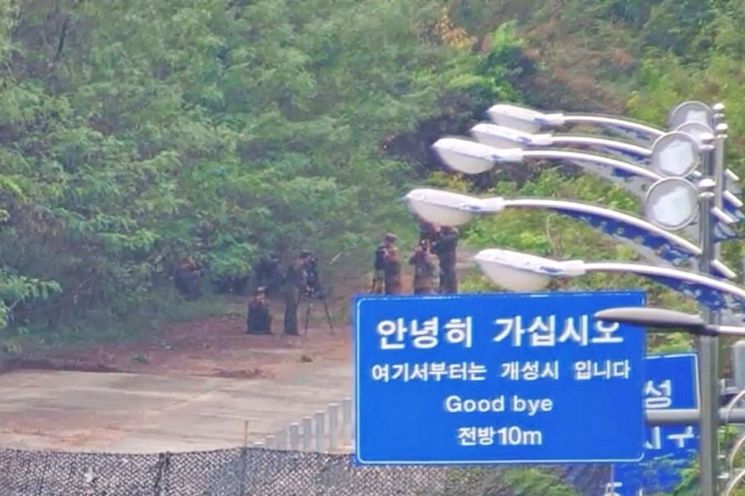 On the 15th, personnel deployed by North Korea for filming during the explosion of the Gyeongui Line inter-Korean connecting road were captured on our military's CCTV. [Image source: Video provided by the Joint Chiefs of Staff]
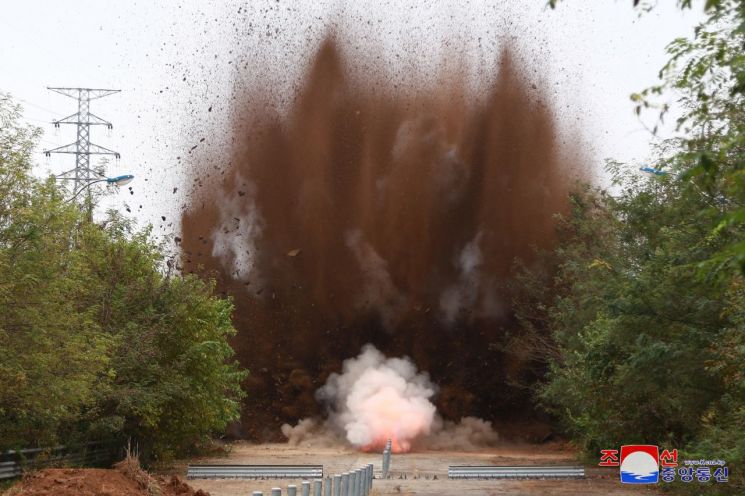 Explosion scene of the inter-Korean connecting road released by the Korean Central News Agency on the 17th.
 [Image source=Yonhap News]
Along with North Korea's separation measures, a concerning point is the realization of the North Korea-Russia treaty. The 'Comprehensive Strategic Partnership Agreement' signed in June is effectively elevating the relationship between North Korea and Russia to a 'military alliance.' Russian President Vladimir Putin submitted a bill for ratification of this treaty to the State Duma on the 14th.
While it is customary for governments to ratify agreements through their legislatures, this procedure itself can be seen as conferring the meaning that the North Korea-Russia treaty is an 'international legal document.' This treaty, which takes effect immediately upon ratification, includes provisions to provide military aid if either party suffers armed invasion and enters a 'state of war.'
North Korea has not yet announced any news regarding the ratification procedure. According to the North Korean Socialist Constitution, 'important treaties' can be ratified or annulled by the State Affairs Commission Chairman representing the state. Although the Supreme People's Assembly may be involved, in North Korea's leader-centered system, Chairman Kim can unilaterally ratify at any time if he wishes.
An official from the Ministry of Unification said, "It is difficult to make a judgment as the results of the Supreme People's Assembly have not been disclosed, but it is not difficult for North Korea to proceed with the treaty ratification process," adding, "If necessary, it is a matter that can be done at any time."
Meanwhile, North Korea is understood to have recently removed the 'Juche calendar' from the pages of the Rodong Sinmun. This is evaluated as continuing the 'erasure of the traces of predecessors' by eliminating the year notation starting from 1912, the birth year of Kim Il-sung.
© The Asia Business Daily(www.asiae.co.kr). All rights reserved.



















