When a serious accident occurs at a workplace, 61% of domestic companies consider the Ministry of Employment and Labor's system of ordering work stoppages to be unreasonable.
On the 17th, the Korea Employers Federation announced that in a survey on the perception of the 'Ministry of Employment and Labor's work stoppage measures in the event of a serious accident' conducted on 340 domestic companies, 61% of the responding companies answered 'negative.' The most common reason for the negative response, at 44%, was "stopping work unrelated to the cause of the accident."
Under current law, when a serious accident such as a fatality occurs at a workplace, the Ministry of Employment and Labor can issue a work stoppage order to the workplace to prevent recurrence of the accident. After an on-site investigation, if an application for lifting the work stoppage is submitted, the work stoppage is lifted by the decision of a review committee.
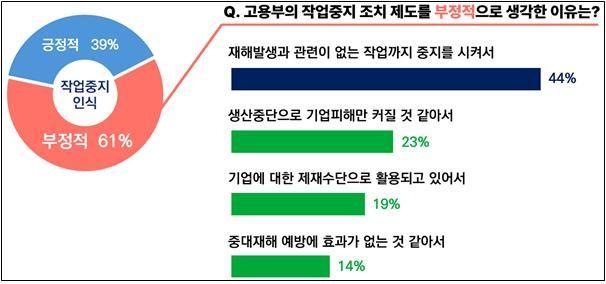 Survey Results on Awareness of Ministry of Employment and Labor's Work Suspension Measures in Case of Serious Industrial Accidents [Data=Korea Employers Federation]
However, in industrial sites, it is argued that work unrelated to the cause of the accident is also stopped, causing side effects such as losses due to prolonged production stoppages. Regarding the criteria for considering this system unreasonable, responses included "the order criteria are ambiguous (60%)" and "the scope of stoppage is excessively regulated (58%)."
Regarding problems in the work stoppage lifting process, respondents mentioned "the inconvenience of having to go through the lifting review committee (76%)," "the lifting procedure is too complicated (47%)," and "inspection and improvement demands are made even for parts unrelated to the cause of the accident (47%)" in that order. A Korea Employers Federation official pointed out, "If the employer takes corrective measures, the inspector can immediately check the site and decide on lifting, but under current law, the review committee must be involved, unnecessarily delaying the work stoppage period."
Furthermore, companies requested improvements such as abolishing the work stoppage lifting review committee (53%) and simplifying the work stoppage lifting procedures (52%). The number of times companies applied for lifting the work stoppage to the Ministry of Employment and Labor was mostly 2 to 3 times, with the total work stoppage period ranging from 14 to 150 days, and the resulting loss amount estimated between 150 million and 119 billion Korean won.
© The Asia Business Daily(www.asiae.co.kr). All rights reserved.

















