Application of Super High-Rise Design Method to Porous Materials
Application in Construction Methods... Increased Structural Stability
A new porous material inspired by architectural construction methods has been developed.
Precisely designed at the molecular level, this material is expected to have diverse applications across various industries.
Professor Won Young Choi's team from the Department of Chemistry at UNIST and Professor Hyun Chul Oh's team developed an innovative Metal-Organic Framework (MOF) by applying the design principles of supertall buildings. They used a merged network strategy that mimics the mega frame system to arrange giant molecules inside the porous material.
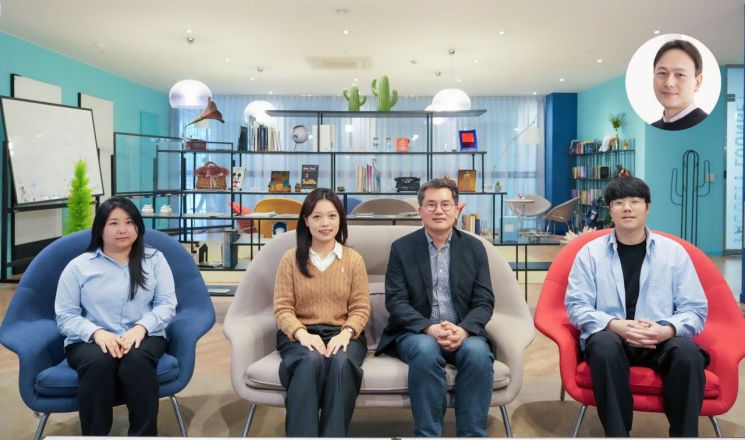 From the left, Dajin Park, Jeonghye Lee Researcher, Wonyoung Choi Professor, Suchan Lee Researcher, Hyuncheol Oh Professor.
The Burj Khalifa, the world's tallest building, is designed to withstand wind, earthquakes, and its own weight. The mega frame system strategically places massive columns, enabling the construction of supertall buildings.
MOFs are porous structures composed of metals and organic compounds, exhibiting excellent moisture adsorption capabilities and maintaining their structure even when in contact with water. While conventional MOFs suffered from structural damage or collapse upon exposure to water, the MOF developed by the research team improved this structural instability.
The team arranged giant molecules within the MOF structure to form a 'structure within a structure.' This approach maintained porosity while securing outstanding structural stability. Additionally, they precisely adjusted the internal structure of the MOF to enhance moisture adsorption efficiency.
First author researcher Jeong Hye Lee stated, “The MOF developed this time significantly improved structural stability compared to existing ones,” adding, “Since the structure does not collapse even when in contact with water, its potential applications in various fields such as moisture adsorption will greatly increase.”
Professor Won Young Choi said, “We achieved excellent water adsorption performance through precise molecular-level design,” and added, “This innovative approach applying architectural construction methods to material design opens new possibilities in material research.”
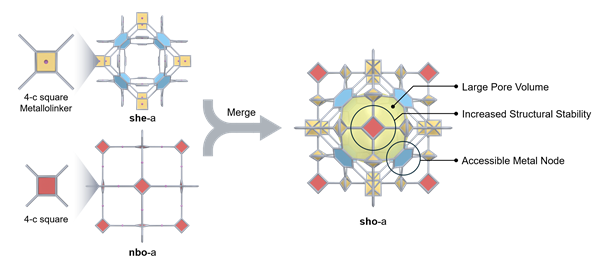
The research results were published on September 17 in the international journal Advanced Functional Materials.
The study was supported by the Ministry of Science and ICT, the National Research Foundation of Korea, Korea Hydro & Nuclear Power, and UNIST.
© The Asia Business Daily(www.asiae.co.kr). All rights reserved.
!["The Woman Who Threw Herself into the Water Clutching a Stolen Dior Bag"...A Grotesque Success Story That Shakes the Korean Psyche [Slate]](https://cwcontent.asiae.co.kr/asiaresize/183/2026021902243444107_1771435474.jpg)

















