Professor Park Cheol-sung of Hanyang University Appointed as Chairman
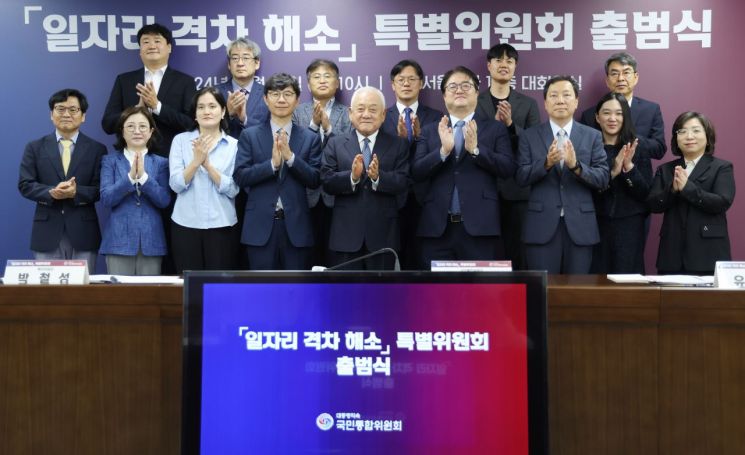 On the morning of the 16th, at the launch ceremony of the Special Committee for Closing the Employment Gap held at the Government Seoul Office, Kim Han-gil, Chairman of the National Integration Committee (fifth from the left in the front row), and Park Cheol-seong, Chairman of the Special Committee (fourth from the left in the front row), are taking a commemorative photo with the committee members.
 [Photo by Yonhap News]
The Presidential Committee on National Integration held the inaugural meeting of the "Special Committee on Job Gap Resolution" on the 16th. Moving forward, the special committee plans to work on measures to prevent the widening wage gap between companies and to establish a performance- and ability-based wage system.
On the same day at 10 a.m., the Committee on National Integration held the launch ceremony of the Special Committee on Job Gap Resolution at the Government Seoul Office. The special committee consists of 14 members, including Chairperson Park Cheol-seong, a professor in the Department of Economics and Finance at Hanyang University, academics and researchers in the labor field, and field experts.
The Committee on National Integration stated, "In South Korea, workers in small-sized companies, non-regular workers, and non-unionized employees face relatively poor wages, working conditions, and unstable status even when performing similar tasks in similar industries, resulting in a severe job gap." They pointed out, "As job seekers concentrate their preferences on large corporations and regular positions, small and medium-sized enterprises suffer from serious labor shortages, while young people prepare only for regular employment at large companies and often give up on employment altogether if they fail, significantly reducing labor market vitality."
They added, "Furthermore, reflecting changes in the labor market environment such as the relaxation of physical restrictions on work forms due to technological advancements and the expansion of new types of workers through platform growth, there is a growing need to expand support for workers in blind spots who are relatively excluded from institutional safety nets." They explained, "Accordingly, the Committee on National Integration has launched the special committee to eliminate job gaps in wages, working conditions, and stability, aiming to create a more vibrant labor market environment."
The special committee plans to derive policy tasks that are highly effective and feasible in the labor field, focusing on three areas: wage gap resolution, enhancement of labor market flexibility and mobility, and protection of vulnerable workers.
In particular, efforts will be made to create an environment where the core wage gap of job disparities does not excessively widen due to company size, employment type, or union presence, and where a performance- and ability-based wage system can spread.
Chairperson Park Cheol-seong said, "Various discussions have been held to alleviate job disparities, but the reality remains challenging. The special committee will focus on how to achieve this by thinking more deeply and approaching strategically to create visible changes."
Kim Han-gil, Chairperson of the Committee on National Integration, said, "Excessive job disparities are likely to deepen polarization across our society, including education, real estate, and regional divides, thereby hindering national integration. I hope the special committee will prepare practical policy proposals to reduce job disparities within the labor market."
© The Asia Business Daily(www.asiae.co.kr). All rights reserved.

















