"11th Century Stone Pagoda Construction Techniques and Styles Revealed"
The ‘Pohang Bogyeongsa Five-story Stone Pagoda (浦項 寶慶寺 五層石塔)’ is designated as a national treasure under the management of the National Heritage Agency. On the 16th, the agency announced that it will be systematically preserved and managed in cooperation with local governments and others as a designated treasure.
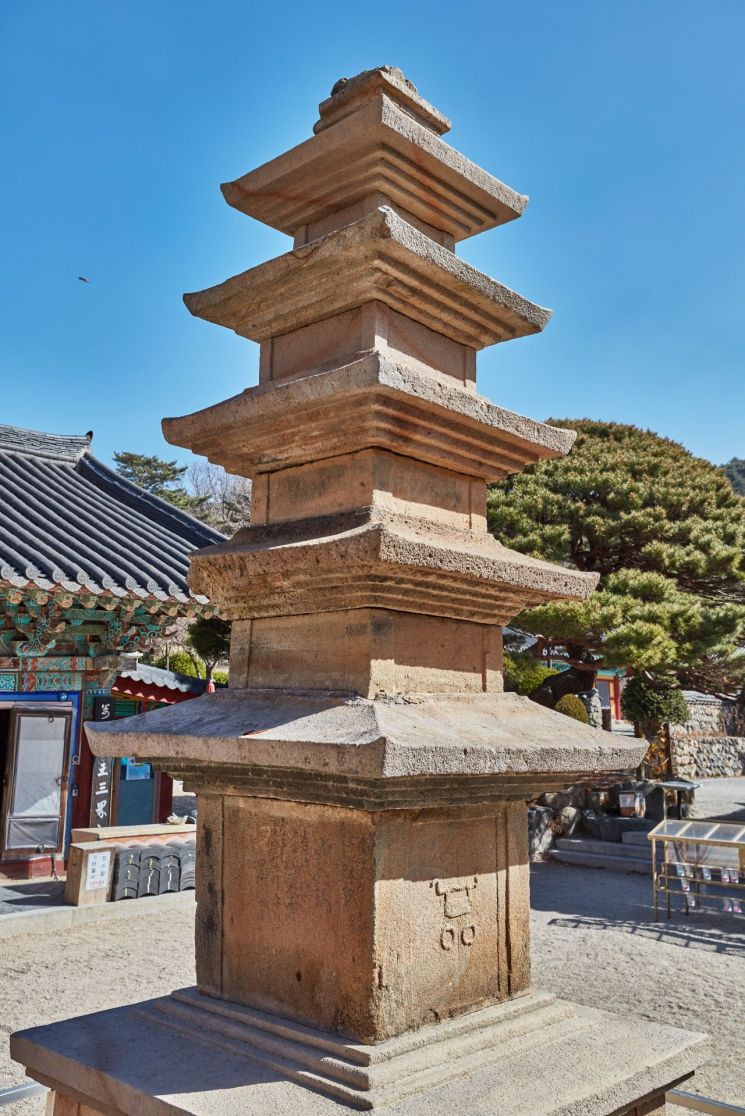
The stone pagoda, standing 4.6 meters tall, is located in front of Jeokgwangjeon Hall within the Bogyeongsa temple grounds in Pohang. The pagoda body consists of five stories of tower body stones (塔身石, main body stones) and roof stones (屋蓋石, roof stones) atop a single-story pedestal. The upper part (the decorative section placed at the top of the stone pagoda) is composed of a no-ban stone (露盤石) and a bok-bal stone (覆鉢石).
According to ‘Naeyeonsan Bogyeongsa Geumdangtapgi (內延山寶慶寺金堂塔記)’, written by the monk Samyeongdaesa Yujeong in 1588, Bogyeongsa had no pagoda for a long time. Therefore, in the 14th year of King Hyeonjong of Goryeo (1023), a five-story pagoda was constructed using blue stone and placed in front of the main hall.
On the front of the tower body stone, there are carvings of a door-shaped window (a door frame or window frame that can be opened and closed), a lock, and a door handle, indicating that relics are enshrined inside the pagoda. The National Heritage Agency speculated, “This symbolizes the relic faith that began with Unified Silla stone pagodas and 승탑 (seungtap, monk’s stupas) and continued into the Goryeo period,” adding, “It is believed that the relics were venerated to honor the teachings and spirit of Buddha.”
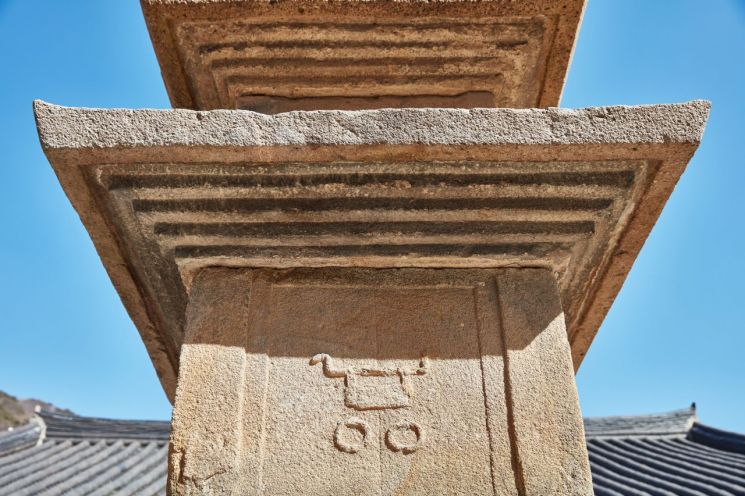
Under the roof stones of the first and second stories, there are water-cut grooves (grooves carved to prevent rainwater from flowing toward the pagoda body). This form is also confirmed in the ‘Yecheon Gaesimsaji Five-story Stone Pagoda (Treasure)’, built in 1010, and the ‘Chilgok Jeongdosaji Five-story Stone Pagoda (Treasure)’, built in 1031.
The National Heritage Agency explained, “This is a stylistic feature of early Goryeo stone pagodas that began in Unified Silla and continued until the 11th century.” It further evaluated, “The records regarding the construction period are clear, and the typical construction techniques and styles of 11th-century stone pagodas are well represented, making it of great academic value.”
© The Asia Business Daily(www.asiae.co.kr). All rights reserved.


















