Mid-sized Ombudsman Holds S.O.S. TALK for Gyeonggi SMEs and Exporters
Financial Services Commission Reviews Strengthening Electronic Financial Operators' Supervision, Including Mandatory Separate Management of Unsettled Amounts
A proposal has been made that effective supervision of electronic financial operators and measures to protect online sales proceeds are necessary to prevent a second Wemakeprice·Timon incident.
On the 16th, Choi Seung-jae, Small and Medium Business Ombudsman (vice ministerial level), held an 'S.O.S. Talk (SME meeting)' together with the Gyeonggi Regional Headquarters, Gyeonggi Eastern Branch, and Gyeonggi Southern Branch of the Small and Medium Business Corporation at the Gyeonggi Institute of Science and Technology Promotion in Suwon, Gyeonggi Province.
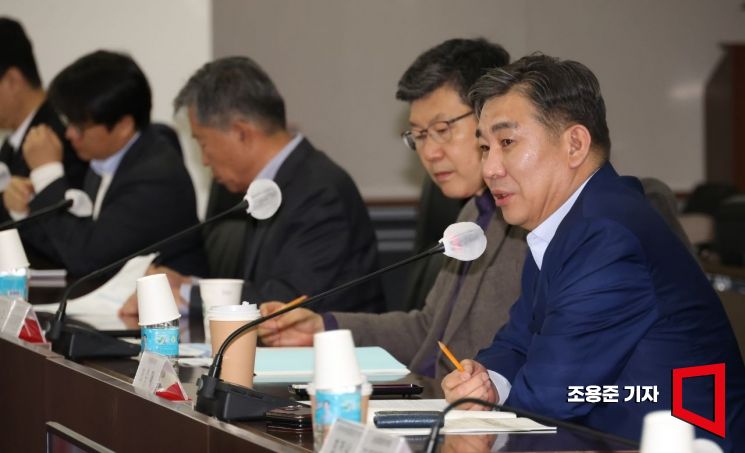 Choi Seung-jae, Deputy Minister-level Ombudsman for Small and Medium Enterprises, speaking. Photo by Jo Yong-jun jun21@
Attending the meeting were Choi Seung-jae, Small and Medium Business Ombudsman; Jeong Dong-ho, Head of the Gyeonggi Regional Headquarters of the Small and Medium Business Corporation; Park Chang-gi, Head of the Gyeonggi Eastern Branch; Jeong Dae-hoon, Head of the Gyeonggi Southern Branch; Bok Deok-gyu, Head of the KOTRA Gyeonggi Support Group; Yoo Ji-heung, Head of the Gyeonggi Regional Headquarters of the Korea Federation of SMEs; and five representatives of SMEs in the Gyeonggi region.
Before the meeting, Ombudsman Choi Seung-jae visited Seoyoung P&I Co., Ltd., an automobile parts specialized manufacturer located in the Gunpo Advanced Industrial Complex.
Ombudsman Choi toured the production facilities for automobile parts such as door locks, start buttons, and spring products, and listened to the difficulties in securing production personnel. Seoyoung P&I expressed that despite seeking various methods such as the military service special system and industry-academia cooperation, it was not easy to hire production personnel. In response, Ombudsman Choi promised to convey the voices from the field to related ministries such as the Ministry of SMEs and Startups and the Ministry of Employment and Labor and to propose solutions.
At the subsequent meeting, proposals related to the 'Timon' incident were a major topic of discussion. Company A, a cosmetics manufacturing and sales company located in Icheon, Gyeonggi Province, suggested that to prevent a recurrence of incidents like the Timon case, there is a need for effective sanctions such as the 'right to request measures' if a registered electronic financial operator poses a risk to management soundness.
In particular, they pointed out that the fundamental cause of the reckless management of sales proceeds by Timon and Wemakeprice was the lack of grounds for sanctions against registered electronic financial operators.
In response, the Ombudsman said that after consultation with the Financial Services Commission, the FSC replied that various measures to safely protect sellers' proceeds are being reviewed.
The FSC explained that through amendments to the Electronic Financial Transactions Act, it plans to mandate separate management of all unsettled funds of payment gateway companies (PG companies), and if PG companies fail to comply with management guidance standards or separate management obligations, it will establish grounds for stepwise measures such as corrective orders, business suspension, and registration cancellation.
Also, Company B, engaged in the distribution of livestock products and other foods in Gwangju, Gyeonggi Province, proposed the need for support for the stabilization of the consumption period labeling system and the expansion of publicity and education to raise awareness.
Although the 'distribution period system' for food underwent a one-year (2023) grace period and was changed to the 'consumption period labeling system' starting January 2024, there is still concern that the coexistence of distribution period and consumption period labels in the field could lead to disputes between companies and consumers.
In response, the Ministry of Food and Drug Safety, the competent authority, informed that with the full implementation of the consumption period labeling system, it has produced videos, audio materials, card news, and leaflets, and is promoting the system through YouTube, social media, and media coverage.
Furthermore, as this year is the first year of the system's implementation, the ministry is strengthening publicity by utilizing places frequently visited by consumers such as large supermarkets, corporate supermarkets, convenience stores, high-speed trains (KTX), and apartment elevators, and plans to provide education on consumption period labeling standards and setting methods through regular regional touring briefings in the second half of the year.
In addition, attendees raised various field regulations and difficulties, including △expansion of type approval targets for environmental measuring instruments △requests for support for safety certification issuance fees for small enterprises' electrical products △requests for recognition of national agency consignment contracts for health functional food production facilities.
At the meeting, Jeong Dong-ho, Head of the Gyeonggi Regional Headquarters of the Small and Medium Business Corporation, said, "Going forward, the Small and Medium Business Corporation will work more closely with the Ombudsman to serve as a bridge so that voices from the field can be actively reflected in policies."
Ombudsman Choi Seung-jae said, "It was a very meaningful time to directly listen to various proposals and difficulties and to think about them together," and promised, "We will continuously convey the voices from the field to related ministries and do our best to achieve good results."
© The Asia Business Daily(www.asiae.co.kr). All rights reserved.

















