ETF LP Department to Submit Abnormal Losses and Internal Control Status by 18th
Other Departments to Submit OTC Derivatives Internal Control Status by End of October
Industry Expresses Concern Over Negative Views on ETF LP... Focus on Additional Misconduct
The Financial Supervisory Service (FSS) has launched a comprehensive inspection of domestic securities firms following the case of Shinhan Investment Corp., which incurred an operating loss of 130 billion KRW during ETF futures trading. Given that additional violations may be uncovered through the FSS's full-scale inspection, damaging industry trust appears inevitable, prompting tension and close attention to the results within the ETF-related sector.
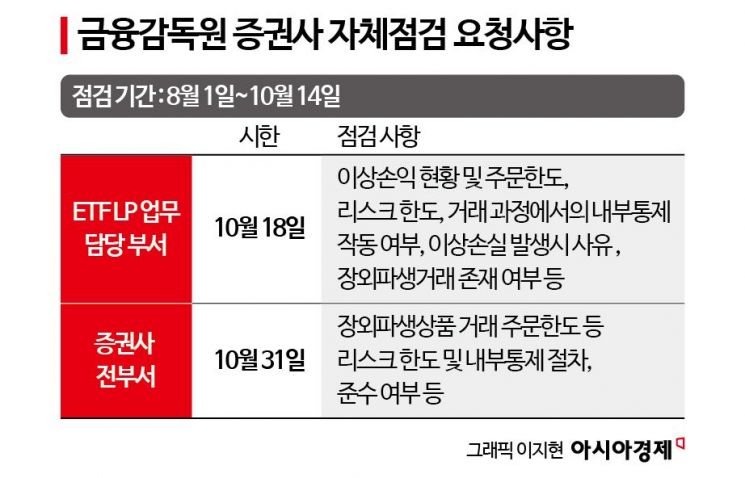
According to the financial investment industry on the 16th, the passive sales departments responsible for ETF liquidity provider (LP) operations at 26 domestic securities firms must submit reports to the FSS by the 18th detailing abnormal loss occurrences, order limits, risk limits, and internal control status during trading processes.
The self-inspection period requested by the FSS spans from August 1 to October 14. Notably, in the Shinhan Investment Corp. case, it was confirmed that the largest losses occurred on August 5, the so-called 'Black Monday,' when Asian stock markets collectively plunged. The FSS has instructed firms to focus particularly on this period.
Other departments within securities firms are equally pressed, as the FSS has requested inspections related to internal controls over over-the-counter (OTC) derivatives trading. By the 31st of this month, all departments must report compliance with risk limits and internal control procedures concerning various OTC derivatives such as equity-linked securities (ELS) and mezzanine products, in addition to ETF trading.
The FSS initially demands self-inspections through each firm's audit office. Should issues arise, it plans to exercise its inspection authority, including on-site examinations. Industry insiders speculate that simple errors in securities firms' IT systems may occur, especially around futures and options expiration dates when liquidation volumes concentrate.
Although 26 firms are officially subject to inspection, approximately 24 firms engage in ETF operations domestically. Particularly, NH Investment & Securities, Meritz Securities, and KB Securities, which hold significant liquidity provision shares in the passive market, are expected to be focal points of the inspection.
As the ETF market size surpassed 100 trillion KRW last year and the overall market expanded, the role of securities firms as ETF LPs has become increasingly important. The industry is concerned that this incident could lead to a decline in individual investors' trust and market contraction amid the ETF market's current vitality.
In fact, controversies over preferential treatment of ETF affiliates centered on asset management companies such as Samsung, Mirae Asset, and KB Asset Management have triggered alarms within securities firms. During the recent National Assembly audit season, the parliament officially urged Financial Services Commission Chairman Kim Byung-hwan for institutional improvements, and some securities firms' audit offices have begun audits targeting ETF LP operation departments.
The Korea Stock Investors Association, a domestic individual investors' coalition, issued a statement on the 14th calling for a special investigation by the FSS's Capital Market Special Judicial Police (Special Investigation Unit) into Shinhan Investment Corp.'s 130 billion KRW loss incident, demanding a full investigation into liquidity providers' illicit and improper operations.
A securities firm official expressed concern, saying, "With this incident, there is worry that ETFs might be perceived as risky assets like ELS or equity-linked warrants (ELW), and that ETF LP departments are managing risky assets. However, in Shinhan's case, it was proprietary trading and unrelated to ETF LP operations."
© The Asia Business Daily(www.asiae.co.kr). All rights reserved.


















