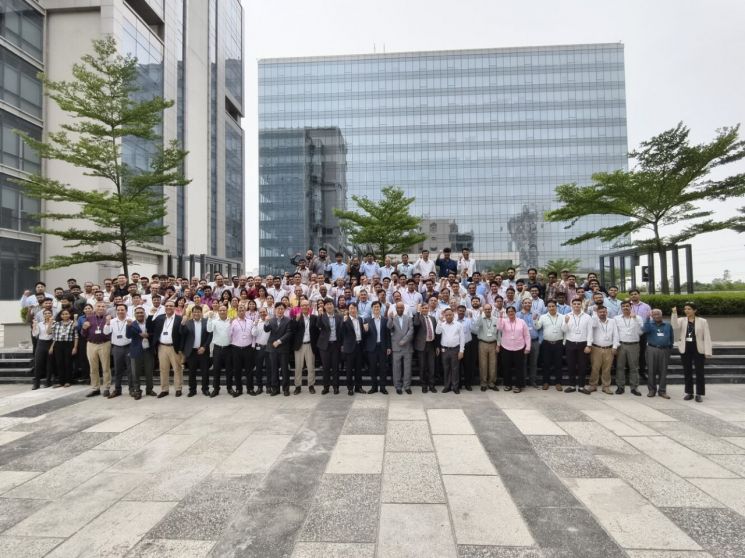
 Samsung Heavy Industries' India branch recently held an opening ceremony and took a commemorative photo after relocating to Noida. Photo by Samsung Heavy Industries India branch LinkedIn
Samsung Heavy Industries has relocated its Indian subsidiary, which is responsible for part of the offshore plant design, from the capital New Delhi to a nearby IT industrial complex.
According to industry sources on the 16th, Samsung Heavy Industries' Indian subsidiary recently announced via SNS (social networking service) that it moved its office from New Delhi to Noida, located 24 km away. Noida is known as an IT industrial complex in India with a large number of engineering personnel.
The local subsidiary stated, "The office was relocated to enhance competitiveness for ongoing and future projects." The opening ceremony of the new office was attended by Jang Hae-gi, CTO (Chief Technology Officer) of Samsung Heavy Industries, Lee Ji-hoon, Head of Samsung Heavy Industries' Offshore EM Group, and Park Seok-jae, Head of Samsung Heavy Industries' Indian subsidiary center.
The relocation of the Indian subsidiary's office is interpreted as a strategic move to strengthen offshore plant capabilities. The local subsidiary is responsible for the design of the offshore plant's topside process, and with the increase in offshore plant orders last year, there is also the possibility of expanding design personnel.
Samsung Heavy Industries showed strong performance in this field, winning 4 out of 5 FLNG orders placed worldwide last year. This is because shipbuilders with FLNG construction capabilities are very rare. Currently, FLNG is gaining attention as an offshore facility that can commercially produce LNG (liquefied natural gas), a fossil fuel that emits less carbon, at sea. The price per FLNG unit ranges from 2 trillion to 4 trillion won, equivalent to 6 to 12 transport ships.
© The Asia Business Daily(www.asiae.co.kr). All rights reserved.












