Korea Real Estate Board Releases Apartment Move-in Statistics
First Half of 2026 Volume Down Compared to Second Half of This Year
Assemblyman Ahn Tae-jun: "Withholding Data Until Before Audit Is a Trick"
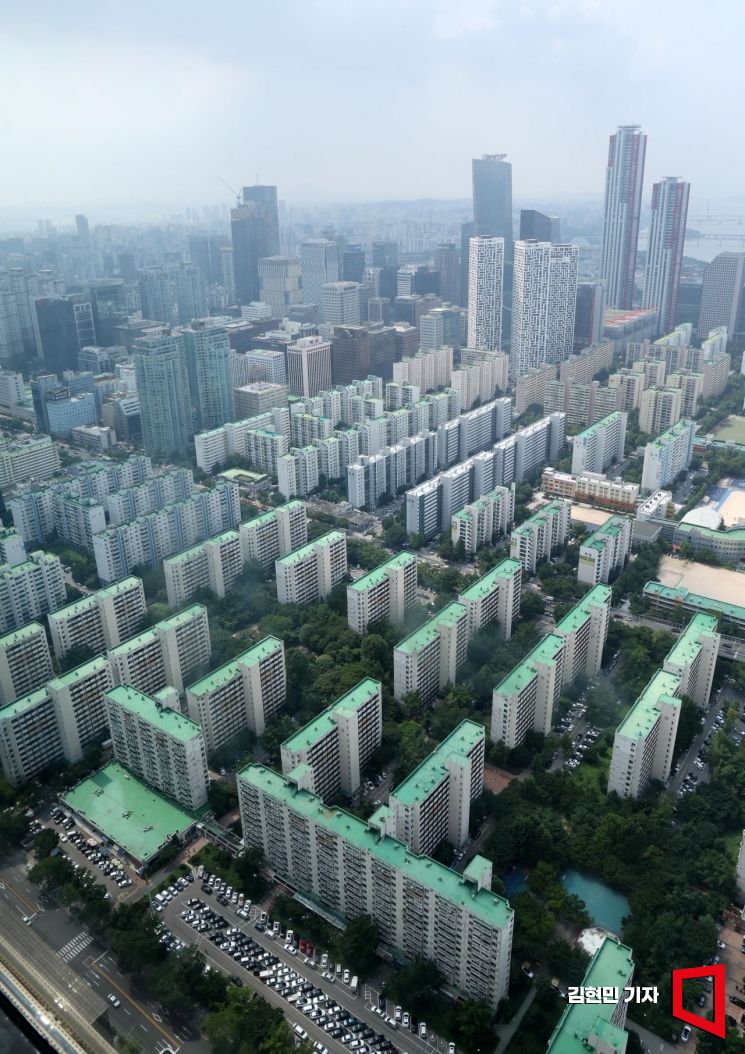
The nationwide supply of new apartment units scheduled for move-in in 2026 is expected to decrease significantly. Although the government increased the announced number of upcoming move-ins by including not only apartments but also urban-style residential housing, row houses, and multi-family units, concerns about supply shortages are expected to grow even further.
On the 15th, the Korea Real Estate Board, in collaboration with the private real estate company Real Estate R114, released the "Information on Scheduled Move-in Volumes for Multi-family Housing." This data includes estimated move-in volumes by region from the second half of this year through the first half of 2026, based on statistics compiled as of June.

The scheduled move-in volume for multi-family housing in Seoul in the first half of 2026 is 18,165 units, a 20.5% decrease compared to 22,839 units in the second half of this year. The volume for next year is 48,184 units. These figures include apartments, urban-style residential housing, row houses, and multi-family units in complexes with 30 or more units.
The nationwide move-in volume is expected to decrease even more sharply. The total nationwide move-in volume in the first half of 2026 is projected to be 116,299 units, a 40.1% plunge compared to 194,280 units in the second half of this year. The volume for next year is 289,244 units.
In Gyeonggi Province, the move-in volumes are 55,620 units in the second half of this year, 73,481 units next year, and 31,332 units in the first half of 2026.
There are no scheduled move-ins in Sejong and Jeju in the first half of 2026. The only regions where the scheduled move-in volume in the first half of 2026 exceeds that of the first half of this year are Gwangju (2,424 units → 11,323 units) and Ulsan (3,091 units → 3,642 units).
Meanwhile, this announcement was supposed to be made before the National Assembly audit held this month but was only released on this day. On the 15th, Ahn Tae-jun, a member of the National Assembly Land, Infrastructure and Transport Committee from the Democratic Party of Korea, criticized the Korea Real Estate Board's release of the "Information on Scheduled Move-in Volumes for Multi-family Housing," calling it a "trick" to announce the move-in statistics just one day before the audit of the Korea Real Estate Board. Ahn had requested the scheduled move-in volume data from the Korea Real Estate Board on the 4th but did not receive the related figures or announcement schedule.
At that time, the Korea Real Estate Board explained, "Due to construction stoppages and delays, the scheduled move-in dates have changed, causing revisions to the estimates. We are manually surveying nationwide projects, so there are limitations to the accuracy of the forecasts, and we are seeking solutions."
Some speculate that the government delayed the announcement to avoid intensifying the controversy over supply shortages. Ahn said, "As apartment move-in volumes have decreased starting this year and housing prices have risen, it appears the government arbitrarily suspended the release of statistics. The scheduled move-in volumes have been continuously revised at every announcement, so now refusing to release them citing 'possible changes in forecasts' is inconsistent."
The Korea Real Estate Board stated when releasing the statistics, "The statistics were not stopped; only the announcement was delayed. The release just before the audit was due to many inquiries about scheduled move-in volumes and because it was later than the usual timing for information disclosure."
© The Asia Business Daily(www.asiae.co.kr). All rights reserved.
![Clutching a Stolen Dior Bag, Saying "I Hate Being Poor but Real"... The Grotesque Con of a "Human Knockoff" [Slate]](https://cwcontent.asiae.co.kr/asiaresize/183/2026021902243444107_1771435474.jpg)












