Proposed Amendments to the Commercial Act in the 21st National Assembly
Opposition from Some Sectors... Government Seeks Opinions from Various Fields
Major Parties May Push Forward Despite Burden on Business Community
With the 'Yoon Seok-yeol-style' Commercial Act amendment finally confirmed after many twists and turns, attention is focused on whether the long-standing debate surrounding it will come to an end. The major opposition party that raised the necessity of the amendment now faces a complicated calculation as the 'duty of effort' has been reflected instead of the 'duty of loyalty' for directors, which the business community had opposed.
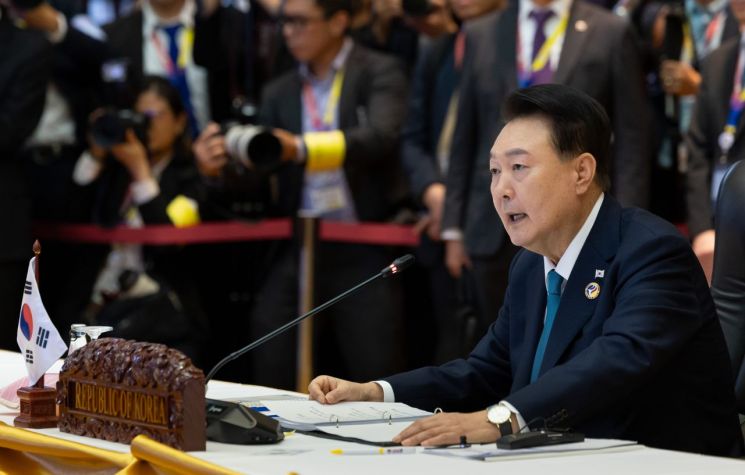 President Yoon Suk-yeol is speaking at the Korea-ASEAN (Association of Southeast Asian Nations) Summit held at the National Convention Center (NCC) in Vientiane, Laos, on the 10th (local time).
 [Image source=Yonhap News]
The Commercial Act was revised in 1998 to include the provision that "directors must faithfully perform their duties for the company." However, even when corporate boards made decisions such as changes in governance tailored only to the management's preferences, courts often ruled that as long as the duties were performed "for the company," it was acceptable even if general investors suffered losses. Since then, voices calling for further amendments to the Commercial Act have been raised, mainly from the progressive camp.
The key issue in the amendment is whether to expand the directors' duty of loyalty to include ordinary shareholders. Expanding the duty of loyalty is argued to fundamentally block corporate decisions that could harm existing investors' interests, such as the recent cases involving Doosan Bobcat and Doosan Robotics or the merger of SK Innovation and SK E&S. On the other hand, the business community points out that expanding the duty of loyalty would harm corporate competitiveness.
Mention of Commercial Act Amendment Alongside Value-Up Program... Government Working to Coordinate Stakeholders
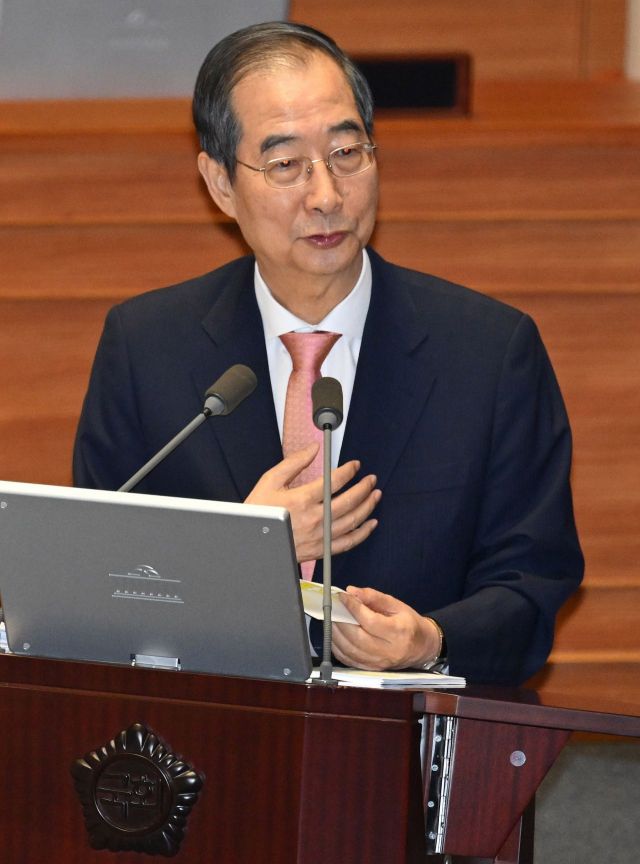 Prime Minister Han Duck-soo attended the plenary session of the National Assembly on the 12th, where questions on education, social, and cultural issues were being raised, and responded to questions from Nam In-soon, a member of the Democratic Party of Korea. Photo by Kim Hyun-min kimhyun81@
Earlier this year, the government introduced a corporate value-up program and mentioned the possibility of amending the Commercial Act. On January 2, President Yoon Seok-yeol stated at the Korea Exchange's securities and derivatives market opening ceremony, "We will push for amendments to the Commercial Act to ensure that the board of directors responsibly reflects the interests of minority shareholders in the decision-making process."
However, the relevant ministries, including the Ministry of Justice, immediately opposed the amendment, halting related discussions. On January 17, after the 4th Public Livelihood Forum held at the Korea Exchange, Koo Sang-yeop, Director General of the Legal Affairs Office at the Ministry of Justice, briefed that "even if a provision amending the directors' duty of loyalty is introduced, it will remain abstract and declarative." This opposition came just 15 days after President Yoon's statement on the amendment. The Commercial Act amendment bill proposed in the 21st National Assembly expired without passage. Although the government proposed an amendment on June 27 this year, it only included provisions for electronic shareholder meetings and the introduction of dissenting shareholders' stock purchase rights.
Subsequently, the government has been working to incorporate the voices of various stakeholders, seeking a middle ground between ordinary shareholders who want protection and the business community that does not want interference with management rights. On May 11, Prime Minister Han Duck-soo said during a parliamentary economic sector question session, "There are opinions that legal amendments are necessary to protect minority shareholders, as well as concerns that it could dampen the business environment," adding, "The government is listening to opinions from all walks of life."
Will the Major Opposition Party Accept the Government Proposal? "Pushing Korea Boost-Up as Party Policy"
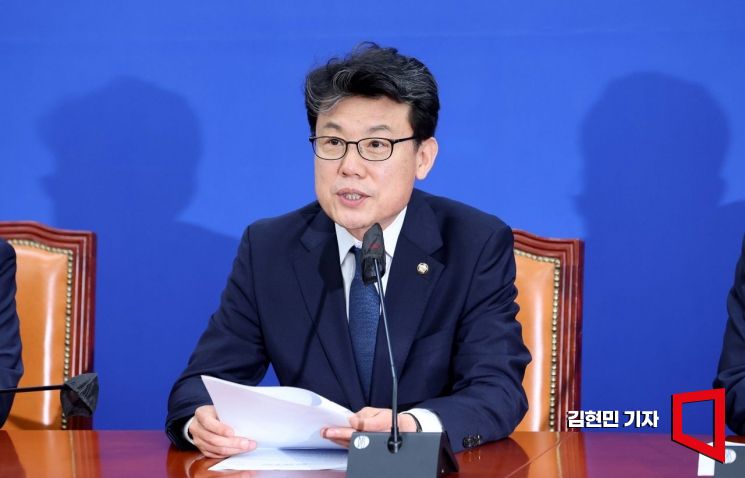 Jinseongjun, the Policy Committee Chairman of the Democratic Party of Korea, is speaking at the party floor strategy meeting held at the National Assembly on the 25th. Photo by Hyunmin Kim kimhyun81@
Attention is now focused on the future moves of the major opposition party. The Democratic Party has indicated that it will adopt the amendment to expand the directors' duty of loyalty to shareholders as its party policy in the 22nd National Assembly. Although the current government proposal may not fully meet the Democratic Party's expectations, it includes provisions reflecting shareholders' interests, which is why there is a possibility of cooperation for the bill's passage. However, the burden of potential backlash from the business community if the duty of loyalty is expanded indiscriminately remains a concern.
Nonetheless, if the Democratic Party pushes the party policy forward, clashes are inevitable. On April 24, the Democratic Party Policy Committee stated in a position paper, "We will draft the Korea Boost-Up Project into a bill and promote it as party policy."
© The Asia Business Daily(www.asiae.co.kr). All rights reserved.



















