'Distinctive' Differentiated University Pursuit
Applying the Convergence Innovation University Model
Full-Scale Structural Transformation to Start Next Year
“In a market where demand is decreasing, competitiveness is an essential requirement for suppliers. It is important to attract consumers with ‘distinctive’ product qualities while simultaneously enhancing their satisfaction. The situation is no different for university campuses that must respond to the declining school-age population.”
On the 11th, I met with Oh Yong-jun, president of the National Hanbat University. President Oh is now at the midpoint of his four-year term. When he took office, he emphasized the word ‘distinctive.’ His inaugural message was a commitment to tirelessly work toward creating a university that is differentiated and competitive compared to others.
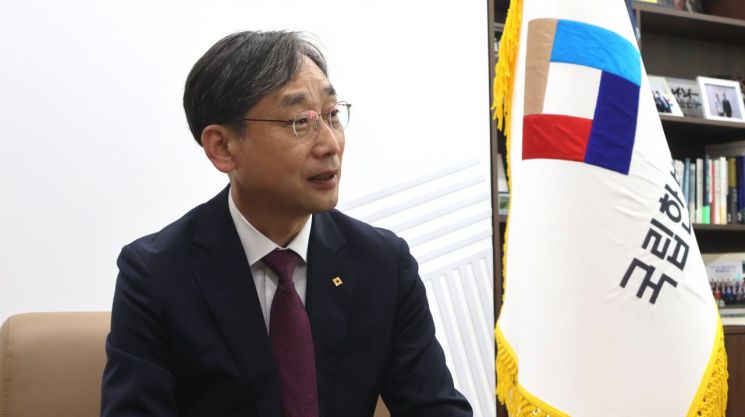 On the 11th, Oh Yong-jun, president of Hanbat National University, introduced plans to strengthen competitiveness through institutional transformation of the university. Photo by Hanbat National University
For President Oh, competitiveness means ‘innovation.’ While the number of universities remains constant, the noticeable decline in freshmen numbers underpins the recognition that universities must change or face difficulty in sustaining their existence.
Turning ideas (plans) into action is not easy. However, if it is a strategy for survival, there is no room for hesitation. This is why Hanbat University has been focusing on transforming its institutional structure since last year, taking Franklin W. Olin College of Engineering as its representative role model.
Olin College of Engineering has established its reputation as one of the most innovative universities in the world by emphasizing project-based curricula led by students, removing departmental barriers to foster interdisciplinary education, and focusing on hands-on, experiment-centered learning. As a result, Olin College was included in Newsweek’s list of 25 prestigious American universities (New Ivies) just four years after its founding in 2006, becoming a benchmark for many universities worldwide, including Hanbat University.
President Oh said, “As the school-age population rapidly declines, a sense of crisis is intensifying in the university sector. From the beginning of my tenure, I have emphasized that Hanbat University must have distinctive strengths (competitiveness) that differentiate it from other universities amid this crisis.”
He added, “The reason we pursue innovation by modeling Olin College is no different. Our ultimate goal is to create new strengths unique to Hanbat University by adapting and applying Olin College’s strengths to Hanbat’s circumstances.”
Last year, President Oh personally met with Gilda A. Barabino, president of Olin College, laying the foundation for exchanges between the two universities. This year, eight Hanbat University professors were dispatched to Olin College to directly experience the educational methods there and share the results with their colleagues on campus.
Based on this, Hanbat University expects to begin full-scale institutional transformation as early as next year. A representative change will be the application of the ‘Convergence Innovation University Model.’
This model, designed by benchmarking Olin College and others, focuses on nurturing talent that meets industry demand by requiring students to complete socially demanded convergence majors (double majors) based on their basic majors, thereby producing graduates with experience and applied skills.
Instead of uniform lecture-based education, the basic direction is to support students in accumulating creative and comprehensive knowledge at university by promoting experience-centered, team project-based education (in convergence major fields).
For example, under the Convergence Innovation University Model, a student majoring in new materials as a basic major is required to select and complete convergence majors in related fields such as energy technology, nano-semiconductors, and space and defense, enabling them to comprehensively acquire knowledge across convergence fields based on their basic major.
President Oh also emphasized ‘experience’ in this process. He explained, “The term ‘experience-centered’ means moving away from rote theoretical education through lectures.”
He added, “Direct experience is an educational method that allows for more certain understanding and internalization than theory. Moreover, cooperative projects among team members will maximize the effectiveness of this experiential education method.”
In the long term, he also revealed plans to extend the university innovation process, experimentally conducted at Hanbat University, to other universities. President Oh stated, “Recently, Hanbat University faced difficulties as the integration with Chungnam National University was temporarily suspended. However, I do not believe the possibility of integration between the two universities has been completely extinguished.”
He continued, “Considering the justification for integration, I believe that the two universities can resume discussions on integration at any time from a long-term perspective. If the university innovation currently pursued by Hanbat University is successfully completed, it will become a valuable asset when the two universities eventually undergo integration and grow competitiveness through a unified channel.”
© The Asia Business Daily(www.asiae.co.kr). All rights reserved.
![Clutching a Stolen Dior Bag, Saying "I Hate Being Poor but Real"... The Grotesque Con of a "Human Knockoff" [Slate]](https://cwcontent.asiae.co.kr/asiaresize/183/2026021902243444107_1771435474.jpg)
















