Daron Acemoglu, Simon Johnson, James Robinson Awarded Nobel Prize in Economics
Studying Global Wealth Gaps, Comparing South Korea's Success and North Korea's Failure
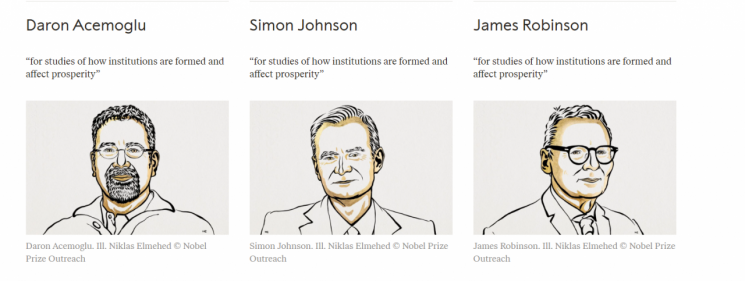
This year's Nobel Prize in Economics was awarded to three individuals: Daron Acemoglu (57), Simon Johnson (61), and James A. Robinson (64), who analyzed the causes of national success and failure through wealth disparities between countries. They have a strong connection to Korea, having focused on Korea's successful economic development during their research on international inequality, and are sometimes regarded as 'Korean experts.'
On the 14th (local time), the Royal Swedish Academy of Sciences announced that it had decided to award them the Nobel Prize in Economics in recognition of their "research on how institutions are formed and how they affect (economic) prosperity."
Jakob Svensson, Chair of the Royal Academy's Prize Committee in Economic Sciences, said, "Reducing income differences between countries is one of the greatest challenges of our time," adding, "The laureates have demonstrated the importance of social institutions in achieving this."
Acemoglu is a professor in the Department of Economics at the Massachusetts Institute of Technology (MIT), Johnson is a professor at the MIT Sloan School of Management, and Robinson is a professor in the Department of Political Science at the University of Chicago.
They focused on the fact that the economic performance of countries that were once colonies of European nations varied depending on the institutions introduced during the colonial era. They argued that countries that were poor during the colonial period but adopted inclusive institutions gradually accumulated wealth, while those that did not remained poor, emphasizing that inclusive institutions must underpin a country's economic success.
The Royal Academy explained, "The laureates have contributed to innovative research on what affects a country's economic prosperity in the long term," and added, "Their insights into the impact of institutions on prosperity show that efforts to support democracy and inclusive institutions are important directions for promoting economic development."
Famous domestically for the book 'Why Nations Fail'
Professors Acemoglu and Robinson are also well-known in Korea as authors of books such as 'Why Nations Fail.' This book identifies social institutions as the determining factors of a nation's success or failure. It particularly emphasizes the importance of political choices by using South Korea and North Korea as examples.
It explains that South Korea chose inclusive economic institutions, while North Korea insisted on exploitative economic institutions, leading to the nation's failure. This book has been cited multiple times in Korean political circles. During the 2022 presidential election, President Yoon Suk-yeol, then a candidate from the People Power Party, listed it among the "books of life or books recommended for young people," alongside Milton Friedman's 'Free to Choose' and John Stuart Mill's 'On Liberty.'
In 2022, Professor Acemoglu highlighted inclusive institutions and democracy as the foundation of peace and economic prosperity at the 'Economic Development Experience Sharing Project (KSP) Performance Sharing Conference' hosted by the Korea Development Institute (KDI), citing Korea as a country that has achieved these.
Professor Johnson is known to have a Korean-American wife. In a conversation last year with economist Tyler Cowen, he said, "Since my wife's parents were born in Korea, Korea is one of my favorite countries," adding, "I have had many conversations with them, thought a lot about Korea, and talked extensively with Korean economists." His 2011 book, 'The Quiet Coup,' was co-authored with his wife's brother, James Kwak (Korean name Kwak Yushin).
In an interview immediately after receiving the award, they expressed serious concern about former U.S. President Donald Trump, who refused to accept the results of the 2020 presidential election, calling it an "act of rejecting inclusive institutions."
Professor Robinson told the Associated Press in a phone interview, "There has clearly been an attack on this country's (the United States') inclusive institutions," pointing to former President Trump. He said, "There was a presidential candidate who refused to accept defeat in the last election. Former President Trump rejected the democratic rules of citizens," emphasizing, "Of course, it is concerning. I am a worried citizen."
Professor Johnson also pointed out that the institutions established in the U.S. are under pressure because former President Trump did not acknowledge his election defeat. Johnson said, "I think that (refusal to accept the election results) is the greatest concern I have witnessed in the industrialized world," adding, "The November 5 election is the most severe pressure test for American democracy."
© The Asia Business Daily(www.asiae.co.kr). All rights reserved.

















