Hankyung Association Holds Special Talk with Former Ministers
"Semiconductor Industry Changes Require National Support"
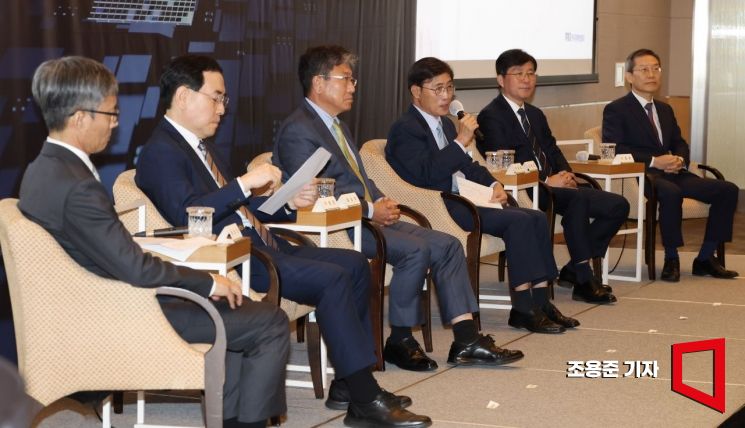 Former Minister of Knowledge Economy Lee Yun-ho is speaking at the "Special Dialogue with Former Ministers of Trade, Industry and Energy" held on the 14th at the FKI Tower Conference Center in Yeouido, Seoul. From the left: Hwang Cheol-seong, Distinguished Professor of Materials Science and Engineering at Seoul National University; Former Minister of Industry Lee Chang-yang; Former Minister of Industry Yoon Sang-jik; Former Minister of Knowledge Economy Lee Yun-ho; Former Minister of Industry Sung Yun-mo; Former Minister of Science and ICT Lee Jong-ho. Photo by Jo Yong-jun jun21@
"Samsung Electronics seems vulnerable to open innovation. When good technologies are discovered, they should be actively adopted and further developed through mergers and acquisitions (M&A) or collaborations."
Lee Chang-yang, former Minister of Trade, Industry and Energy under the Yoon Suk-yeol administration, said this on the 14th during a special discussion titled "Korea's Tasks for Regaining Semiconductor Hegemony," hosted by the Korea Economic Association and attended by former ministers of Trade, Industry and Energy and Science and ICT. He emphasized, "Samsung Electronics needs to raise its technological and managerial antennas high and continuously explore what technologies competitors are developing."
He added, "The transition to the era of artificial intelligence (AI) is like a seasonal change; if this period is navigated well, it can lead to a greater leap forward," diagnosing that Samsung Electronics is currently facing an opportunity to leap forward through internal reorganization and setting new goals.
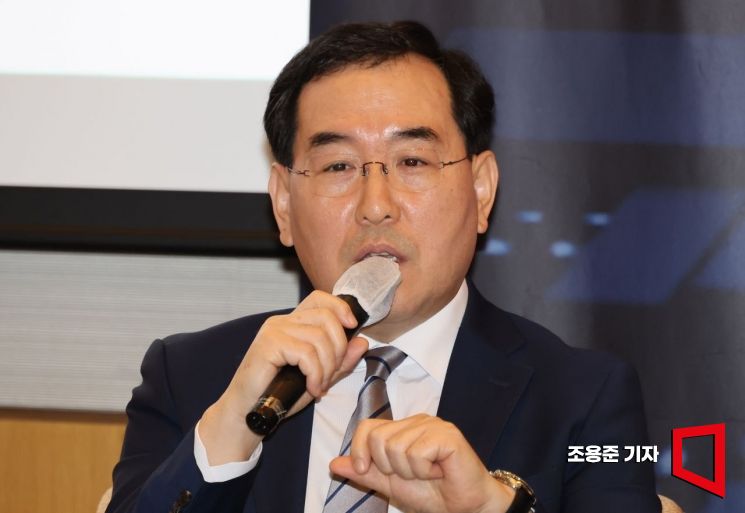 Former Minister of Trade, Industry and Energy Lee Chang-yang attended a special discussion inviting former ministers of the Ministry of Trade, Industry and Energy at the FKI Tower Conference Center in Yeouido, Seoul on the 14th, holding a special talk on the theme "The Future and Strategy of Korea's Semiconductor Industry." Photo by Jo Yong-jun jun21@
On the same day, including former Minister Lee Chang-yang, former Trade, Industry and Energy Ministers Lee Yoon-ho (Lee Myung-bak administration), Yoon Sang-jik (Park Geun-hye administration), Sung Yun-mo (Moon Jae-in administration), and former Minister of Science and ICT Lee Jong-ho (Yoon Suk-yeol administration) advised that "Samsung Electronics has sufficient resilience to overcome the current crisis, and to do so, it must strengthen technological innovation, organizational restructuring, and external cooperation."
"Opportunity to Leap Amid Crisis... Internal Reorganization Needed"
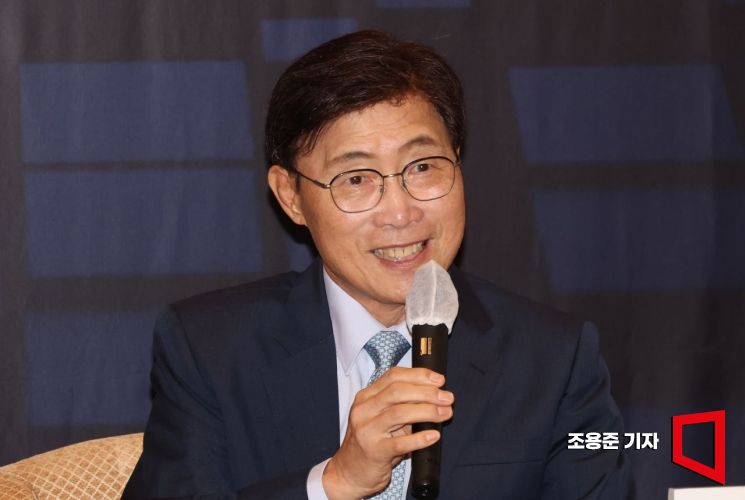 Former Minister of Knowledge Economy (now Ministry of Trade, Industry and Energy) Lee Yun-ho attended a special dialogue with former ministers of the Ministry of Trade, Industry and Energy at the FKI Tower Conference Center in Yeouido, Seoul on the 14th, holding a special discussion on the topic "The Future and Strategy of Korea's Semiconductor Industry." Photo by Jo Yong-jun jun21@
Former Minister Lee Yoon-ho pointed out Samsung Electronics' recent situation, saying, "It seems that organizational tension has dropped significantly due to complacency from long-term success in DRAM rather than technical issues." He evaluated, "The pressure Samsung Electronics is facing in the DRAM market and its weakness in the foundry sector serve as a good wake-up call for the company."
He emphasized that Samsung Electronics has enough resilience to take this crisis as an opportunity for internal reorganization and to leap forward once again. Former Minister Lee Yoon-ho said, "Samsung Electronics is preparing and has the ability to pull itself out of the crisis," and regarding the recent stock price decline, he remarked, "It is actually a great relief for Samsung Electronics."
 Former Minister of Trade, Industry and Energy Yoon Sang-jik is attending a special dialogue with former ministers of the Ministry of Trade, Industry and Energy at the FKI Tower Conference Center in Yeouido, Seoul on the 14th, holding a special discussion on the topic "The Future and Strategy of Korea's Semiconductor Industry." Photo by Choi Seo-yoon
Former Minister Yoon Sang-jik diagnosed that Samsung Electronics' crisis differs from Intel's. "Intel has run out of cash, but Samsung still holds massive internal funds," he said. He added, "To fundamentally strengthen Samsung Electronics' technological competitiveness, it is necessary to consider where to start because it is difficult to predict where technology will head and what personnel will be needed."
Former Minister Yoon Sang-jik analyzed that Samsung Electronics' crisis ultimately stems from an ecosystem battle. He said, "In an AI-based business environment, one cannot succeed alone; a culture of cooperation within the ecosystem is important. Organizational and corporate culture must change," adding, "The key is how Samsung Electronics utilizes its internal reserves to quickly build this ecosystem."
"Samsung Electronics Facing Industrial Change, Basics and Cooperation Are the Way to Overcome Crisis"
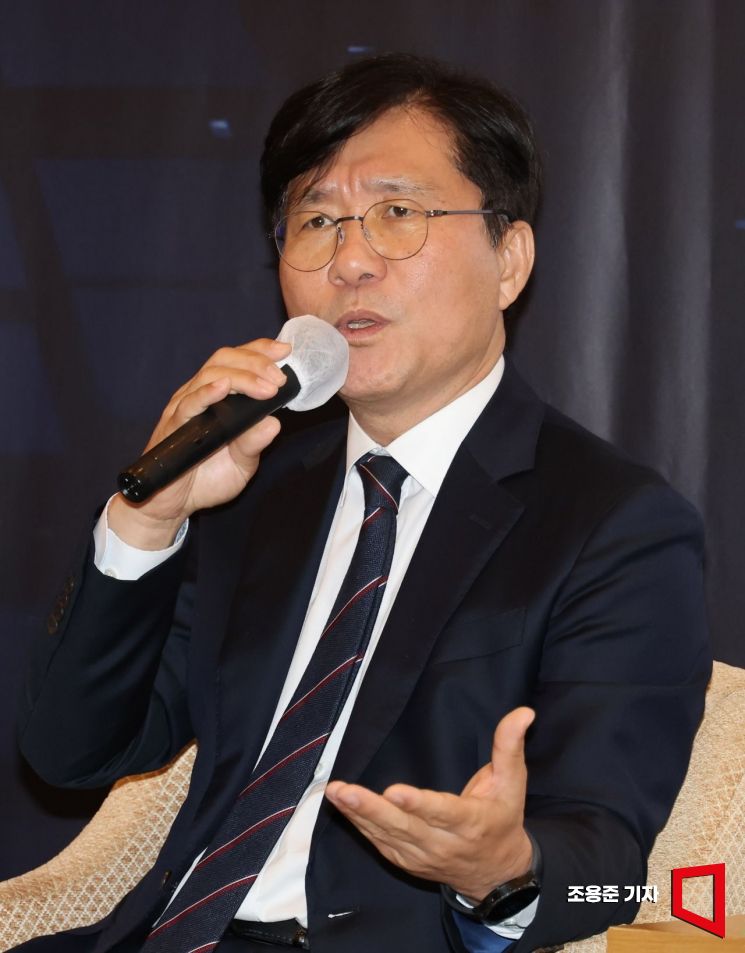 Former Minister of Trade, Industry and Energy Sung Yun-mo attended a special dialogue with former ministers of the Ministry of Trade, Industry and Energy at the FKI Tower Conference Center in Yeouido, Seoul on the 14th, holding a special discussion on the topic "The Future and Strategy of Korea's Semiconductor Industry." Photo by Jo Yong-jun jun21@
Former Minister Sung Yun-mo said about Samsung Electronics' situation, "If there were a clever solution, it would have been fixed already," and added, "This crisis is not an individual problem of Samsung but stems from changes in the semiconductor industry's structure and competitive landscape." He recalled the Intel case during the US-Japan semiconductor hegemony competition, noting that Intel, once the top in DRAM, eventually focused on central processing units (CPU) to reclaim the top spot amid Japanese challenges.
Former Minister Sung Yun-mo highly evaluated Samsung Electronics' resilience and said that the company's super-gap strategy, which has maintained the No. 1 position in DRAM for 30 years, will play an important role in overcoming the current difficulties. He said, "Samsung has already built that ecosystem, so it can overcome this crisis well," and emphasized, "Returning to basics is crucial for overcoming the crisis."
He continued, "It is necessary to constantly check and reflect on whether the business and plans are heading in the right direction and whether the pace is appropriate, and if necessary, take on new challenges," adding, "Returning to basics is the only way for Samsung Electronics' continuous growth and crisis overcoming."
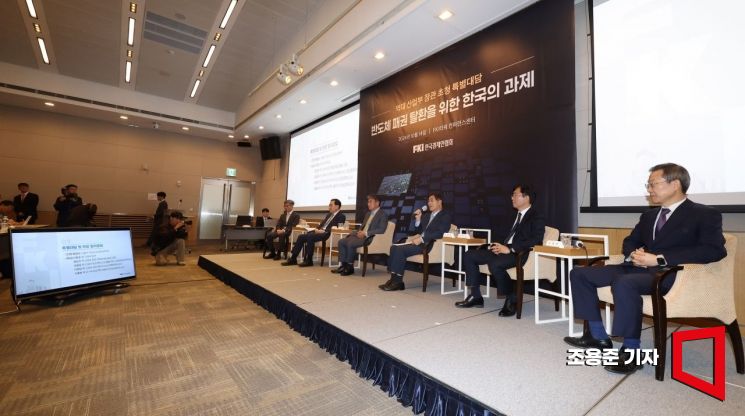 Former Ministers of Industry and Energy Lee Yun-ho, Yoon Sang-jik, Sung Yoon-mo, Lee Chang-yang, and former Minister of Science and ICT Lee Jong-ho attended a special dialogue inviting former Ministers of Industry at the Korea Economic Association on the 14th at the FKI Tower Conference Center in Yeouido, Seoul, holding a special dialogue on the theme "The Future and Strategy of Korea's Semiconductor Industry." Photo by Jo Yong-jun jun21@
Former Minister of Science and ICT Lee Jong-ho pointed out that Samsung Electronics has done very well so far but lacked response to the rapidly changing environment recently. He noted that Samsung Electronics, which showed strong competitiveness as a fast follower in the past, set a strategy to transition to a first mover after becoming the world's No. 1, but there were some shortcomings in the process.
Former Minister Lee Jong-ho emphasized the importance of industry-academia-research cooperation, saying, "It is now an era where one company cannot handle all technologies alone." He said, "If barriers with research institutes and universities are lowered and communication and cooperation become organic, Samsung Electronics can wisely overcome the current difficulties."
He added, "A million-strong army does not always win," and said, "How to cooperate strategically and how to leverage one's own strengths determine victory or defeat in the hegemony competition."
Semiconductor Crisis, National Support Is the Way... Call for Direct Subsidies
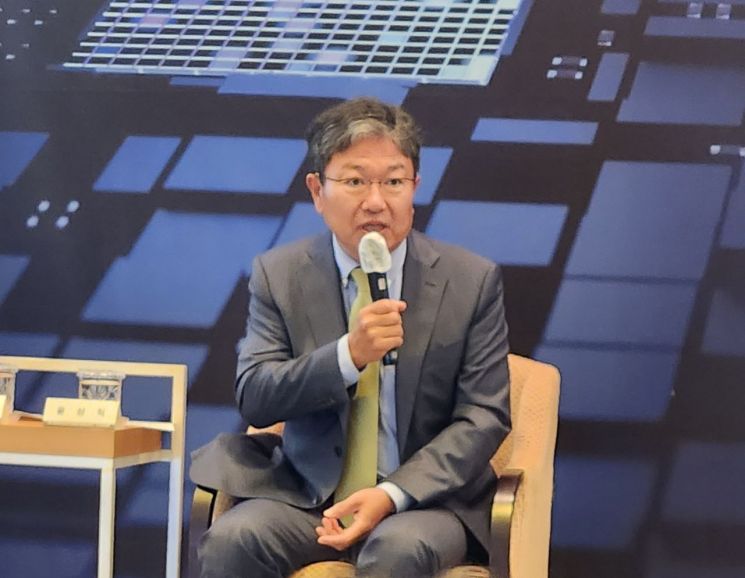
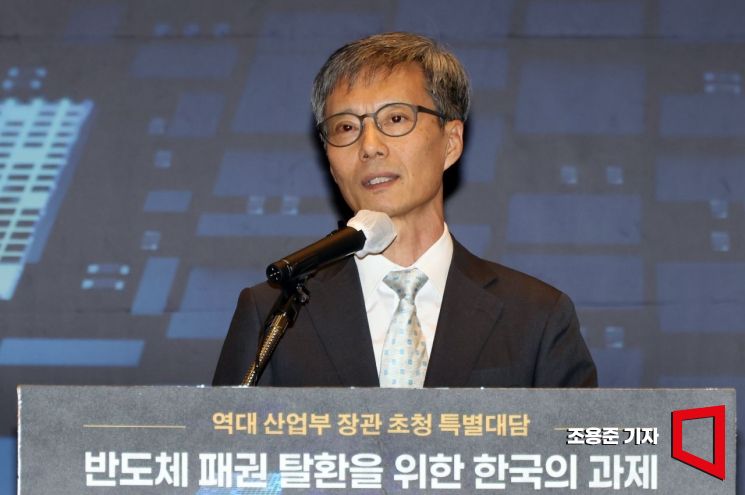 On the 14th, Professor Hwang Cheol-seong, Chair Professor of the Department of Materials Science and Engineering at Seoul National University, attended a special talk inviting former Ministers of Industry at the FKI Tower Conference Center in Yeouido, Seoul, and gave a presentation titled "The Future and Strategy of Korea's Semiconductor Industry." Photo by Jo Yong-jun jun21@
On the same day, Hwang Cheol-sung, Chair Professor of the Department of Materials Science and Engineering at Seoul National University and the keynote speaker, pointed out that "DRAM performance improvement will reach its limit within the next five years," making the transition to 3D DRAM structures inevitable. Professor Hwang expressed concern that "the weakening of DRAM competitiveness and the slow development of system semiconductors could pose instability to our semiconductor industry." He emphasized the need for national support, stating, "The entry of Chinese semiconductor companies into the memory sector, backed by national support, will be a significant challenge for our country in the future, so we must overcome this through national support and efforts from academia and industry."
Former ministers agreed with Professor Hwang's presentation and unanimously called for aggressive support policies such as direct subsidies. Since major countries like the United States, Japan, and China are investing massive subsidies in the semiconductor industry, it is necessary for our country to prepare comprehensive support measures including direct subsidies, financial support, and tax benefits.
Former Minister Lee Yoon-ho said, "Semiconductors are directly linked to national competitiveness and security," and added, "Support for the semiconductor industry should not be viewed merely as benefits for individual companies." Former Minister Yoon Sang-jik mentioned that "for the development of the semiconductor industry, essential prerequisites such as skilled personnel, financial power, electricity, and data must be met," highlighting the importance of power grid construction, new nuclear power plants, and early commercialization of next-generation small modular reactors (SMRs).
Former Minister Sung Yun-mo urged strengthening government support for the semiconductor materials, parts, and equipment industry, while former Minister Lee Chang-yang stressed, "Policy efforts to secure infrastructure such as power, which the private sector cannot handle, are urgently needed," adding, "Rather than simply saying 'Taiwan's TSMC receives direct subsidies but we do not,' there needs to be in-depth discussion and consensus on what well-targeted and justified support should be."
© The Asia Business Daily(www.asiae.co.kr). All rights reserved.



















