Agricultural, Fisheries, and Credit Unions and Forest Cooperatives' Soundness Indicators Hit Worst in 5 Years
Return on Total Assets Declined Across the Board Over 5 Years
Assemblyman Yudongsoo Urges Financial Supervisory Service to Supervise Central and Large Cooperatives
One in three nationwide mutual finance cooperatives, which have supported the local economy, recorded deficits, and delinquency rates have sharply increased, signaling a red alert on overall soundness.
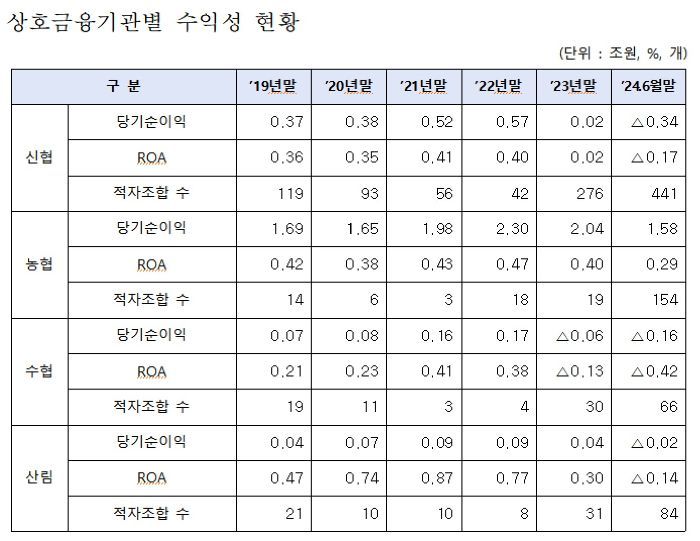
According to data submitted by the Financial Supervisory Service to Representative Yoo Dong-su of the National Assembly's Political Affairs Committee on the 14th, as of the first half of this year, 745 out of 2,208 nationwide mutual finance cooperatives, including agricultural, fishery, credit unions, and forestry cooperatives, were operating at a deficit.
Among mutual finance companies, the fishery cooperatives (Suhyup) had the highest proportion of deficit cooperatives as of the first half of this year. Suhyup recorded deficits in 66 out of 90 cooperatives nationwide (73.3%). They were followed by forestry cooperatives, credit unions (Shinhyup), and agricultural cooperatives (Nonghyup). Forestry cooperatives had 80 deficit cooperatives out of 141 (56.7%), credit unions recorded net losses in 441 out of 866 cooperatives (56.7%), and agricultural cooperatives had 154 deficit cooperatives out of 1,111, representing a deficit rate of 13.9%.
Due to the increase in deficit cooperatives, the soundness of mutual finance companies is also being shaken. Both the return on assets (ROA) and delinquency rates, which are indicators of the soundness of the four mutual finance companies, recorded their worst figures in five years.
The return on assets (ROA) is an indicator that shows how efficiently assets are managed, representing the size of net income relative to assets. The ROA of the four mutual finance companies has shown a declining trend over the past five years. Suhyup's ROA plummeted from 0.21% in 2019 to -0.42% in the first half of this year. During the same period, credit unions' ROA dropped from 0.36% to -0.17%, forestry cooperatives from 0.47% to -0.14%, and agricultural cooperatives also decreased from 0.42% to 0.29%.
The delinquency rates of the four mutual finance companies more than doubled over five years. In particular, forestry cooperatives' delinquency rate surged 3.4 times from 1.67% in 2019 to 5.63% in the first half of this year. Agricultural cooperatives' delinquency rate increased 2.7 times, credit unions 2.3 times, and fishery cooperatives 2.2 times.
The biggest cause of the deterioration in mutual finance companies is attributed to real estate project financing (PF) loans. Mutual finance companies expanded real estate project financing (PF) loans during the low-interest rate period to grow their scale, but as interest rates rose, loans to businesses whose project viability worsened became non-performing. According to the Financial Supervisory Service, the real estate PF risk exposure of mutual finance companies in the first half of this year was 54.6 trillion won, accounting for one-quarter of the total risk exposure of 216.5 trillion won.
Contrary to the deterioration in soundness, the asset size of mutual finance companies is increasing. The number of cooperatives with assets exceeding 1 trillion won among mutual finance cooperatives is on the rise. Among the four mutual finance companies, the number of cooperatives with assets over 1 trillion won surpassed 100 (115 cooperatives) in 2021 from 89 in 2019, reaching a record high of 163 in the first half of this year.
In response, Representative Yoo pointed out that concerns about the reckless expansion of mutual finance companies are growing, but regulations to manage and supervise them are lax. Mutual finance companies effectively operate as financial institutions but are not directly supervised by financial authorities. Similar savings banks, of which only 31 out of 79 have assets exceeding 1 trillion won, are under the supervision of the Financial Supervisory Service and are preparing accountability structures.
Representative Yoo stated, "The size of mutual finance companies is growing, but their soundness is shaken due to PF defaults and internal control failures," adding, "The supervisory authorities for mutual finance companies are fragmented, and lax regulations have created blind spots." He emphasized, "Mutual finance companies also need to be regulated at a level comparable to other financial institutions under the principle of 'same business, same regulation.' Consideration should be given to having the Mutual Finance Central Association and large cooperatives with assets over 1 trillion won be supervised by the Financial Supervisory Service."
© The Asia Business Daily(www.asiae.co.kr). All rights reserved.

















