Revision of 'Byeokji Line Support Project' Operation Guidelines
Support Extended to Long-Distance Intercity and Express Bus Routes
Autonomy Granted for Local Government Support Ratios for City and Intercity Buses
The Ministry of Land, Infrastructure and Transport (MOLIT) will support long-distance travel for residents in transportation-disadvantaged areas. Previously, only losses from short-distance bus operations within the same province (do) were compensated, but now losses from bus routes traveling to other metropolitan local governments will also be reimbursed.
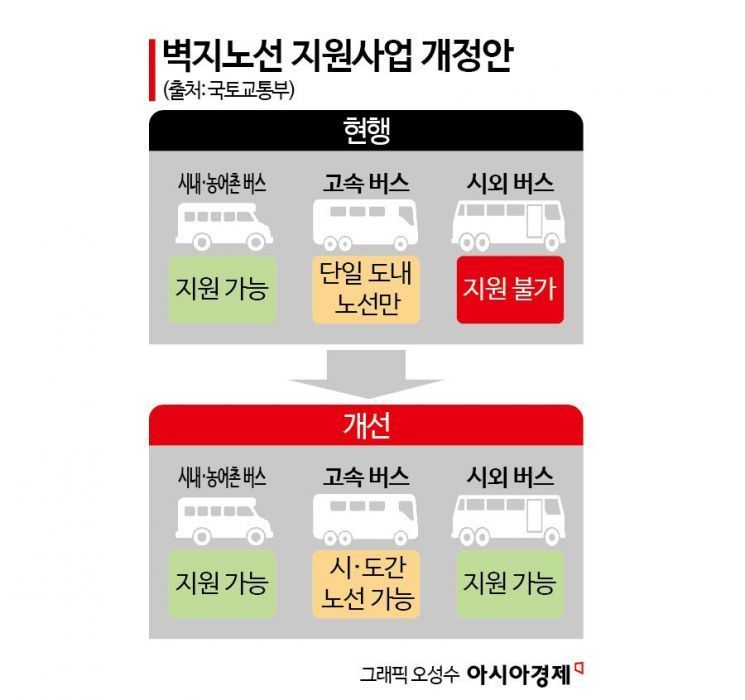
On the 14th, MOLIT announced that starting from the 15th, it will implement a revised operational guideline for the "Remote Route Support Project" reflecting these changes. The Remote Route Support Project, introduced in 2020, reimburses losses incurred from operating unprofitable bus routes to guarantee mobility rights for local residents, with funding shared between the national government (30%) and local governments (70%) across eight provincial local governments.
With this revision, intercity and express bus routes passing through depopulated areas can now be included in the Remote Route Support Project. This measure aims to respond to the acceleration of local extinction caused by regional disconnection and to ensure long-distance travel for residents in underdeveloped areas. Previously, support was limited to short-distance routes operating only within the same province.
Additionally, the scope of supported routes will be expanded. Besides routes related to daily convenience facilities such as schools and childcare centers, losses from routes serving essential and cultural facilities like large hospitals, performance halls, and museums will also be reimbursed.
Furthermore, local governments will be allowed to autonomously set the support ratio by bus type?intercity, city, or rural?based on regional conditions within this project’s budget. For example, if one local government sets the budget support ratio at 30% for intercity buses and 70% for city buses, another local government can set it differently, such as 10% for intercity buses and 90% for city buses. Until now, local governments could only support intercity buses up to 10% through this project.
Park Jeong-su, Director General of Comprehensive Transportation Policy at MOLIT, said, "This revision of the operational guidelines will improve long-distance mobility rights for local residents. Intercity and express buses are representative long-distance public transportation modes, and we will manage them to prevent transportation blind spots caused by route closures due to operational deficits."
Meanwhile, the national budget for the Remote Route Support Project this year is 37.5 billion KRW. The national budget in previous years was 33.7 billion KRW in 2022, 33.9 billion KRW in 2021, and 28.7 billion KRW in 2020.
© The Asia Business Daily(www.asiae.co.kr). All rights reserved.

















