VS Research Institute and Road Traffic Research Institute Sign Research Agreement on Driver Factor Accident Prevention
Advancement of In-Cabin Sensing Solution for Vehicle Interior Spatial Detection
LG Electronics has decided to jointly advance a solution that analyzes the interior of vehicles with Korea Expressway Corporation to prevent accidents. The company plans to provide a differentiated customer experience through cooperation in advanced driver assistance system (ADAS) technology, whose importance has recently been increasing.
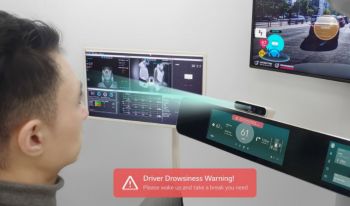 LG Electronics' In-Cabin (driver and vehicle interior space sensing) solution recognizes the driver's face to check their condition.
 [Photo by LG Electronics]
On the 14th, LG Electronics announced that the VS Research Center within the VS (Vehicle Components, Electric and Electronic Equipment for Vehicles) Business Division signed a "business agreement for research on driver factor accident prevention" with the Korea Expressway Corporation Road Traffic Research Institute on the 10th. Lee Sang-yong, Head of LG Electronics VS Research Center (Executive Vice President), and Cho Nam-min, Director of the Road Traffic Research Institute, attended the signing ceremony.
The two organizations have formed a collaboration to advance in-cabin sensing (detecting the driver and vehicle interior space) solution technology. In-cabin sensing is a solution that detects and prevents traffic accidents caused by driver negligence such as drunk or drowsy driving and using a mobile phone while driving.
The next-generation in-cabin sensing solution being developed by LG Electronics incorporates artificial intelligence (AI) technology. It recognizes the driver's face and automatically adjusts the seat, air conditioning, lighting, and more. During driving, it monitors heart rate to check the driver's health condition.
Drivers can control functions on the vehicle display without touching it through voice control and gaze tracking technology. When exiting the vehicle, it also alerts if any belongings are left inside. Previously, LG Electronics presented the concept of the next-generation in-cabin solution at the 37th World Electric Vehicle Symposium and Exhibition (EVS37) held in April.
LG Electronics and the Road Traffic Research Institute apply driver response data tested with the "road driving simulator" to LG Electronics' in-cabin sensing solution. The simulator is a facility of the Road Traffic Research Institute that uses virtual reality technology to recreate extreme situations difficult to reproduce on actual roads, enabling various driving tests.
Through the agreement, the two parties plan to expand the scope of using the road driving simulator and jointly promote the establishment of policies and standardization related to in-cabin sensing.
The growth potential of the in-cabin sensing market is high. Automakers consider in-cabin sensing an important item in vehicle safety assessments (NCAP). According to market research firm Roland Berger, the global ADAS market, including in-cabin sensing, is expected to grow from $25.3 billion (approximately 34.2 trillion KRW) next year to $53.2 billion (71.9 trillion KRW) by 2030, nearly doubling.
Eun Seok-hyun, Vice President and Head of LG Electronics VS Business Division, said, "LG Electronics supplies high-level in-cabin sensing solutions integrated with AI technology," adding, "We will strengthen our in-cabin sensing technology that protects the safety of drivers and passengers in various driving situations through cooperation with Korea Expressway Corporation."
© The Asia Business Daily(www.asiae.co.kr). All rights reserved.
!["The Woman Who Threw Herself into the Water Clutching a Stolen Dior Bag"...A Grotesque Success Story That Shakes the Korean Psyche [Slate]](https://cwcontent.asiae.co.kr/asiaresize/183/2026021902243444107_1771435474.jpg)
















