Asahi Shimbun Mentions in Editorial: "A Work Filled with Hope"
Japan's Asahi Shimbun evaluated Korean author Han Kang's Nobel Prize in Literature by stating, "War, disparity, division. In a world full of anguish, his works increasingly possess a universality that transcends borders."
On the 13th, Yonhap News quoted an editorial from Asahi Shimbun, reporting that "Han Kang's works are expected to continue resonating with readers." Asahi noted, "This is the first time an Asian woman has received the Nobel Prize in Literature, and also the first Korean recipient," introducing Han Kang as "one of the authors who has led the growing popularity of Korean literature in Japan."
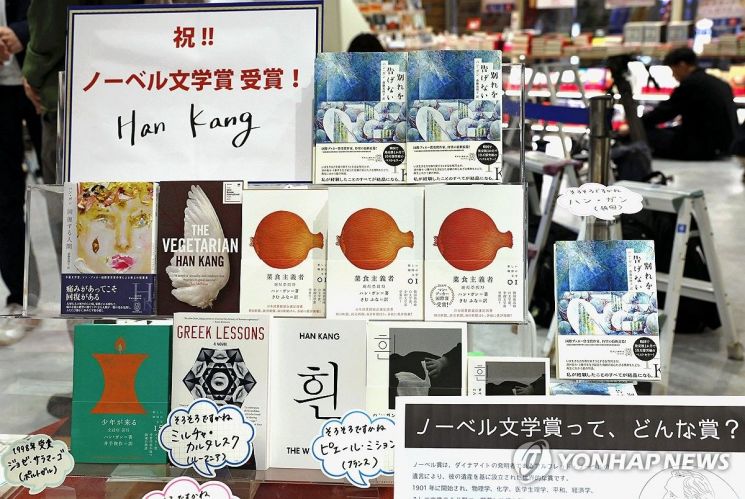 Han Kang's work displayed at the special Nobel Literature Prize corner in a major Japanese bookstore
 Photo by Kyodo News, Yonhap News Agency archive photo
Furthermore, Asahi mentioned that Han Kang's representative work Boyhood deals with the Gwangju Democratization Movement, and Human Acts centers on the Jeju 4.3 incident. Through these, the author repeatedly explores "the enigma and essence of human existence."
Regarding Han Kang, they said, "Her diverse literary world sometimes depicts violence that one might want to turn away from," and "Her delicately and meticulously crafted sentences possess a power that feels like sharp pain penetrating the body."
They added, "Through the imagination of literature, Han Kang has sought hope without losing trust in humanity," and "The empathy for such an author may show that our imagination holds at least that hope to overcome violence and suffering."
 On the weekend of the 13th, citizens are purchasing books by Nobel Literature Prize winner Han Kang at Kyobo Bookstore Gwanghwamun branch.
 [Photo by Yonhap News]
On the same day, aside from the editorial, Asahi also published an article summarizing a conversation between translator Konosu Yukiko and University of Tokyo professor Yanagihara Takaatsu about Han Kang's Nobel Prize in Literature.
In the dialogue, when Konosu said, "Han Kang's name has been mentioned continuously, but she is still young," Professor Yanagihara responded, "She is the first Nobel laureate born in the 1970s."
Konosu then remarked, "I think this is a great achievement," noting that Han Kang is a Nobel laureate whose translated works have been widely published and popular in Japan since Kazuo Ishiguro, the Japanese-British author who won the Nobel Prize in Literature in 2017.
Earlier, on the 10th (local time), the Swedish Academy announced Han Kang as this year's Nobel Prize in Literature laureate. Anders Olsson, chair of the Nobel Literature Committee, praised her at a press conference as "a writer whose intense poetic prose confronts the wounds of history and reveals the vulnerability of human life as it is."
© The Asia Business Daily(www.asiae.co.kr). All rights reserved.













