Observed in Various Northern Hemisphere Locations Including the US and Russia
Aurora Phenomenon Seen in Korea for the First Time in 21 Years Last May
Due to the impact of a solar geomagnetic storm, the night skies in several parts of the Earth's northern hemisphere, including New York and Washington in the United States, were unusually colored with pink, purple, and green auroras.
On the 11th (local time), the US National Oceanic and Atmospheric Administration (NOAA) Space Weather Prediction Center (SWPC) and the New York Times (NYT) reported that aurora phenomena were observed across various regions from northern to central parts of the US the previous night. This aurora was visible in major northern US cities such as Chicago and New York, as well as in central regions like Washington DC and Kentucky. Additionally, auroras were observed over a wide area including Russia and Northern Europe on the same day.
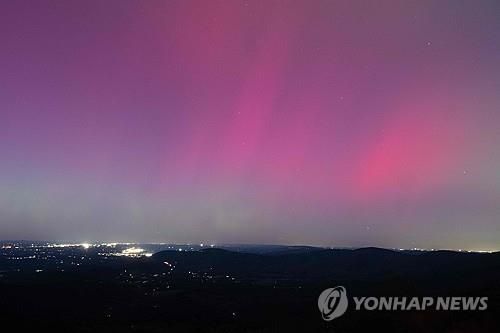 Aurora observed on the night of the 10th (local time) at Shenandoah National Park, Virginia, USA
 [Photo by AFP Yonhap News]
Earlier, the SWPC forecasted that a coronal mass ejection (CME) caused by a recent powerful solar eruption would affect the Earth between the 10th and 11th. They also warned that this could cause satellite communication disruptions, power grid failures, and GPS service interruptions.
Auroras occur when part of the solar wind from the solar system enters the Earth's magnetic field and collides with the atmosphere, producing various lights. They mainly appear in the upper atmosphere of high-latitude regions such as the Arctic Circle. The ring-shaped pattern formed around the Earth's magnetic north and south poles is called the "auroral oval." Among the various colors of auroras, green and red auroras are emitted by oxygen atoms, while the purple auroras sometimes seen at the bottom are light emitted by nitrogen molecules.
The SWPC predicted that although the geomagnetic storm's intensity had somewhat weakened, auroras could still be observed on the night of the 11th in northern US regions including Canada and Alaska.
Meanwhile, in May, auroras were observed in South Korea for the first time in over 20 years. Generally, auroras are rarely visible in mid-latitude regions like the Korean Peninsula, which are far from the polar regions. The last time auroras were captured in South Korea was about 21 years ago, on October 30, 2003, when red auroras were observed at Bohyunsan Optical Astronomy Observatory.
The reason for the aurora occurrence at that time was a powerful solar storm hitting the Earth. The Korea Astronomy and Space Science Institute explained, "One of the reasons for frequent aurora observations is solar activity," adding, "Solar activity repeats in cycles of about 11 years, alternating between strong and weak phases, and it is predicted that solar activity will reach its peak next year."
© The Asia Business Daily(www.asiae.co.kr). All rights reserved.
![From Bar Hostess to Organ Seller to High Society... The Grotesque Con of a "Human Counterfeit" [Slate]](https://cwcontent.asiae.co.kr/asiaresize/183/2026021902243444107_1771435474.jpg)
















