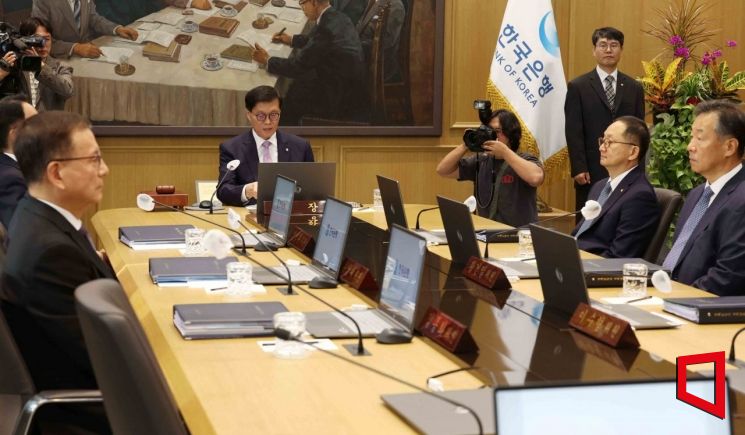
 Lee Chang-yong, Governor of the Bank of Korea, is presiding over the Monetary Policy Direction meeting of the Monetary Policy Committee held on the 11th at the Bank of Korea in Jung-gu, Seoul. The Bank of Korea ended its monetary tightening stance, which began in August 2021 with a 0.25 percentage point increase, and lowered the rate by 0.25 percentage points, shifting to a more accommodative policy for the first time in 3 years and 2 months. Photo by Joint Press Corps
The Bank of Korea analyzed that the uncertainty of South Korea's economic growth path has increased due to rising external risks such as the growth trends of major countries and the direction of the global IT industry.
In the 'October Economic Situation Assessment' released on the 11th, the Bank of Korea forecasted that the domestic economy would see a narrowing gap between exports and domestic demand, with exports continuing to grow and domestic demand improving mainly through consumption, leading to a gradual improvement in the perceived economic conditions.
In the second half of this year, the domestic economy is expected to show a recovery trend in private consumption and facility investment alongside sustained export growth. However, construction investment is assessed to face somewhat increased downside risks due to continued sluggishness in new housing starts and reduced execution of social overhead capital (SOC) projects.
Next year, moderate growth centered on consumption is expected to continue due to price stability and easing of domestic and external monetary tightening. Accordingly, the gap between domestic demand and exports is expected to gradually narrow, and the perceived economic conditions to improve.
However, the outlook remains highly uncertain regarding the growth trends of major countries such as China, the direction of the global IT industry, and the development of Middle East conflicts. Compared to August, the uncertainty of the economic growth rate forecast (2.4% this year, 2.1% next year) has increased.
The future consumer price inflation rate is predicted to slightly underperform the initial forecast of 2.5% this year due to downward supply-side pressures such as oil prices. Core inflation is expected to remain stable around 2%, as initially anticipated.
The consumer price inflation rate is expected to remain below 2% for some time due to downward supply-side pressures such as the recent decline in oil prices and frozen electricity rates, and then stabilize around 2%. However, uncertainty regarding oil prices has increased due to the development of the Middle East situation.
© The Asia Business Daily(www.asiae.co.kr). All rights reserved.

















