October Monetary Policy Direction Meeting Resolution
The Monetary Policy Committee of the Bank of Korea announced on the 11th that it lowered the base interest rate from 3.50% to 3.25% per annum, stating, "With the inflation rate showing a clear stabilization trend and the government's strengthening of macroprudential policies, the pace of household debt increase has begun to slow down," and added, "As foreign exchange market risks have also somewhat eased, it was judged appropriate to slightly reduce the degree of monetary policy tightening and monitor its effects."
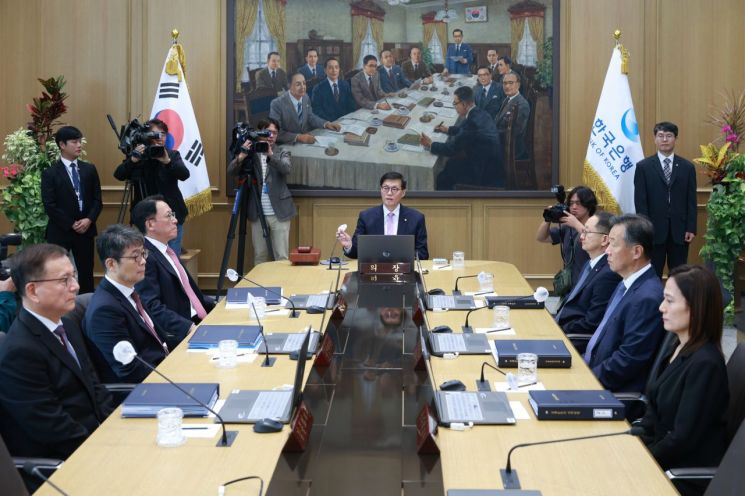
In the resolution of the monetary policy direction meeting held that morning, the Bank of Korea's Monetary Policy Committee said, "From a financial stability perspective, although the increase in housing prices in the metropolitan area and household debt is expected to gradually slow due to the strengthening of macroprudential policies, it is still necessary to pay close attention to related risks such as the impact of the base rate cut on household debt," and added, "Future monetary policy will carefully examine the trade-offs among policy variables such as inflation, growth, and financial stability, and cautiously decide on the pace of further rate cuts."
Regarding the domestic economy, it stated, "Exports continued to increase, but the recovery of domestic demand remains sluggish," and added, "Going forward, the domestic economy is expected to maintain a moderate growth trend, but due to delays in domestic demand recovery, the uncertainty of the outlook (2.4% this year, 2.1% next year) has increased compared to August."
On inflation, it evaluated that stabilization has become clear, stating, "Next year's inflation rate is expected to generally align with previous forecasts (2.1% for consumer prices and 2.0% for core inflation)," but added, "However, uncertainties remain high regarding international oil price fluctuations, exchange rate movements, and public utility fee adjustments due to developments in Middle East risks."
The full text of the monetary policy direction meeting resolution is as follows.
The Monetary Policy Committee decided to operate monetary policy by lowering the Bank of Korea's base interest rate from the current 3.50% level to 3.25% until the next monetary policy direction decision. With the inflation rate showing a clear stabilization trend, the government's strengthening of macroprudential policies has begun to slow the pace of household debt increase, and as foreign exchange market risks have somewhat eased, it was judged appropriate to slightly reduce the degree of monetary policy tightening and monitor its effects.
The global economy continues to grow moderately, but economic uncertainties in major countries have somewhat increased, and inflation has continued to ease. In international financial markets, long-term government bond yields and the US dollar index fell and then rebounded, influenced by changes in expectations regarding the pace of the US Federal Reserve's rate cuts, Middle East risks, and China's economic stimulus measures. Going forward, the global economy and international financial markets are expected to be influenced mainly by the economic conditions and monetary policy changes of major countries, geopolitical risks, and political situations in major countries.
The domestic economy saw continued export growth, but the recovery of domestic demand remains sluggish. Employment showed a gradual slowdown in the increase of the number of employed persons, but the unemployment rate remained at a low level. Going forward, the domestic economy is expected to maintain moderate growth, but due to delays in domestic demand recovery, the uncertainty of the outlook (2.4% this year, 2.1% next year) has increased compared to August. Future growth paths are expected to be influenced by the speed of domestic demand recovery, the economic conditions of major countries, and IT export trends.
Domestic inflation has clearly stabilized. In September, the consumer price inflation rate fell to 1.6% due to a sharp decline in petroleum prices, and the core inflation rate (excluding food and energy) slowed to 2.0%. Short-term inflation expectations also decreased to 2.8%. Inflation is expected to continue on a stable path due to low demand pressures. The consumer price inflation rate is expected to remain below 2% for the time being, with this year's inflation rate slightly below the August forecast (2.5%), and the core inflation rate is expected to remain stable around 2%, aligning with the previous forecast (2.2%). Next year's inflation rates for both consumer prices and core inflation are expected to generally align with previous forecasts (2.1% and 2.0%, respectively), but uncertainties remain high regarding international oil price fluctuations, exchange rate movements, and public utility fee adjustments due to developments in Middle East risks.
In financial and foreign exchange markets, long-term government bond yields fell and then rebounded due to changes in expectations regarding domestic and foreign monetary policies, and the won-dollar exchange rate fluctuated influenced by the US dollar trend and geopolitical risks. In the housing market, price increases in the metropolitan area slowed and transaction volumes shrank, while sluggishness continued in provincial areas. Accordingly, the scale of household loan increases also significantly decreased.
The Monetary Policy Committee will operate monetary policy while monitoring growth trends to ensure that inflation stabilizes at the target level over the medium term and paying attention to financial stability. The domestic economy is expected to maintain moderate growth with inflation stabilizing at the target level, but uncertainty in the growth outlook has increased. From a financial stability perspective, the increase in metropolitan area housing prices and household debt is expected to gradually slow due to the strengthening of macroprudential policies, but it remains necessary to pay close attention to related risks such as the impact of the base rate cut on household debt. Therefore, future monetary policy will carefully examine the trade-offs among policy variables such as inflation, growth, and financial stability, and cautiously decide on the pace of further rate cuts.
© The Asia Business Daily(www.asiae.co.kr). All rights reserved.
![From Bar Hostess to Organ Seller to High Society... The Grotesque Con of a "Human Counterfeit" [Slate]](https://cwcontent.asiae.co.kr/asiaresize/183/2026021902243444107_1771435474.jpg)
















