'Minor Crimes' Allowing Non-Appearance Trials
Judgment Should Be Based on Statutory Penalties, Not Sentencing Types
Even in cases where a fine of 100,000 won was imposed in the first trial, the Supreme Court has ruled that it is illegal to conclude the second trial's arguments without the defendant's presence if the charges against the defendant are not minor crimes that allow for trials in absentia.
The ruling emphasizes that whether a crime is minor enough to permit a trial in absentia under the Criminal Procedure Act should be judged based on the statutory penalty, not the actual sentence handed down.
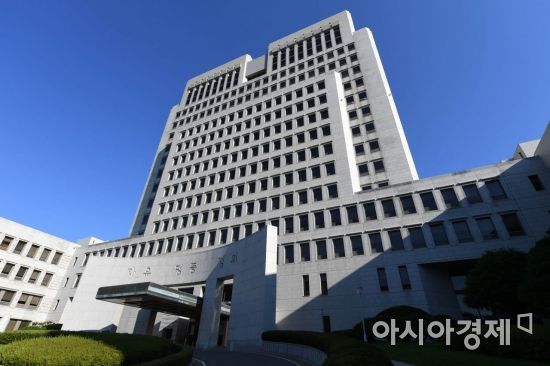
According to the legal community on the 11th, the Supreme Court's Second Division (Presiding Justice Park Young-jae) overturned the appellate court's decision dismissing the appeal of Mr. A, who was indicted for stealing dozens of decorative pebbles and was fined 100,000 won in the first trial, and remanded the case to the Incheon District Court.
The court stated, "In principle, the appellate court cannot proceed without the defendant's presence, and if the defendant does not appear at the appellate trial date, a new date must be set. If the defendant fails to appear again without justifiable reason, the court may render a judgment without the defendant's statement."
Article 276 (Right of the Defendant to Appear) of the Criminal Procedure Act stipulates that "If the defendant does not appear at the trial date, the trial cannot proceed unless otherwise specified." Article 365 (Defendant's Appearance) Paragraph 1 states, "If the defendant does not appear at the trial date, a new date must be set," and Paragraph 2 states, "If the defendant fails to appear again without justifiable reason, the court may render a judgment without the defendant's statement."
Meanwhile, Article 277 (Minor Cases and Defendant's Absence) of the same law enumerates cases where trials can proceed without the defendant's presence, including ▲cases punishable by a fine or penalty not exceeding 5 million won (Item 1), ▲cases where dismissal or acquittal is clearly expected (Item 2), and ▲cases punishable by imprisonment of up to 3 years or detention, fines exceeding 5 million won, or detention where the defendant has applied for absence and the court recognizes that the absence does not hinder the defendant's rights (Item 3).
Article 370 (Application of Provisions) states, "The provisions concerning trials in Part 2 shall apply mutatis mutandis to appellate trials unless otherwise specified," clarifying that these rules apply to second trials as well.
The court pointed out, "The appellate court proceeded with the trial and concluded the arguments without the defendant's presence after the defendant failed to appear at the first trial date despite being served a summons, based on Articles 370 and 277 Item 1 of the Criminal Procedure Act. However, the statutory penalty under Article 329 (Theft) of the Criminal Act applicable to this case is 'imprisonment for up to 6 years or a fine not exceeding 10 million won,' so this case does not fall under those allowing trials in absentia at the appellate level under the Criminal Procedure Act."
It added, "Nevertheless, the appellate court proceeded with the trial and concluded the arguments without the defendant's presence at the first trial date, which constitutes a procedural violation of the Criminal Procedure Act that affected the judgment," explaining the reason for overturning and remanding the case.
Mr. A was prosecuted for stealing dozens of white decorative pebbles (worth about 5,000 won per hour) placed in front of the victim B's house entrance for aesthetic and drainage purposes while taking a walk in Michuhol-gu, Incheon, on the morning of May 24, 2023, by putting them into a black plastic bag and taking them away.
When many of the pebbles were missing, victim B found it suspicious and checked CCTV footage, discovering that Mr. A had taken the pebbles. Later that evening, when B confronted Mr. A in an alley, Mr. A said, "Yes, I took them, but how much does that really matter?" as if it were a trivial matter. Even when B immediately demanded the return of the pebbles, Mr. A refused, leading B to report him to the police.
In court, Mr. A denied the charges, claiming he thought the items were ownerless or discarded.
However, the first trial court found him guilty of theft and sentenced him to a fine of 100,000 won.
The court judged, "Considering the circumstances under which the defendant took the stolen items and that he did not return them despite protests from the victim immediately after acquisition, the defendant's intention to unlawfully possess the items is recognized."
Mr. A appealed, but the second trial court upheld the same judgment.
At the first trial date of the second trial, Mr. A did not appear, but the court proceeded with the trial and concluded the arguments without his presence, then set a date for sentencing.
The court explained the reason for dismissing Mr. A's appeal, stating, "Considering the circumstances recognized by the evidence lawfully collected and examined by the appellate court, including on-site photos, it is sufficient to acknowledge that the defendant stole the decorative pebbles belonging to the victim as stated in the indictment, and the defendant's claims cannot be accepted."
The court based its judgment on the following: ▲Given the location and shape of the pebbles at the time, a reasonable person with common sense would know they were not ownerless or discarded but placed by the person who installed the wooden deck for aesthetic and drainage purposes; ▲The defendant found the pebbles protruding beside the wooden deck in front of the victim's house entrance, looked around, then arbitrarily gathered dozens of pebbles into a black plastic bag and took them; ▲The defendant refused to return the pebbles despite the victim's demand.
However, the Supreme Court ruled that there was a procedural violation of the Criminal Procedure Act in the second trial and decided that the trial must be held again with Mr. A present.
© The Asia Business Daily(www.asiae.co.kr). All rights reserved.
![User Who Sold Erroneously Deposited Bitcoins to Repay Debt and Fund Entertainment... What Did the Supreme Court Decide in 2021? [Legal Issue Check]](https://cwcontent.asiae.co.kr/asiaresize/183/2026020910431234020_1770601391.png)















