KAIST announced on the 11th that Professor Jongse Park's research team from the School of Computing (students Jaehong Jo, Minsu Kim, Hyunmin Choi, and Guseul Heo) recently won both the Best Paper Award and the Best Research Artifact Award at the ‘2024 IEEE International Symposium on Workload Characterization (IISWC 2024)’ held in Vancouver, Canada.
IISWC is an international conference specializing in computer system workload characterization. Typically, the Best Paper Award and the Best Research Artifact Award have been given separately. However, this year, it is unprecedented that Professor Park’s team swept both awards with their paper.
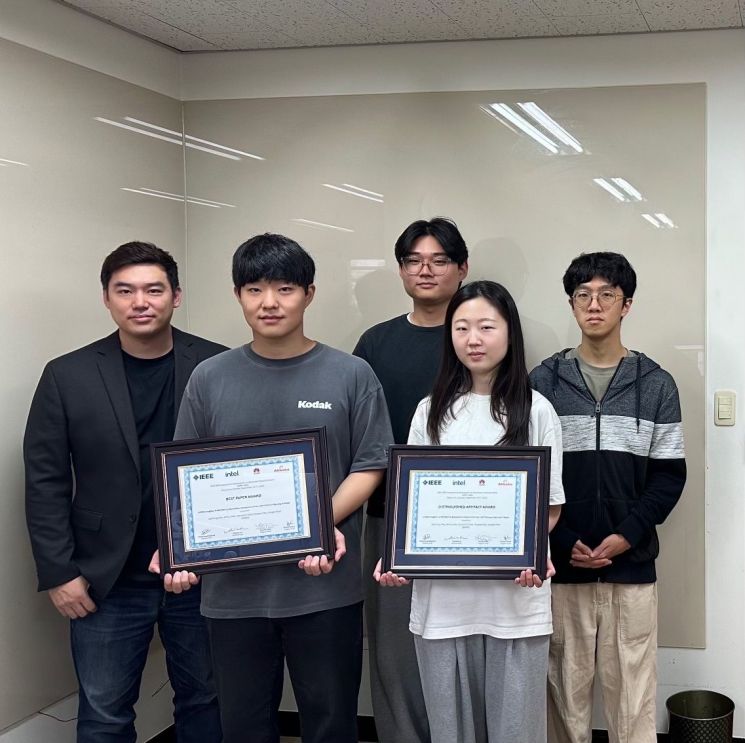 Professor Jongse Park (first from the left) and members of the research team are taking a commemorative photo after receiving the Best Paper and Records Award at the 2024 IISWC. Photo by KAIST
Previously, the research team published a paper titled ‘LLMServingSim: A HW/SW Co-Simulation Infrastructure for LLM Inference Serving at Scale’.
Through their research, the team proposed a simulation infrastructure capable of simulating large-scale systems running inference services for large language models (LLMs) such as ChatGPT by integrating various hardware and software components.
This made it possible to simulate all hardware elements such as Graphics Processing Units (GPUs), Neural Processing Units (NPUs), and Processing-In-Memory (PIM) semiconductors, as well as software components for LLM inference like loop-level scheduling and KV cache paging.
The research team expects that their results will be utilized in building cloud systems based on heterogeneous AI semiconductors in the future AI industry, represented by generative AI, going beyond simple chatbot AI using LLMs like ChatGPT.
IISWC highly evaluated the team for being the first to develop an integrated hardware and software simulation infrastructure for LLM inference services, as well as for the completeness and user-friendliness of the open-source code they released.
Professor Park stated, “The research team will continue to pursue cloud system research for generative AI.”
Meanwhile, this research was conducted with support from the National Research Foundation of Korea’s Excellent Young Researchers Support Program, the Institute for Information & Communications Technology Planning & Evaluation (IITP), the AI Semiconductor Graduate School Support Program, and HyperXcel.
© The Asia Business Daily(www.asiae.co.kr). All rights reserved.

















