Breast Cancer Society's Analysis of the Current Status of Breast Cancer in Koreans
The incidence rate of breast cancer among people under their 40s continues to rise. Experts analyzed this as a distinctly different pattern from Western countries, where breast cancer patients are increasing among the elderly.
On the 10th, Yonhap News reported that the Korean Breast Cancer Society (Chairman Han Won-sik) will officially announce the current status of breast cancer in Koreans at the autumn academic conference to be held on the 12th at the Grand Josun Jeju in Jeju Island.
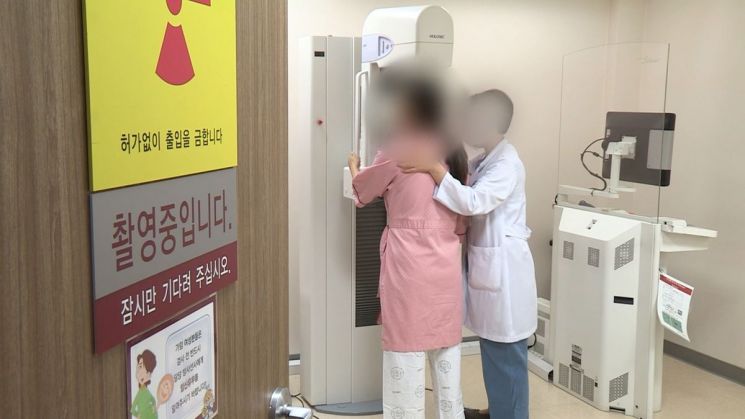
Breast cancer, the number one cancer incidence among women in Korea, is a representative disease threatening women's health. According to the "2024 Breast Cancer White Paper" published by the Korean Breast Cancer Society, the number of female breast cancer patients in Korea increased 5.5 times over 21 years, from 6,234 in 2000 to 34,628 in 2021. Breast cancer often shows no symptoms in the early stages, making early detection difficult. In most cases, a lump (nodule) in the breast is felt only after the cancer has progressed to some extent.
The society analyzed data from the National Cancer Registry and announced the results. According to this, breast cancer is the most common type of cancer among Korean women, with an age-standardized incidence rate of 68.6 per 100,000 people annually as of 2021. The annual average breast cancer incidence rate increased by 6.8% until 2007, after which the increase slowed somewhat to 4.6%.
If this trend continues, the society predicts that 30,665 new breast cancer patients (30,536 women, 129 men) will be diagnosed this year (2024). This accounts for 21.8% (ranked first) of all female cancer cases in Korea. The age-standardized mortality rate due to breast cancer this year is expected to be 5.8 per 100,000 people, corresponding to 9.2% (ranked fourth) of female cancer deaths in Korea.
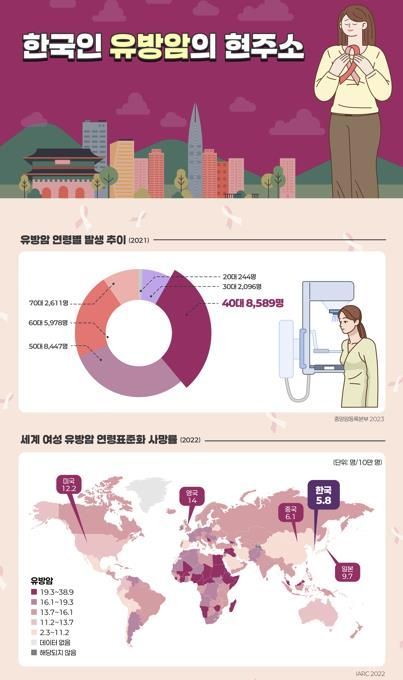
This mortality rate is somewhat lower than that of advanced countries as of 2022. The United States has 12.2, the United Kingdom 14, and Japan 9.7 per 100,000 people. This is attributed to increased early diagnosis due to active national health screenings and well-established standard treatments tailored to the characteristics of breast cancer. The breast cancer screening rate in Korea has significantly increased by 2.88% annually, from 33.2% in 2004 to 72.7% in 2023.
The age group with the highest number of breast cancer patients (as of 2021) is those in their 40s, totaling 8,589 patients. This is followed by those in their 50s with 8,447 patients, 60s with 5,978, 70s with 2,611, and 30s with 2,096 patients.
The society stated that it remains to be seen whether the increase in breast cancer incidence with age, as seen in the United States, is due to a shift toward Westernized patterns. Professor Park Se-ho of the Breast Surgery Department at Severance Hospital told Yonhap News, "The analysis showed that the breast cancer incidence rate among Korean women increases until the early 50s and then gradually decreases. This pattern differs from that of Western countries, so it is necessary to closely monitor the breast cancer incidence trends in Koreans in the future."
Meanwhile, tumors in the breast are classified as malignant or benign. Fibroadenoma, a benign tumor, does not progress to cancer. Breast cancer refers to all malignant tumors occurring in the breast. The causes of breast cancer are very diverse, but generally, the accumulation of genetic mutations is considered a major cause. Various factors affecting genetic mutations are believed to be involved in the occurrence of breast cancer.
If a lump is felt in the breast, cancer may be suspected, but since it could also be a benign tumor such as fibroadenoma, it is necessary to visit a specialist for an accurate diagnosis. Breast lumps are examined through mammography or ultrasound to check for lesions and abnormalities in the mammary glands, and a biopsy is performed if cancer is suspected.
© The Asia Business Daily(www.asiae.co.kr). All rights reserved.


















