'Border Fortification' Construction... North Korea Aims to Sever Ties with South
'Unification Abandonment' Unclear... Constitutional Amendment Made but Not Disclosed
Possibility of Provocations Other Than Nuclear Tests Ahead of US Presidential Election
North Korea has declared the 'fortification' of its southern border, signaling a military provocation. This is interpreted as an intention to raise the level of severance between the North and South by blocking the front-line area for full-scale military facility construction. Analysts note that North Korea's failure to disclose whether it will amend the constitution to abolish 'unification' or revise the 'territorial clause' suggests it still has not resolved the dilemma of establishing a regime ideology to replace 'unification.'
'Fortification' Declaration... What Is the Intention Behind the Comprehensive Separation Measures?
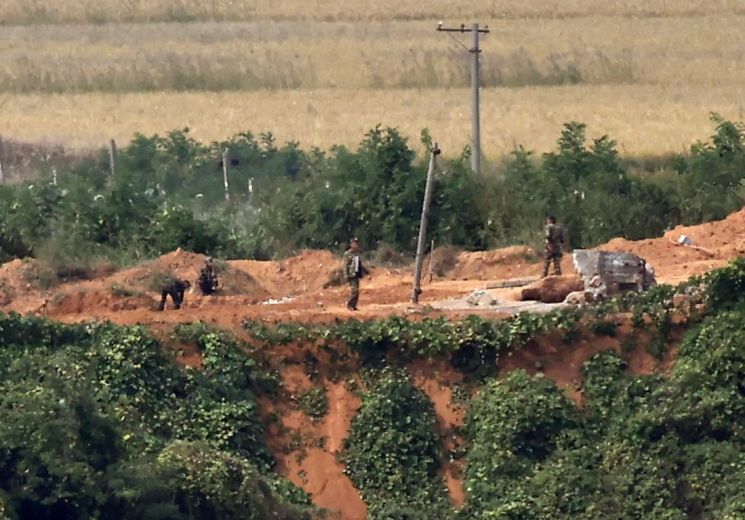 North Korea announced that it will completely sever the roads and railways connecting to the South from the 9th and carry out fortress construction to fully block and seal off the "southern border." The photo shows the area of Kaepung County, Hwanghaebuk-do, North Korea, as seen from Odusan Observatory on the 9th.
 [Image source=Yonhap News]
According to military authorities on the 10th, North Korea announced through a statement issued by the 'General Staff Department of the Korean People's Army' the day before that "from this day forward, construction work will proceed to completely sever roads and railways connected to the Republic of Korea on our side and fortify them with solid defensive fortifications." The 'southern border fortification' project announced by North Korea means cutting off roads and railways connecting the North and South and installing barriers within the Demilitarized Zone (DMZ) as part of separation measures.
North Korea had already foreshadowed such separation measures earlier this year. The term 'border line,' which had not been used in the past, appeared. In January, the term 'land border line' was used, and in February, the term 'maritime border line' for Yeonpyeong Island and Baengnyeong Island was introduced.
With the use of the term 'land border line,' North Korea began planting landmines on the Gyeongui and Donghae railway lines. From April, it deployed large-scale troops to the front-line areas to build walls. In June and July, it also started removing the Gyeongui and Donghae railway tracks. Currently, North Korea is conducting land leveling work in barren areas within the DMZ. Some view this as North Korea building a 'Berlin Wall' along the 248 km Military Demarcation Line.
The military assesses that this will not be easy due to the challenging terrain such as steep valleys. However, additional landmine planting within the DMZ, anti-tank barriers, and the establishment of garrisons for troop deployment are possible.
Some speculate that these blockade measures are aimed at preventing defections of North Korean soldiers. After the full resumption of loudspeaker broadcasts toward the North in July, one North Korean soldier defected by walking across the armistice line near the Donghae railway in Goseong County, Gangwon Province. In other words, North Korea's comprehensive separation measures are analyzed as efforts for internal control.
Unclear Whether 'Unification' Will Be Deleted in Constitutional Amendment as 'No. 1 Directive'
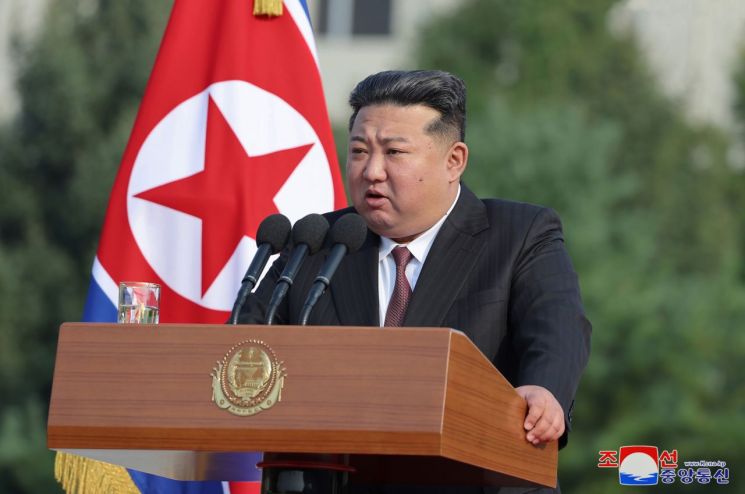 North Korean State Affairs Commission Chairman Kim Jong-un is delivering a speech at the Kim Jong-un National Defense Comprehensive University, which celebrated its 60th anniversary on the 7th.
 [Image source=Yonhap News]
Moreover, although it was expected that North Korea would introduce new provisions such as the 'abolition of unification' and a 'territorial clause' to demarcate borders at this Supreme People's Assembly, no details were disclosed. It is not even confirmed whether a constitutional amendment will take place. This was the 'No. 1' directive in North Korea. Since there is no reason not to disclose a constitutional amendment after making it, there is a possibility that the amendment itself has been postponed.
Hong Min, a senior research fellow at the Korea Institute for National Unification, said, "It was expected that North Korea would introduce a territorial clause through constitutional amendment and proceed with follow-up measures such as denying ethnicity and unification and antagonizing inter-Korean relations, but rather, the process may proceed in reverse order." He evaluated, "This can be seen as an intention to secure internal persuasion among residents by first severing ties under the pretext that South Korea and the U.S. are creating a crisis, followed by gradual realization."
There is also a view that the amendment has been made but not disclosed. Professor Park Won-gon of Ewha Womans University’s Department of North Korean Studies pointed out, "In Kim Jong-un’s policy speech in January this year, he very clearly ordered 'to implement (constitutional amendment) at the next Supreme People's Assembly,' and in the North Korean system, this is the leader's directive." He added, "Unification is the identity of the North Korean authorities and the foundation of the Baekdu bloodline, so abolishing it means Kim Jong-un himself is denying legitimacy," emphasizing the possibility that North Korea could not publicly present a new guiding regime ideology to replace 'unification.'
If North Korea has carried out the amendment but only withheld the content, there is speculation that it is adjusting the timing of disclosure to maximize political effect ahead of the U.S. presidential election. Professor Yang Moo-jin of the University of North Korean Studies said, "What is urgent for North Korea now is to influence the U.S. presidential election through nuclear threats and secure leadership over the Korean Peninsula issue," adding, "Issues such as maritime boundaries could be disadvantageous under international law."
Blatant Tongmibongnam... What Are North Korea's Future Provocative Moves?
In the announcement of the Supreme People's Assembly results and the 'fortification' notification process by the General Staff Department of the Korean People's Army, North Korea revealed a more blatant Tongmibongnam (通美封南) attitude. It refuses and blocks dialogue with the South while expressing a desire to communicate directly with the United States. North Korea notified only the United Nations Command of the fortification construction. It is known to have been done through the so-called 'pink phone,' a direct hotline in the Panmunjom Joint Security Area (JSA). North Korea, which has equated the United Nations Command, whose commander also serves as the commander of the U.S. Forces Korea, with the U.S. military, used the term 'U.S. military side' again this time.
Professor Park Won-gon said, "North Korea's Tongmibongnam is becoming increasingly blatant," citing the absence of additional launches of the intercontinental ballistic missile (ICBM) Hwasong-18, which threatens the U.S. mainland since December last year, as a key indicator. He described it as "a typical divide-and-conquer tactic against South Korea and the U.S." and said, "All provocations shown this year have been aimed at the South."
Many North Korea experts expect that North Korea will use various military provocation methods such as ICBM, satellite, and missile launches rather than nuclear tests ahead of the U.S. presidential election in November. Nuclear tests could face obstacles such as China's opposition and unilateral U.S. sanctions. However, if former President Donald Trump returns to power after the election, the possibility of arms control negotiations between North Korea and the U.S. increases even without nuclear tests.
The National Intelligence Service also observed in last month's report to the National Assembly Intelligence Committee that "there are various provocation methods such as ICBM, satellite, and missile launches, so a nuclear test may occur after the U.S. presidential election rather than before." This is a step further than National Security Office Director Shin Won-sik's prediction on the 23rd of last month that "North Korea may conduct a nuclear test around the time of the U.S. presidential election."
© The Asia Business Daily(www.asiae.co.kr). All rights reserved.



















