Ministry of Economy and Finance August Fiscal Trends
Managed Fiscal Balance Deficit of 84.2 Trillion Won
Third Largest Since 2014
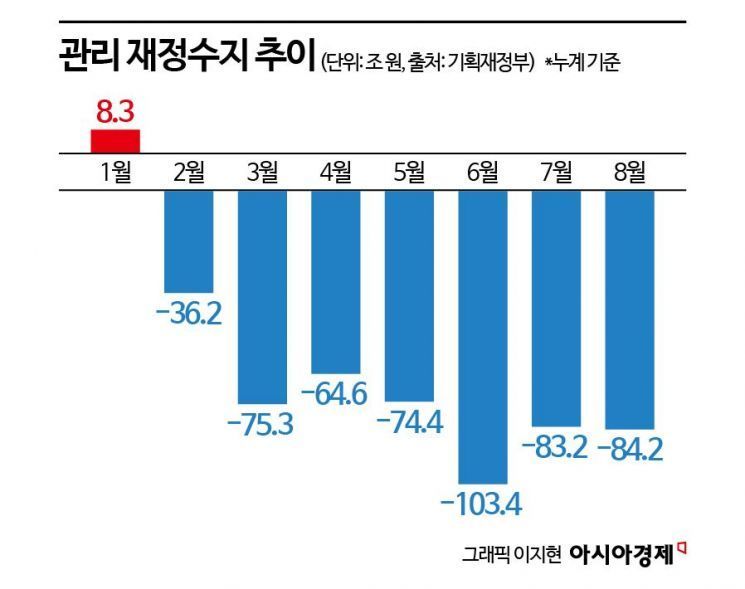
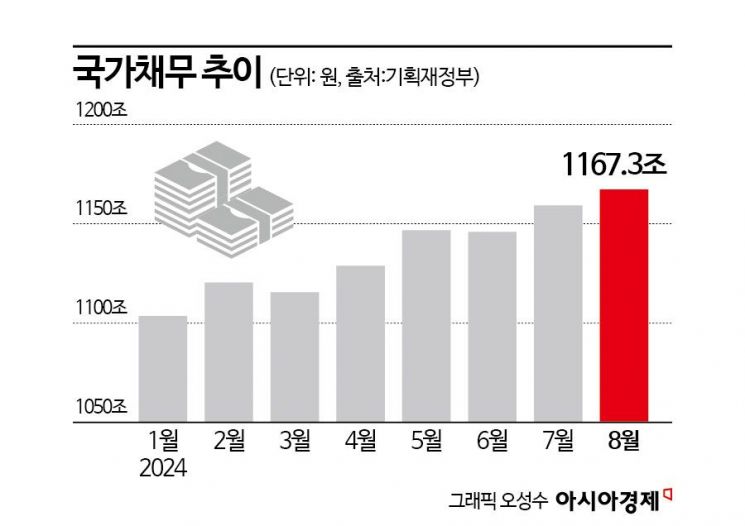
As of August this year, the managed fiscal balance deficit, which shows the state of the national finances, reached 84.2 trillion won, marking the third highest level on record as of the end of August. National debt also reached a record high of 1,167.3 trillion won.
According to the 'Monthly Fiscal Trends (August issue)' released by the Ministry of Economy and Finance on the 10th, the cumulative total revenue as of the end of August was 396.7 trillion won, an increase of 2.3 trillion won compared to the previous year. Tax revenue was 232.2 trillion won, down 9.4 trillion won from a year earlier.
Although value-added tax revenue increased by 7.1 trillion won compared to the previous year, corporate tax revenue decreased by 16.8 trillion won due to poor corporate performance. Non-tax revenue was 20.6 trillion won, up 1.3 trillion won, influenced by an increase of 500 billion won in land sale proceeds related to military facilities compared to the previous year. Fund revenue recorded 143.8 trillion won, an increase of 10.4 trillion won from the previous year.
Total expenditure was 447 trillion won, up 21.3 trillion won from the previous year. This increase was influenced by higher spending in welfare areas such as health insurance subscriber support (3.6 trillion won) and retirement benefits (1.3 trillion won) compared to the previous year.
The managed fiscal balance, which shows the government's actual fiscal condition by deducting the balances of the four major social security funds including the National Pension from the integrated fiscal balance, showed a deficit of 84.2 trillion won. The size of the managed fiscal balance deficit was the third largest on record as of the end of August. It followed 2020 (96 trillion won) and 2022 (85.3 trillion won), during the height of the COVID-19 pandemic, since the publication of Monthly Fiscal Trends began in 2014.

As of the end of August, national debt reached a record high of 1,167.3 trillion won, increasing by 8 trillion won from the previous month. This is close to the central government debt target of 1,163 trillion won set in this year’s main budget. The national debt reported in the Monthly Fiscal Trends refers only to central government debt, while local government debt is calculated and announced once a year.
Kim Wansu, head of fiscal soundness at the Ministry of Economy and Finance, explained, “It is common to issue a large amount of government bonds initially to cover expenditures or raise funds,” adding, “When government bond repayments are made at the end of the year, the debt returns to the target level set in the main budget.” He further explained, “According to the government bond repayment schedule, about 17 to 18 trillion won in maturities will be repaid in December, so by the end of the year, it is expected to be managed within the originally planned range.”
© The Asia Business Daily(www.asiae.co.kr). All rights reserved.



















