Professor Baek Min-kyung of Seoul National University, Former Member of Nobel Laureate Professor Baker's Research Team, Suggests
"Bold Support for Creative and Meaningful Research"
"Accept Failures"
"Need GPUs for AI-Based Research"
Artificial intelligence (AI) researchers have consecutively won Nobel Prizes in 2024. As the paradigm of the Nobel Prize changes, there is growing optimism that Korea, once considered a 'Nobel Prize barren land,' can also win the prize with active support.
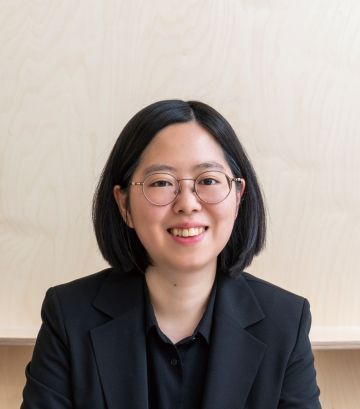 Professor Min-Kyung Baek of Seoul National University, the first author of the paper "RosettaFold," by Professor Baker, who won the 2024 Nobel Prize in Chemistry.
This year’s Nobel Prize in Physics was awarded to Geoffrey Hinton, a professor at the University of Toronto known as the 'Godfather of AI,' while the Nobel Prize in Chemistry went to David Baker, a professor at the University of Washington, and Demis Hassabis, CEO of Google DeepMind?all of whom are connected to AI.
The Nobel Prize has traditionally favored scholars who have conducted decades of research. However, this formula has been broken in the AI era. For example, the paper on 'AlphaFold,' which brought the award to Hassabis, was published in 2020?only four years ago. Professor Baker at the University of Washington released 'RosettaFold (RF)' for protein structure decoding in 2021, and in 2022 unveiled the AI 'RosettaFold Diffusion,' capable of generating proteins as desired. The Nobel Committee has supported research that took only three to four years.
Min-Kyung Baek, a professor at Seoul National University and first author of the 'RosettaFold' paper, who worked in Professor Baker’s lab, offers a hint for producing Korean Nobel laureates. Professor Baek said, "Although Professor Baker’s team started research in 2003, the pace accelerated dramatically after introducing AI," emphasizing the importance of securing computing resources for AI research. "Professor Baker made every effort to secure research support, and fortunately, GPU resources were provided by Microsoft (MS) near the university, which greatly accelerated the research speed," she said. It is not easy to secure large-scale GPUs essential for AI research within academic institutions. This example highlights the need for government or private sector support for innovative and creative research worthy of a Nobel Prize.
Professor Baek also commented on Korea’s research environment. "The Nobel Prize values originality. Support must be provided for new research to be possible, but when proposing completely new research in Korea, the response is often, 'If it’s not done in the U.S., will this work?'" she expressed regret.
Professor Baek welcomed the recent policy by the Ministry of Science and ICT to support challenging research and tolerate failure. She advised, "If truly meaningful research is judged to be significant, it should be boldly supported." This is a simple and clear solution for Korea to win a Nobel Prize in the AI era.
© The Asia Business Daily(www.asiae.co.kr). All rights reserved.

















