"Gender and Migration: The Right to Be Welcomed and the Courage to Welcome" Theme
Refugee Issues and Korean Women Migration Experts Lecture... Seeking Solidarity and Coexistence
The Pusan National University (President Choi Jaewon) Women's Studies Institute will host the "2024 Pusan National University Women's Studies Institute Citizen Lecture Series" in the second half of the year, following the first half, under the theme "Gender and Migration: The Right to Be Welcomed in a Strange Place, The Courage to Welcome Others." The lectures will be held from November 6 to 27.
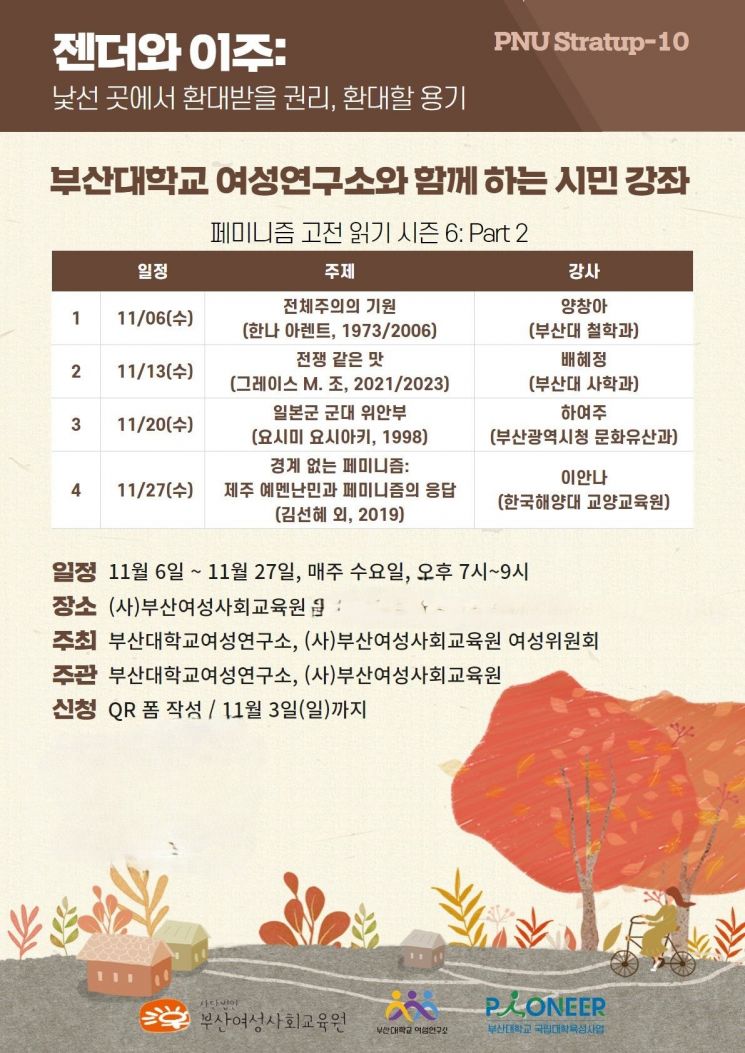
This series consists of consecutive lectures by experts in gender and diversity studies. It will take place every Wednesday evening from 7 to 9 PM in November at the Busan Women's Social Education Center. Anyone interested can participate for free, and online pre-registration is open until November 3.
This lecture series is organized with support from the PNU Startup-10 project for research facility support and is jointly held for the second time this year, following May, in collaboration with the "Reading Feminist Classics" program of the Busan Women's Social Education Center.
This citizen lecture series focuses on refugee issues and the migration of Korean women. According to the United Nations High Commissioner for Refugees (UNHCR), the current number of refugees worldwide has reached 68.5 million. While the refugee issue has long been a subject of social controversy in Europe and the United States, it became a major topic in Korea in June 2018 when Yemeni refugees arrived in Jeju.
In 1992, Korea joined the "Convention Relating to the Status of Refugees," and in 2012, it became the first country in Asia to enact an independent refugee law. Nevertheless, until now, the refugee issue has remained a foreign matter for most Koreans. This lecture series will discuss what stance Korea should take on refugee issues in this era of migration.
The citizen lecture series consists of four lectures by experts in philosophy and history who practice feminism in various fields. Covering topics such as refugees, war and diaspora, comfort women, and feminism, the lectures will address a range of social and political issues and discuss the necessity of solidarity and coexistence in practice.
The first lecture on November 6 will be given by Yang Changa, professor of philosophy at Pusan National University, who will explore the figure of the refugee and its political significance, focusing on Chapter 9 of Hannah Arendt's "The Origins of Totalitarianism." Arendt argues that the large-scale refugee crises during the First and Second World Wars signaled the collapse of the modern Western nation-state system. She explains that nation-states are structurally incapable of solving refugee issues and that the very concept of human rights is fraught with challenges. Refugees reveal the limitations of the existing state system and emerge as a key figure in modern politics, demanding new forms of statehood.
The second lecture on November 13 will be given by Bae Hyejeong, professor of history at Pusan National University, who will examine the diaspora of war brides through Grace M. Cho's "Taste of War." This book is a memoir in which the daughter reflects on the life of her mother, Gukja, who worked in a camptown and married an American sailor, eventually moving to the United States. The book also investigates the social causes of the mother's schizophrenia, deeply exploring issues of diaspora identity through the story of a woman who survived family loss, war, hunger, and racial discrimination, and the confusion of her daughter as an Amerasian (mixed-race child of an American and an Asian).
The third lecture on November 20 will be given by Ha Yeoju from the Cultural Heritage Division of Busan City Hall, focusing on Yoshimi Yoshiaki's "Comfort Women of the Japanese Military," which addresses the issue of "military comfort women" who were sexually exploited by the military during war. This book, written by a conscientious Japanese scholar, meticulously analyzes the background, process, and operation of the military comfort women system by uncovering hidden official documents. It has become a foundational work in the study of the Japanese military "comfort women" issue, particularly delving into how Japan systematically organized comfort women during World War II and exposing the true nature of imperialist Japan.
The fourth lecture on November 27 will be given by Lee Anna from the General Education Center of Korea Maritime and Ocean University. She will read Chandra Mohanty's "Feminism Without Borders," a postcolonial feminist theorist, alongside Guk Jihae's "Refugees and Misogyny," which contains the arguments of radical feminists on the subject. The lecture will examine how feminism can respond to and be practiced in contemporary social agendas, including refugees. In particular, it will address the controversy in Korean society surrounding the arrival of Yemeni refugees in Jeju in 2018, and the differing voices within feminist circles at the intersection of refugee (hostility) and women's (human rights) issues.
© The Asia Business Daily(www.asiae.co.kr). All rights reserved.
![Clutching a Stolen Dior Bag, Saying "I Hate Being Poor but Real"... The Grotesque Con of a "Human Knockoff" [Slate]](https://cwcontent.asiae.co.kr/asiaresize/183/2026021902243444107_1771435474.jpg)
















