Guardian Consent and Reporting Principles upon Admission
Only 5% of Runaway Youth Entered Shelters Last Year
Investigation Agency "Measures Needed to Exclude Reporting Obligations"
There have been calls for the law regarding ‘guardian consent’ required for runaway youth to enter shelters to be revised to better reflect reality.
On the 10th, Heo Min-sook, a researcher at the National Assembly Legislative Research Office, stated in the recently published report titled 'Reasons Why Youth Outside the Home Cannot Enter Shelters' that "the 'guardian consent principle' for youth shelter admission is actually pushing youths who cannot return home onto the streets," adding, "Youth who gave up on entering shelters due to the policy of contacting guardians were wandering the streets or disappeared without ever inquiring about re-admission again."

According to estimates based on data compiled by the National Police Agency and the Ministry of Gender Equality and Family, approximately 130,000 youths reported missing or having runaway experiences last year. According to the '2024 Youth Statistics' released last year by Statistics Korea and the Ministry of Gender Equality and Family, the number of students with runaway experiences was 105,665. The 'Missing and Runaway Persons Report Status' received by the National Police Agency shows that 23,425 children and youths aged 9 to 17 were reported missing last year. Currently, there is no survey that accurately captures the scale of youth outside the home.
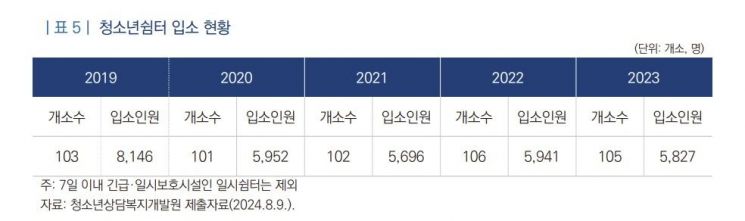
However, it is estimated that less than 10% of youth outside the home enter youth shelters. According to data submitted by the Korea Youth Counseling and Welfare Institute, 5,827 youths entered youth shelters last year, accounting for only 5.5% of youths with runaway experiences. Youth shelters are facilities established and operated for at-risk youths who have run away from home and have no suitable place to stay even temporarily; as of last year, 138 such shelters were in operation.
A significant portion of youth outside the home were found to be staying at acquaintances’ homes. According to the 2022 'Living Conditions Survey of Users of Crisis Youth Support Institutions' by the Ministry of Gender Equality and Family, 55.5% of surveyed youth outside the home reported staying at friends’ or senior/junior acquaintances’ homes. Additionally, 35.4% reported 'homelessness in buildings or on the streets,' and 4.1% had stayed at the homes of so-called 'helpers' they met online.
The report emphasized the need to revise the reporting principle under the Missing Child Act and the guardian consent principle under the Ministry of Gender Equality and Family’s operational guidelines. According to the current 'Act on the Protection and Support of Missing Children, etc.,' when youth outside the home enter protective facilities, the head or staff of the facility must promptly report the youth as missing to the police. Furthermore, according to the Ministry’s operational guidelines, contacting guardians upon youth shelter admission is the standard procedure.
In response, the Ministry of Gender Equality and Family recently explained in a briefing that "the purpose is not to seek guardian consent but to inform that the youth is being safely protected."
Researcher Heo suggested, "A proviso could be added to the 'Missing Child Act' to exclude youth shelters, where youth voluntarily seek refuge to protect themselves from abusive parents, from mandatory reporting institutions," adding, "It is also necessary to allow protective facilities to shelter runaway children and youth who are victims of domestic abuse for a certain period without guardian consent." She also proposed notifying parents or guardians of admission for youths under 16 years old without disclosing the exact location.
According to data compiled by the National Police Agency and the Ministry of Gender Equality and Family, approximately 130,000 youths reported missing or having runaway experiences last year. However, only 5,827 youths entered youth shelters last year, accounting for just 5.5% of youths with runaway experiences.
Under the current Missing Child Act, when youth outside the home enter protective facilities, the head or staff of the facility must immediately report the youth as missing to the police. Additionally, according to the Ministry of Gender Equality and Family’s operational guidelines, contacting guardians upon youth shelter admission is the standard procedure.
Researcher Heo urged, "A proviso should be added to the 'Missing Child Act' to exclude youth shelters, where youth voluntarily seek refuge to protect themselves from abusive parents, from mandatory reporting institutions."
© The Asia Business Daily(www.asiae.co.kr). All rights reserved.


















