Seminar on Resolving International Conflicts
"Responding to the US and Europe-Centered Ecosystem"
As South Korea, one of the world's top five patent powers, faces marginalization as a venue for patent disputes, calls are emerging for it to take the lead in establishing an Asian Union Intellectual Property Court. In response, experts from the judiciary, academia, and industry gathered in one place to explore concrete directions for setting up such a court. They unanimously agreed on the need for an Asia-centered patent dispute resolution body capable of competing with the U.S. and Europe, especially as patent lawsuits tend to concentrate in jurisdictions favorable to patent holders and with large market sizes.
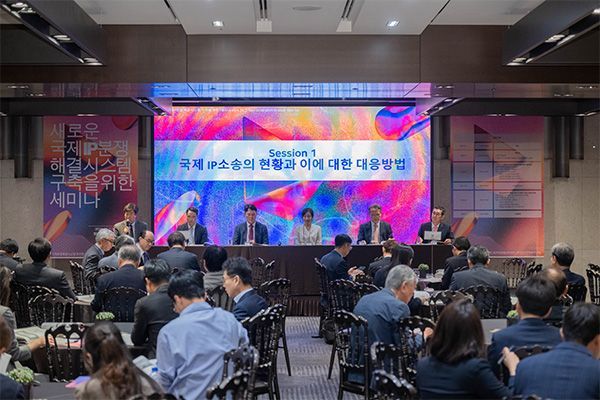
The International Dispute Resolution System Research Association (Chairman: Supreme Court Justice Noh Tae-ak) held a seminar titled “Building a New International Intellectual Property (IP) Dispute Resolution System” on the 7th at the Ruby Hall of EL Tower in Yangjae-dong, Seoul, together with the National Intellectual Property Committee (Chairman: Lee Kwang-hyung) and the Federation of Intellectual Property Organizations (Chairmen: Jung Gap-yoon and Won Hye-young).
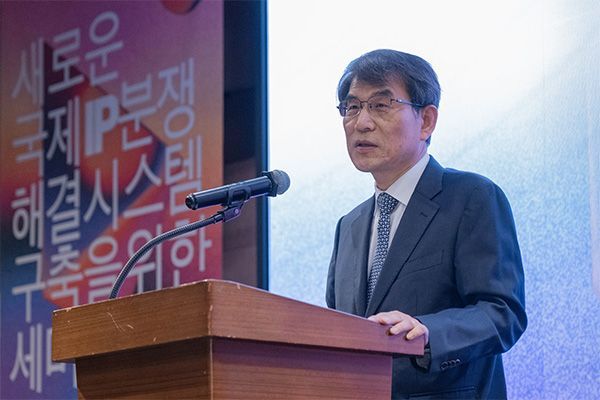 Justice No Tae-ak is delivering a greeting at the seminar held on the 7th for the establishment of a new international intellectual property (IP) dispute resolution system. [Image source=Legal Times]
In his opening remarks, Supreme Court Justice Noh Tae-ak (62, Judicial Research and Training Institute Class 16) said, “Today’s IP dispute resolution ecosystem is rapidly being reorganized around two pillars, the U.S. and Europe, following the establishment of the Unified Patent Court (UPC) in Europe in 2023. Many international IP lawsuits are choosing the U.S. and Europe as venues for dispute resolution.” He added, “It is urgent to establish specialized courts and alternative dispute resolution bodies, as well as to prepare trial procedures at an international level, so that Korea, a patent powerhouse, can play a leading role in international patent litigation.”
Lee Hye-jin (49, Class 33), a senior judge at the Patent Court, who gave a presentation on “The Current Status of International IP Litigation and Countermeasures,” emphasized, “In the short term, Korean courts should realize an international IP tribunal and leap forward as a specialized court for international IP litigation. In the long term, an Asian Union Intellectual Property Court must be established.”
She pointed out that as forum shopping (seeking favorable jurisdiction) and forum selling (courts competing to attract cases) among countries are expected to intensify and competition among nations to attract international litigation grows, Korea should take the lead in creating a joint Asian intellectual property court dedicated to such matters.
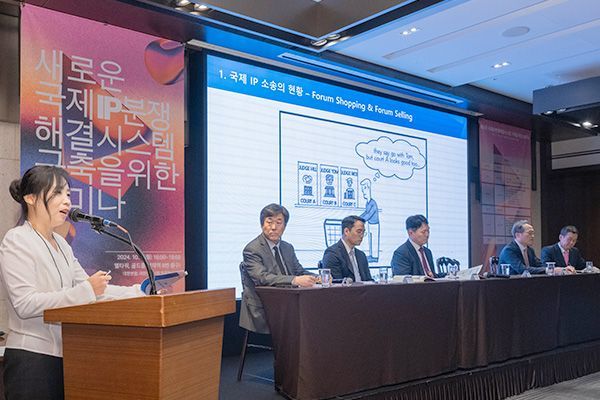
Judge Lee explained, “Under the Patent Cooperation Treaty (PCT), patents are currently filed simultaneously in countries worldwide, and infringements also occur simultaneously in multiple countries. As a result, international jurisdictional conflicts arise globally.” She added, “When jurisdictional conflicts occur, lawsuits may be filed in specific countries or courts chosen by the plaintiff, with the U.S. and Europe being selected as venues for dispute resolution.”
She also pointed out, “There is a phenomenon where Non-Practicing Entities (NPEs) concentrate lawsuits against companies like Samsung Electronics in specific U.S. federal district courts. Moreover, international intellectual property infringement lawsuits where Korean companies are patent holders are frequently held in overseas courts.”
She further noted, “Constraints on Korean courts include not only the small domestic market size but also differences in litigation systems compared to the U.S. and Europe, limited disclosure of judgments and trial broadcasts, litigation delays, absence of discovery procedures, and insufficient provision of English information.” She added, “If Korea cooperates with China, Japan, and others to establish an Asian Union Intellectual Property Court capable of responding to the U.S. and the UPC, unified resolution of international disputes will be possible.”
In a panel discussion attended by Lee Jung-hwan (53, Class 27), Vice President of Samsung Electronics; Ye Beom-su, Executive Director of KT and Chairman of KINPA; Han Sang-wook (62, Class 17), attorney at Kim & Chang Law Firm; and Kang Han-gil, U.S. attorney at Law Firm Kwangjang, suggestions were made for the active use of punitive damages, concentrated hearing schedules, and prompt judgments.
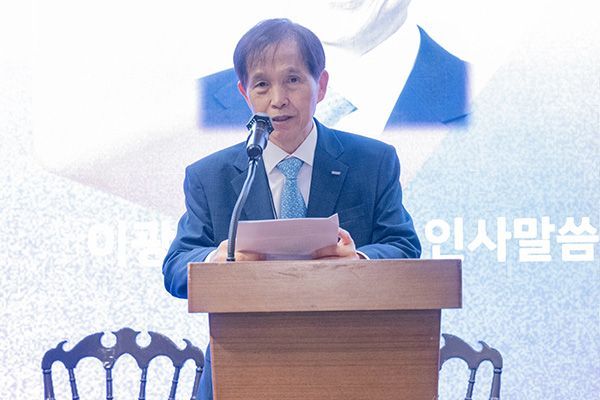
The second session was held under the theme “Reviewing the Possibility of Introducing New Evidence Collection Systems in IP Litigation.” Opinions were expressed that for Korean courts to become a hub for international patent trials, effective evidence collection methods that are predictable and satisfactory to international dispute parties are necessary. In particular, improvements in evidence collection systems are needed in patent infringement lawsuits where the patent infringement victim must prove the infringement details and damages.
Lee Hyung-won, a director at the Korean Intellectual Property Office, who gave the keynote presentation, introduced a proposed amendment to the Patent Act prepared by the Patent Office to improve the evidence collection system. He argued for the introduction of △ fact-finding investigations by experts △ preservation orders for materials △ and out-of-court witness examination systems.
In the discussion, panelists including Kim Ki-soo (46, Class 35), senior judge at the Patent Court; Lee Jin-su, head of Hurom; Jung Sang-tae (51, Class 41), attorney at Yulchon Law Firm; and Chae Dong-yoon, U.S. attorney at Kim & Chang, participated to discuss considerations for introducing effective evidence collection systems.
Hong Yoon-ji, Reporter for Legal Times
※This article is based on content supplied by Law Times.
© The Asia Business Daily(www.asiae.co.kr). All rights reserved.
![Clutching a Stolen Dior Bag, Saying "I Hate Being Poor but Real"... The Grotesque Con of a "Human Knockoff" [Slate]](https://cwcontent.asiae.co.kr/asiaresize/183/2026021902243444107_1771435474.jpg)


















