Nobel Prize Embraces AI Field, Chemistry Award Likely to Go to AI Expert
Announcement on the Evening of the 9th
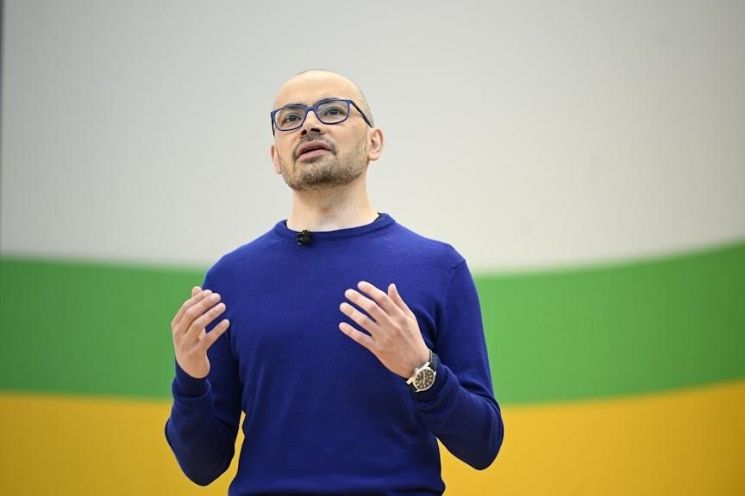 Demis Hassabis, CEO of Google DeepMind, mentioned as a Nobel Chemistry Prize candidate [Image source=Yonhap News]
Defying expectations, Professor Geoffrey Hinton, known as the 'godfather of artificial intelligence (AI),' was awarded the Nobel Prize in Physics, drawing the scientific community's attention to the Nobel Prize in Chemistry announced the following day. This is because there is a possibility that AI researchers may consecutively win the Nobel Prize in Chemistry as well.
The Nobel Prize in Physics announced on the 8th (local time) was awarded to Professor Geoffrey Hinton and Professor John Hopfield for their research on artificial neural networks, which laid the foundation for machine learning and ushered in the current AI era.
In particular, Professor Hinton's award recognizes his contribution to overcoming the dark period known as the 'AI winter' from the 1970s to 2000 through deep learning, and to the advancement of generative AI represented by ChatGPT. This unexpected award in the field of physics once again demonstrated the importance and influence of AI technology on scientific research.
Until now, the Nobel Prize had a conservative image. It was awarded to individuals who contributed to basic scientific research over decades. This was why many experts were skeptical despite raising the possibility of AI winning the prize.
The tide has now turned. Since the Nobel Committee for Physics acknowledged the impact of AI on research, it is highly likely that a similar trend will continue in the Chemistry Prize. The Nobel Prize in Chemistry, announced on the 9th, also has strong candidates related to AI.
Clarivate, well known for predicting Nobel laureates, mentioned Demis Hassabis, CEO of Google DeepMind, and researcher John Jumper as candidates for this year's Nobel Prize in Chemistry. They attracted attention in the scientific community for their contributions to predicting and designing three-dimensional protein structures and functions.
Baek Sang-yeop, former CEO of LG CNS and an AI expert, said, "It seems that each field of the Nobel Prize competed to award AI first. The physics field may have acted preemptively." He added, "If it were not physics or chemistry, AI figures could have won the Nobel Prize in Physiology or Medicine."
Baek also expressed the opinion that "Professor Hopfield is a physicist who also researched AI, but there is a significant gap in status compared to Professor Hinton. It might be that Hopfield was included to justify awarding Hinton."
The Nobel Prizes in Physics and Chemistry are decided after review by the respective Nobel committees in each field and ratified by the Royal Swedish Academy of Sciences, with the laureates kept secret until the announcement.
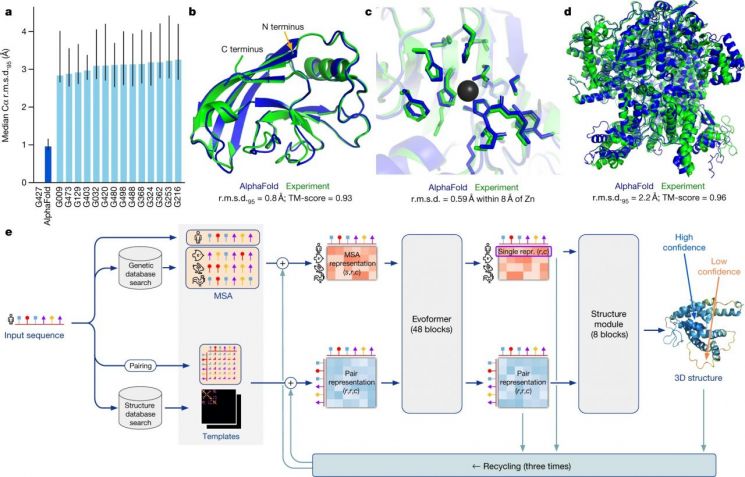
Meanwhile, 'AlphaFold,' developed by CEO Demis Hassabis and researcher John Jumper, has brought revolutionary changes to the scientific community. The AlphaFold-related paper published in 2021 has already been cited over 16,000 times, and the recently released 'AlphaFold 3' amazed scientists with its even more advanced capabilities.
Dr. James Rothman, Nobel Laureate in Physiology or Medicine in 2013, evaluated, "AI technology has opened a new era of discovery in basic science laboratories and industrial fields. The ability to predict protein structures with astonishing accuracy has led to unprecedented progress in understanding biological mechanisms and accelerating drug development."
The influence of AlphaFold has already been proven in actual research. Professor James R. Heath of Stanford University, Nobel Laureate in Chemistry in 2013, recently succeeded in identifying a compound that can effectively kill liver cancer cells within 30 days using AlphaFold.
© The Asia Business Daily(www.asiae.co.kr). All rights reserved.


















