Minister Cho Kyu-hong "No Prior Discussion but No Opposition"
Opposition Lawmakers "Threat to Public Safety Due to Low-Quality Medical Care"
Deputy Prime Minister Lee Ju-ho "Emergency Measures Only" Steps Back
During the National Assembly's Health and Welfare Committee and Education Committee audits, a blame game continued over the collective resignation of medical residents and the resulting medical service gap triggered by the government's policy to increase medical school admissions. There was also fierce opposition and concerns about the decline in the quality of medical education regarding the conditional leave approval for medical students announced just before the audit and the plan to shorten the medical education curriculum from the current 6 years to 5 years.
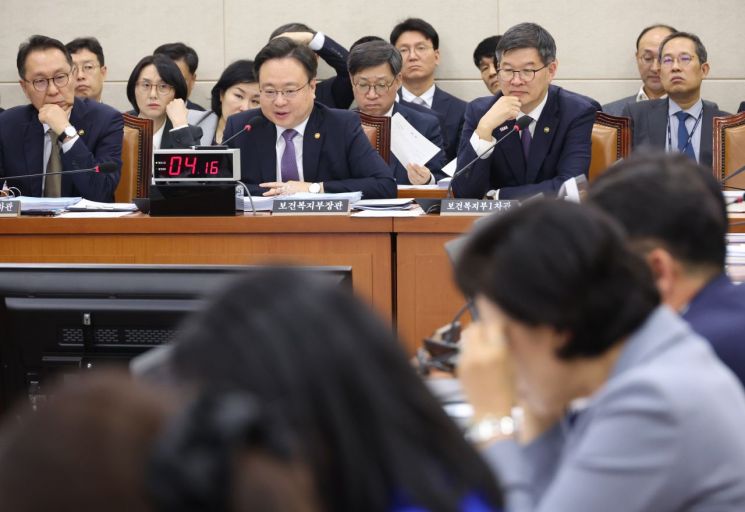 Minister of Health and Welfare Cho Kyuhong is responding to a lawmaker's question at the Health and Welfare Committee's audit held at the National Assembly on the 7th. [Image source=Yonhap News]
At the Health and Welfare Committee audit on the 7th, the opposition party criticized the Ministry of Education's plan to shorten the medical education curriculum, announced on the 6th as part of the 'Emergency Measures for Normalizing Medical School Academics,' and launched a focused attack saying, "President Yoon Suk-yeol should personally apologize for the medical service gap." Health and Welfare Minister Cho Kyu-hong defended the Ministry of Education's decision, saying, "If shortening the time is possible while ensuring the quality of medical education, I do not oppose it," and drew a line on the demand for an apology from President Yoon, stating, "That is a matter for the president to decide."
Baek Hye-ryun, a member of the Democratic Party of Korea, pointed out, "The general opinion among medical school professors is that even the current 6-year curriculum is insufficient, so reducing it to 5 years is impossible," adding, "The government has recklessly pushed for increasing medical school admissions, but now things are going off track. They said they would reform healthcare, but now they have reached a stage where they threaten public safety with really low-quality medical care." Kim Seon-min of the Innovation Party also said, "The government increased medical school quotas and is now even considering shortening medical education to 5 years. It seems like they are just throwing out any words without thought."
Seo Young-seok of the Democratic Party said, "Among the public, there is a growing number of people saying not to shorten medical education to 5 years, but rather to shorten President Yoon Suk-yeol's term," and So Byung-hoon of the same party claimed, "Since veterinary schools have a 6-year curriculum, medical students are lamenting, asking if their lives are worth less than those of dogs and pigs because medical education is being shortened to 5 years."
On the 8th, Im Jin-soo, Planning Director of the Korean Medical Association and a former resident who resigned, strongly criticized, "It is deplorable that the government's countermeasure after coming here is a '5-year medical school system,'" calling it "a breach of duty by the Minister of Education." He said, "Dental, pharmacy, and veterinary schools also have 6-year programs, so the idea of training doctors in just 5 years is unbelievable," adding, "It is a great insult to the professionalism of doctors."
In response to such backlash, Minister Cho said, "The Ministry of Education is not mandating a uniform transition from 6 years to 5 years or making it compulsory for students entering in a specific year to follow a 5-year program," and added, "We will allow shortening the education period within the scope that does not compromise the quality of education depending on the school's circumstances." However, when asked whether the Ministry of Education had consulted on the plan to shorten medical education, he admitted, "There was no prior discussion," effectively acknowledging that it was a unilateral policy decision by the Ministry of Education.
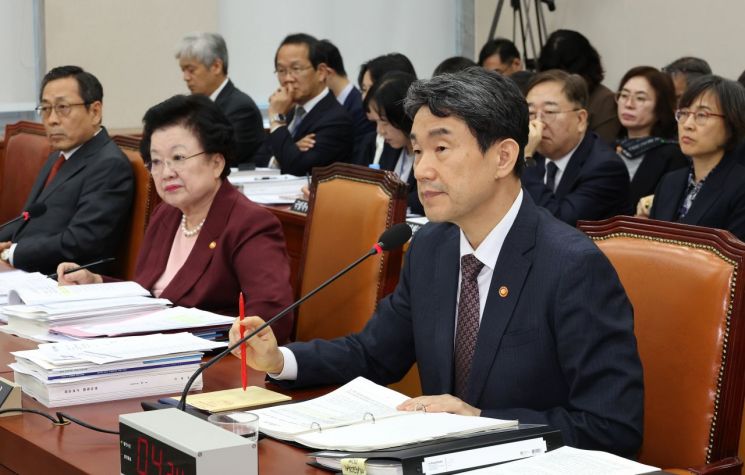 Lee Ju-ho, Deputy Prime Minister for Social Affairs and Minister of Education, is attentively listening to lawmakers' questions during the Education Committee's audit at the National Assembly on the 8th. [Image source=Yonhap News]
Reversed Two Days After Announcement... "If Universities Can't Do It, Then They Won't"
Ultimately, Lee Ju-ho, Deputy Prime Minister and Minister of Education, made a statement at the Education Committee audit saying, "We will not forcibly or uniformly push the plan to shorten the medical education curriculum," effectively abandoning the related policy just two days after its announcement.
Deputy Prime Minister Lee explained, "Universities that can shorten the curriculum from 6 years to 5 years will be supported." In response to a question from Democratic Party lawmaker Go Min-jung about whether any prior research had been conducted to see if shortening the medical education curriculum to 5 years would be feasible, he said, "It was one of the measures to overcome the emergency situation in medical workforce supply."
He also pledged, "If universities autonomously adopt the 5-year system, the government will provide strong support in terms of quality management." When asked, "What if no medical school wants the 5-year system?" he replied, "We will support schools that can do it, so if none exist, then it won't be done."
Regarding whether the plan to shorten the medical curriculum was discussed in advance with universities, professors, and medical students, he said, "We regularly hold meetings with the Korean Association of Medical Colleges (KAMC) and have created policies based on various opinions." However, immediately after his remarks, KAMC directly refuted this claim.
KAMC emphasized, "While there was communication with the Ministry of Education to convey the necessity of approving leave of absence submitted by students according to school regulations, the '5-year medical school education plan' was never a topic of discussion," adding, "Association representatives attending the meeting clearly stated that a 5-year system is impossible." In response, Deputy Prime Minister Lee explained again, "Various ideas came from KAMC, the Ministry of Education, and medical school professors, and we compiled them. I meant that such ideas emerged during multiple discussions."
Meanwhile, regarding the government's legislative notice on the 'Regulations on Evaluation and Accreditation of Higher Education Institutions,' which aims to reduce the authority of the Korea Institute of Medical Education and Evaluation (KIMEE), Director Ahn Deok-seon expressed concerns, saying, "It could cause difficulties in proper medical education evaluation."
When Park Joo-min, Chair of the Health and Welfare Committee, asked, "Is there anything you feel is becoming concrete regarding concerns that there might be an intention to cancel KIMEE's re-designation?" Director Ahn replied, "The newly established provisions regarding cancellation of accreditation bodies, mandatory granting of a supplementary period instead of non-accreditation during disaster situations, and mandatory prior review of evaluation standards and procedures autonomously implemented by KIMEE are all provisions that could cause difficulties in confirming medical education conditions through proper evaluation and accreditation."
© The Asia Business Daily(www.asiae.co.kr). All rights reserved.


















