SNS Use Increases Depression Risk
Solving Addiction with Lock Apps and Challenges
#Office worker Choi (32) downloaded an app-lock application to reduce his social networking service (SNS) usage time. He felt left behind whenever acquaintances posted luxury brand photos on Instagram. After seeing a post about a former colleague who had succeeded in a personal business, he even felt the urge to quit his job. Only after blocking Instagram access with a screen-blocking app was Choi able to focus on meditation and reading.
The MZ generation (Millennials + Generation Z) is taking on SNS quitting challenges to escape so-called 'caffeine depression' stemming from relative deprivation. Caffeine depression is a newly coined term derived from the first letters of KakaoStory, Facebook, and Instagram, referring to the feeling of depression caused by comparing oneself to others through SNS.
In fact, SNS usage time is closely linked to the incidence of depression. According to a 2022 study conducted by researchers from the University of Arkansas, Oregon State University, and the University of Alabama involving over 1,000 adults aged 18 to 30, 27% of participants who used SNS for more than 300 minutes a day were found to have depression. Particularly, users sensitive to negative emotions who used SNS for over 300 minutes daily were twice as likely to develop depression compared to those who were not.
Since the MZ generation uses SNS more frequently than other age groups, they are constantly exposed to caffeine depression. According to statistics from the Korea Information Society Development Institute, as of last year, 58% of Generation Z and 44% of Millennials checked other people's SNS posts at least once a day. In contrast, only 31% of Generation X and 27% of Baby Boomers reported viewing others' posts at least once daily.
Some MZ generation members recognize the seriousness of addiction and are actively working to reduce their SNS usage time. The popular 'lock apps' in online app stores are a representative example. These apps allow users to block access to SNS for a specific period. University student Kim Seoyoung (27) said, "Every time I accessed SNS and saw posts by influencers, I felt depressed all day comparing myself as a job seeker. Now, I lock the X (formerly Twitter) and Instagram apps from 8 a.m. to 6 p.m. and focus on studying for the TOEIC."
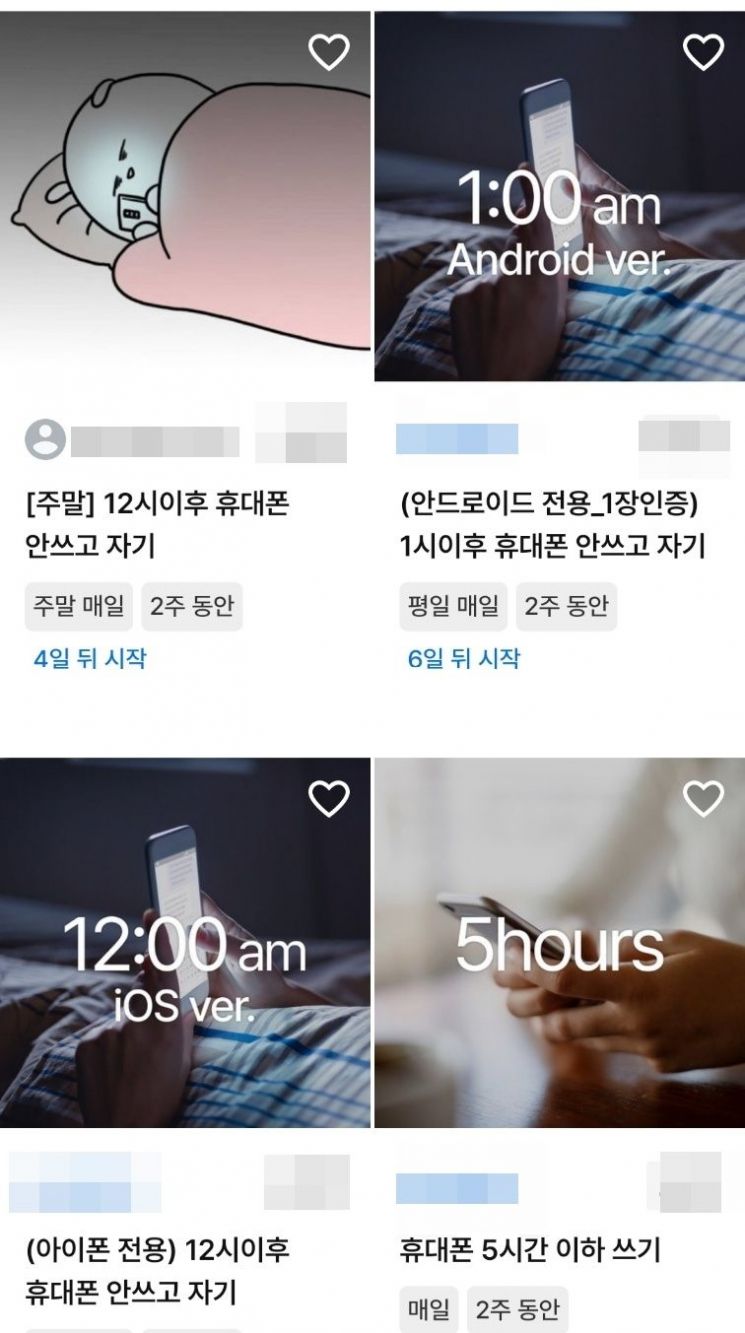 On the 8th, a smartphone usage reduction challenge was uploaded to a dedicated challenge application.
 [Photo by Lee Ji-eun]
Additionally, group challenges involving deposits have recently gained popularity. University student Kim (25) paid a deposit of 10,000 won two weeks ago on a challenge app and took on the task of 'using the phone less than 5 hours a day.' For two weeks, he must verify that his smartphone usage is under 15 minutes during specific time slots daily to reclaim the full deposit. Kim said, "I try to reduce my smartphone usage even more to get my deposit back," adding, "I decided to do this because my life seemed greatly shaken by SNS."
Experts say caffeine depression arises from SNS addiction, which intensifies cravings for stimulation, and recommend gradually reducing access time over intervals. Professor Lim Myungho of Dankook University's Department of Psychology stated, "Addiction to a specific behavior creates cravings for stimulation. When these cravings are not satisfied, depression manifests. Since SNS addiction is a type of behavioral addiction, it is better to gradually reduce usage time and adapt rather than abruptly stopping."
© The Asia Business Daily(www.asiae.co.kr). All rights reserved.


















