Unlikely to Reach '100-Year Life Expectancy' This Century
"Impossible Unless Aging Itself Is Slowed"
Only 15% of Women and 5% of Men Reach 100 Years
12.8% and 4.4% for 2019 Birth Cohort... Only 3% in Korea
No matter how advanced medicine becomes, there may be limits to the maximum human lifespan. According to a recent study published in the international journal 'Nature,' the rate of increase in average life expectancy among citizens of developed countries has slowed in the 21st century. While life expectancy itself continues to improve steadily, the number of people expected to reach the symbolic age of '100 years' is not likely to be very high.
Professor Stuart Olshansky and his team at the University of Illinois Chicago School of Public Health recently analyzed trends in average life expectancy in high-income countries worldwide and published their findings in 'Nature Aging.'
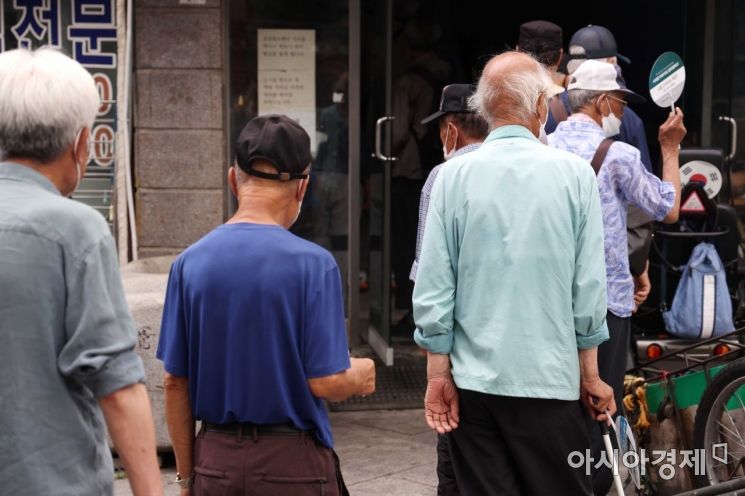 Elderly people are waiting to receive free meals at Tapgol Park in Jongno. [Asia Economy archive photo]
Life expectancy refers to the average number of years a person born in a specific year is expected to live. Until the mid-19th century, human life expectancy ranged from 20 to 50 years, less than half of today's levels. However, thanks to advances in public health and medicine since the 20th century, life expectancy has increased by nearly 30 years. Today, most citizens of developed countries enjoy a life expectancy of around 80 years.
However, there may be limits to the 'longevity miracle' humanity achieved in the 20th century. Data on life expectancy from 1990 to 2019 show that improvements in life expectancy have slowed since 1990. Although medicine continues to advance and infant mortality rates have decreased, resistance to further increases in lifespan is gradually growing.
In particular, since 2010, the rate of increase in life expectancy in the United States has slowed more than in nine other developed countries used as comparison groups, and South Korea also saw a decrease in the rate of life expectancy increase from 2010 to 2019 compared to 2000 to 2009.
According to the 'Life Table' data released by Statistics Korea last year, the average life expectancy of Koreans increased nearly 20 years over 40 years, from 62.3 years in 1970 to 80.2 years in 2010. However, life expectancy in 2022 was 82.7 years, confirming a clear reduction in the rate of increase over the past decade.
While life expectancy itself continues to improve steadily, the population expected to reach the symbolic age of '100 years' is very small. Among those born in developed countries in the 21st century, the predicted proportion of people whose life expectancy will exceed 100 years was only 15% for women and less than 5% for men. Based on those born in 2019, Hong Kong had the highest levels, with 12.8% for women and 4.4% for men. South Korea was only in the 3% range on average.
Regarding this, the research team predicted, "Unless the biological aging process itself is significantly slowed, dramatic lifespan extension in the 21st century will be impossible." This means that simply treating illnesses and improving hygiene and environmental conditions have clear limits in extending lifespan.
© The Asia Business Daily(www.asiae.co.kr). All rights reserved.
![Clutching a Stolen Dior Bag, Saying "I Hate Being Poor but Real"... The Grotesque Con of a "Human Knockoff" [Slate]](https://cwcontent.asiae.co.kr/asiaresize/183/2026021902243444107_1771435474.jpg)
















