Rep. Kim Yoon's Office: "Delayed Treatment Due to Decrease in Medical Staff"
The number of intensive care unit (ICU) inpatients who died in February, when the collective resignation of residents began, and in March immediately after, was found to be 375 more than a year ago.
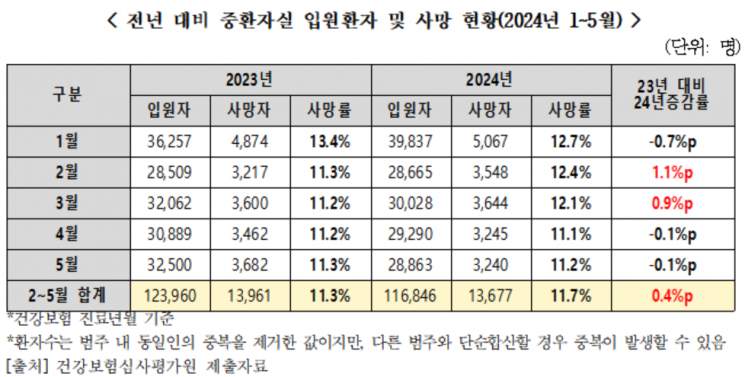
On the 8th, based on data received from the Health Insurance Review and Assessment Service, Kim Yoon, a member of the National Assembly's Health and Welfare Committee from the Democratic Party of Korea, analyzed that among 28,665 ICU inpatients in February this year, 3,548 died, with a mortality rate of 12.4%. The number of deaths increased by 331 compared to February last year (3,217 deaths out of 28,509 inpatients), raising the mortality rate by 1.1 percentage points from last year's 11.3%.
The number of deaths in March was 3,644, with a mortality rate of 12.1% out of 30,028 inpatients. Although the number of deaths was similar to March last year (3,600), the mortality rate rose by 0.9 percentage points from last year's 11.2%. This contrasts with the ICU inpatient mortality rate in January this year, which decreased by 0.7 percentage points from 13.4% in January last year to 12.7% this year.
However, the mortality rates in April and May were 11.1% and 11.2%, respectively, each decreasing by 0.1 percentage points compared to last year. Additionally, the overall mortality rate from February to May was 11.7%, 0.4 percentage points higher than the same period last year (11.3%).
Looking at the mortality rates of emergency room inpatients by type of medical institution, in February this year, compared to the same period last year, the Big 5 hospitals increased by 1.6 percentage points, tertiary general hospitals by 1.3 percentage points, general hospitals by 0.8 percentage points, and hospital-level institutions by 4.8 percentage points. In March, the Big 5 hospitals rose by 2.2 percentage points, tertiary general hospitals by 0.4 percentage points, general hospitals by 1.1 percentage points, while hospital-level institutions decreased by 0.4 percentage points.
Earlier, residents collectively left medical sites around February 20 in protest against the government's announcement to increase medical school admissions.
Assemblyman Kim stated, "It is presumed that the reduction in ICU medical personnel led to patients who needed ICU treatment not receiving proper care," and argued, "The abnormally undervalued ICU fees should be normalized, and based on that, the workforce, equipment, facilities, and operational systems should be reorganized, including expanding dedicated ICU specialists."
© The Asia Business Daily(www.asiae.co.kr). All rights reserved.


















