US Ambassador to Korea Visits Artificial Graphite Anode Factory in Pohang
POSCO Future M is gaining attention from U.S. political figures as a key supplier in the secondary battery supply chain.
On the 8th, POSCO Future M announced that Philip Goldberg, the U.S. Ambassador to Korea, visited its artificial graphite anode material factory located in Pohang on the 7th. Ambassador Goldberg reportedly visited to directly inspect the production site of anode materials, which are essential components in the battery supply chain.
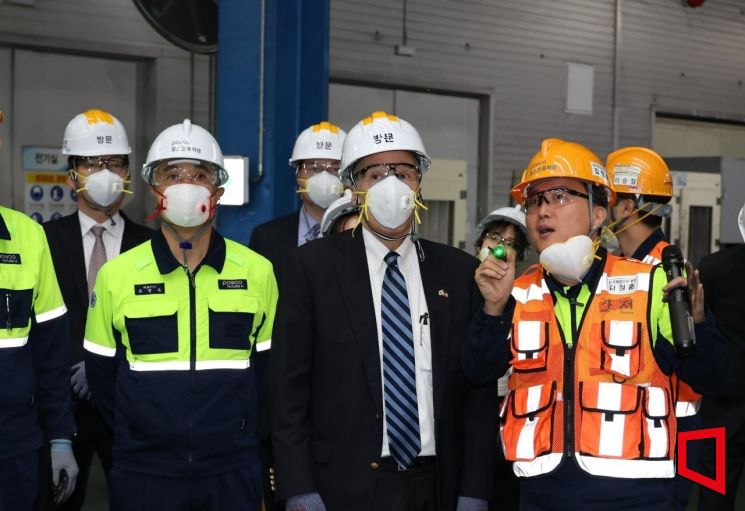 Yoo Byung-ok, President of POSCO Future M (left), is touring the production line of the artificial graphite anode factory in Pohang with Philip Goldberg, U.S. Ambassador to Korea (center), on the 7th. (Photo by POSCO Future M)
POSCO Future M is the only domestic company producing both cathode and anode materials and is regarded as a key partner in establishing a stable supply chain for the U.S. battery industry. According to market research firm SNE Research, among the top 10 companies by global market share in the first quarter of 2024, POSCO Future M is the only non-Chinese company.
In particular, artificial graphite anode materials have advantages over natural graphite anode materials by extending battery life and reducing charging time, leading to continuously increasing demand as the electric vehicle market expands. POSCO Future M produces artificial graphite anode materials using needle coke made from coal tar, a byproduct of the steelmaking process. Unlike natural graphite anode materials, stable raw material procurement is possible domestically, which is advantageous for supply chain stabilization.
POSCO Future M has a total anode material production capacity of approximately 80,000 tons, including artificial graphite anode materials. Recently, however, strategic price reductions of anode materials by competing countries have caused difficulties due to decreased operating rates and profitability. As a result, voices are growing for global battery and automakers, as well as governments worldwide, to support anode materials and establish a stable global supply chain through mutual cooperation.
Yoo Byung-ok, CEO of POSCO Future M, said, "Despite POSCO Future M being the only alternative for stabilizing the U.S. anode material supply chain, we are facing practical difficulties due to the two-year grace period granted to the Foreign Extraterritorial Operations Committee (FEOC)." He added, "We urge the U.S. government to pursue consistent policies to stabilize the supply chain."
Ambassador Goldberg responded, "It is important to build a supply chain that does not rely on any single country and is not affected by unfair trade practices."
Meanwhile, in February, POSCO Future M met with Jose Fernandez, U.S. Deputy Secretary of State for Economic Growth, Energy, and the Environment, at the Seoul office in Daechi-dong during his visit to attend the Korea-U.S. Senior Economic Dialogue (SED). They introduced ongoing cathode and anode material projects and the group's raw material investment initiatives aligned with U.S. supply chain stabilization policies. Deputy Secretary Fernandez also posted, "I met with POSCO Future M to discuss cooperation on electric vehicle batteries and critical mineral supply chains and partnerships for a clean future."
© The Asia Business Daily(www.asiae.co.kr). All rights reserved.

















