321 Tons of Food Waste in National Parks from 2018 to This Year
Jirisan National Park Has the Most Food Waste
Group Tours Increase and Camping Facilities Expand After COVID-19
"Strong Measures Needed to Prevent Illegal Dumping"
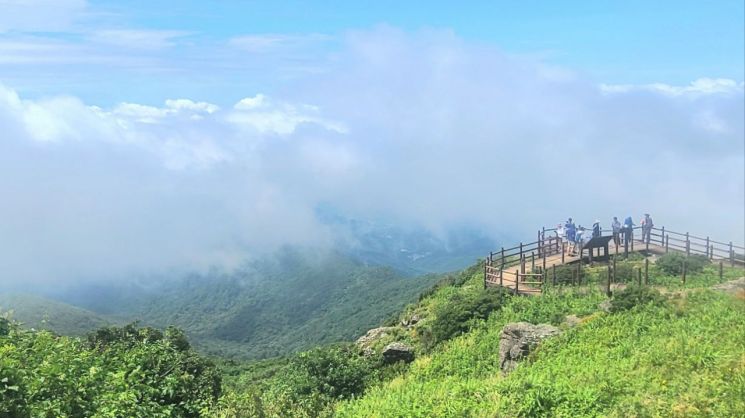 Hikers who climbed Nogodan on Jirisan, located in Toli-myeon, Gurye-gun, Jeollanam-do.
 [Image source=Yonhap News]
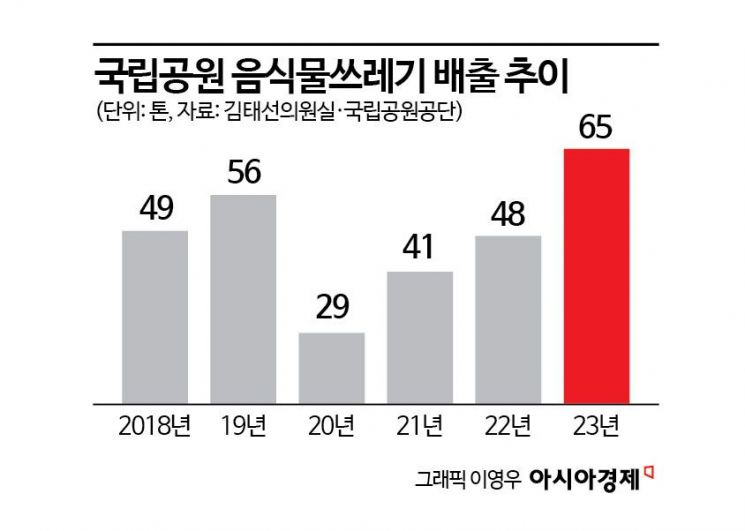
National parks are suffering from food waste. Last year alone, food waste discarded in domestic national parks reached 65 tons. The amount of food waste accumulated from 2018 to this year approached 321 tons. As food waste in national parks continues to increase, there are calls for fundamental measures to address the issue.
According to data submitted by the Korea National Park Service to the office of Assemblyman Kim Tae-seon of the National Assembly Environment and Labor Committee on the 8th, food waste generated from 22 domestic national parks, including Jirisan, reached 65 tons last year. Food waste in national parks has been gradually increasing, with 29 tons in 2020, 41 tons in 2021, and 48 tons in 2022. In the first half of this year, 33 tons of food waste were generated, and at the current rate, it is likely to exceed last year's amount.
The national park with the most food waste is Jirisan. From 2018 to the end of June this year, a total of 66.3 tons of food waste was produced. During the COVID-19 pandemic from 2020 to 2022, food waste in Jirisan was about 6 to 9 tons, but as tourists increased afterward, 13.4 tons of food waste were generated last year. The next highest national parks in terms of food waste were Deogyusan with a total of 25.8 tons, followed by Seoraksan (25 tons), Hallyeohaesang (23.4 tons), and Naejangsan (23.2 tons).
Food waste in national parks is not simply due to an increase in visitors. According to the Korea National Park Service, about 39.45 million visitors came to national parks last year. Although this is an increase compared to 35.9 million in 2021 and 38.79 million in 2022, it has not recovered to the pre-COVID-19 level of 43.18 million in 2019. In other words, the number of visitors has decreased compared to several years ago, but food waste has increased.
Increase in Group Tours and Campgrounds Leads to More Food Waste
The Korea National Park Service explained that the surge in group tours is the cause. A representative from the Korea National Park Service said, “After the end of COVID-19, the proportion of group tours to national parks has increased significantly,” adding, “It seems that a large number of people visiting national parks at once brought a lot of food with them.”
This is also related to changes in government policy. Originally, national parks had many restrictions on installing cooking facilities to protect the natural environment, but with the Yoon Seok-yeol administration emphasizing public leisure activities, campgrounds within parks greatly increased last year. As campgrounds where cooking is relatively free appeared, officials analyze that more visitors started bringing food.
The problem is that as food waste increases, concerns about illegal dumping naturally grow. Hallasan is a representative example. In 2021, Hallasan installed food waste processors at shelters, but hikers dumped large amounts of various waste, causing the 1000ℓ capacity devices to overflow. As a result, side effects such as hikers throwing food waste on the ground occurred.
Once food waste is discarded, it is highly polluting and very difficult to process. For example, the broth of instant noodles, which hikers often discard, contains a large amount of salt, polluting the soil and threatening organisms that drink clean water. According to the National Institute of Environmental Research, 1.41 tons of water is needed to dilute 150㎖ of instant noodle broth.
There are also calls for measures to reduce food waste in national parks. Assemblyman Kim Tae-seon said, “Food waste damages the precious natural heritage of national parks and adversely affects the ecosystems of plants and animals living there,” adding, “Strong measures are needed to solve the food waste problem, along with enhanced education and campaigns targeting hikers.”
© The Asia Business Daily(www.asiae.co.kr). All rights reserved.


















