Unexpected Job Growth in September Removes Big Cut Outlook
US 10-Year Treasury Yield Hits 4% Range for First Time in Two Months
Some on Wall Street Raise No-Landing Scenario
As the U.S. labor market proved to be more resilient than expected, the 10-year U.S. Treasury yield surpassed 4% for the first time in two months. With expectations for a 'big cut' (0.5 percentage point rate cut) in November fading, speculation is growing that the pace of rate cuts will slow down. On Wall Street, the no landing scenario, where the U.S. economy continues to grow without a downturn, is gaining traction.
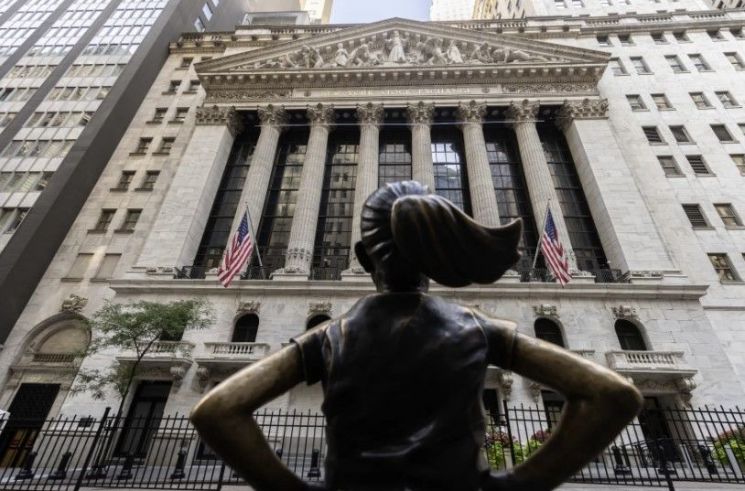
According to the global bond market as of 4:41 p.m. Eastern Time on the 7th (local time), the benchmark 10-year U.S. Treasury yield rose 5 basis points (1bp = 0.01 percentage points) from the previous trading day to 4.03%. This is the first time in two months since early August that the 10-year Treasury yield has crossed 4%.
The 2-year U.S. Treasury yield, which is sensitive to monetary policy, traded at 3.99%, up 6 basis points from the previous day. It briefly surpassed 4% during the day but slightly retreated from that level.
The sharp rise in U.S. Treasury yields was triggered by the September employment report released by the U.S. Department of Labor on the 4th. Contrary to concerns about a cooling labor market, employment increased significantly last month, fueling expectations that the Federal Reserve (Fed) will not rush to cut interest rates. According to the report, nonfarm payrolls increased by 254,000 last month, the largest increase in the past six months and well above market expectations of 147,000. In August, nonfarm payrolls rose by 159,000 compared to the previous month.
Following this employment data release, expectations that the Fed would implement a big cut at the next Federal Open Market Committee (FOMC) meeting in November disappeared. According to the Chicago Mercantile Exchange (CME) FedWatch tool, the probability of a 0.5 percentage point rate cut in November dropped from 34.7% a week ago to 0% on the day. The likelihood of a 0.25 percentage point cut increased from 65.3% to 84%, while the probability of holding rates steady rose from 0% to 16% during the same period.
Concerns over escalation between Israel and Iran, which have driven international oil prices sharply higher, are also reinforcing views that the pace of rate cuts may slow. If oil prices rise and inflation rebounds, the Fed could halt its rate-cutting path or even raise rates again. On the day, Brent crude, the global benchmark for oil prices, rose $2.88 (3.7%) to $80.93 per barrel, marking the highest level since late August.
On Wall Street, the possibility of a no landing scenario, where the U.S. economy avoids both a soft landing and a recession while maintaining growth momentum, has been raised.
Alice Andres, a currency and foreign exchange strategist at Bloomberg, said, "Signs of inflation remain latent, and there is little concern about a labor market collapse. Economic momentum is on a positive trajectory, so it is possible to bypass a soft landing and move toward a no landing scenario."
However, many analysts caution that it is difficult to assess the overall U.S. economic situation based solely on the September employment report, as the labor market is showing a trend of slowing down.
Jamie Patten, Global Head of Rates at TCW, analyzed, "Overall indicators such as declining quit rates and rising delinquencies on auto loans and credit cards point to a slowing labor market and risks of economic downturn. A single data point does not change our macro outlook that the labor market is broadly slowing."
© The Asia Business Daily(www.asiae.co.kr). All rights reserved.