Google DeepMind CEO who created 'AlphaGo' draws attention for Nobel Chemistry Prize possibility
Revolutionary evolution in protein structure research with 'AlphaFold' AI
"AI-supported research will win Nobel Prize within 10 years"
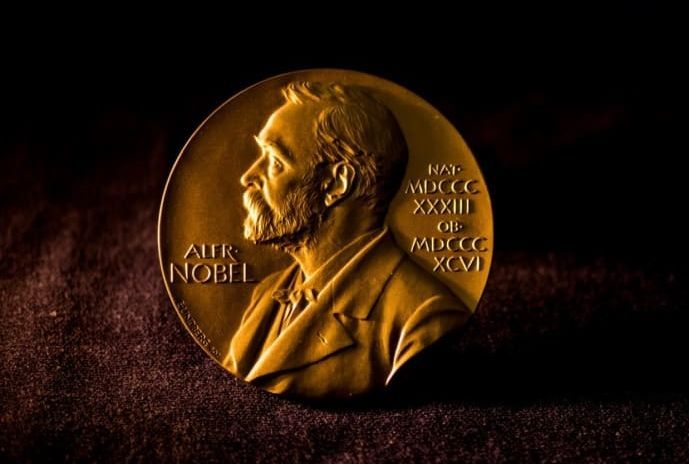
"AI technology has ushered in a new era of discovery in basic science laboratories and industrial fields. The ability to predict protein structures with astonishing accuracy has led to unprecedented advances in understanding biological mechanisms and accelerating drug development." (James Rothman, 2013 Nobel Prize in Physiology or Medicine laureate)
The Nobel Prize season has arrived. This year, the Nobel Prizes will be announced starting with Physiology or Medicine on the 7th, followed by Physics on the 8th, Chemistry on the 9th, Literature on the 10th, Peace on the 11th, and Economics on the 14th.
The origin of the Nobel Prize lies in the scientific field. While Literature, Peace, and Economics also receive attention, interest in scientific discoveries or inventions that have had a significant impact on human life remains strong.
This year, the spotlight of the Nobel Prize is on the rapid rise of artificial intelligence (AI). Although there is no Nobel Prize category specifically for AI itself, opinions are spreading that the Nobel Prize can no longer ignore AI. This is because AI’s capabilities have rapidly grown, greatly increasing its importance in scientific research.
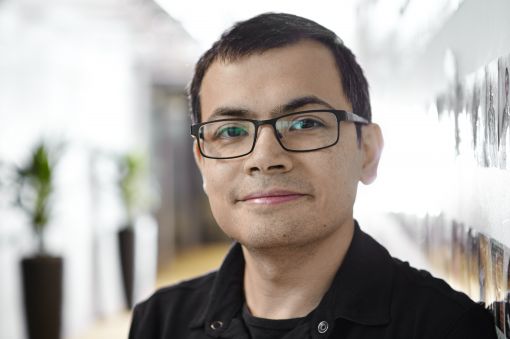 Demis Hassabis, CEO of Google DeepMind. Photo by Google DeepMind
The trigger was when Clarivate, famous for predicting Nobel laureates, presented three fields as candidates for this year’s Nobel Prize in Chemistry. Among them, the list of those who contributed to the prediction and design of three-dimensional protein structures and functions included names related to AI. These were Demis Hassabis, CEO of Google DeepMind, and researcher John Jumper, who created AI capable of contributing to the development of next-generation anticancer drugs and other new medicines. Google DeepMind, well known to us for creating AlphaGo, which defeated 9-dan Go player Lee Sedol, has now approached the realm of the Nobel Prize.
AI itself cannot receive a Nobel Prize. If an award is given for AI research, there are pioneers like Professor Geoffrey Hinton who led AI development, but those who developed AI that can be practically used in scientific fields are more suitable candidates from the Nobel Prize perspective.
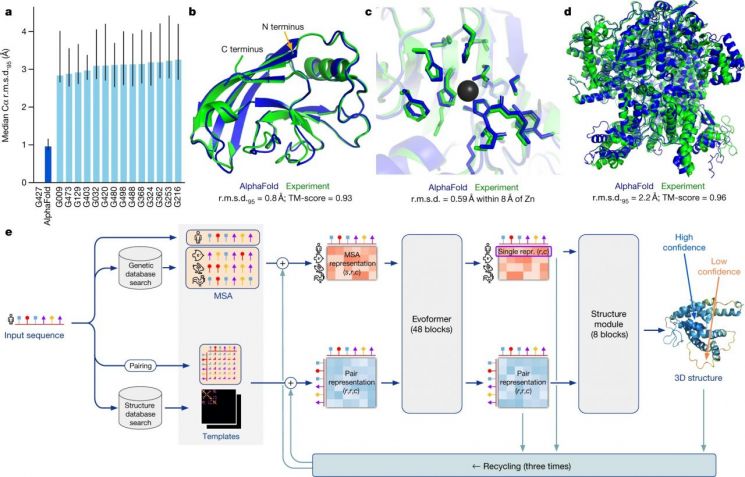
CEO Hassabis’s achievements stand out prominently. The core is the AI that predicts protein structures, called 'AlphaFold'. The 2021 paper titled 'Highly accurate protein structure prediction with AlphaFold' has already been cited more than 16,000 times. CNN reported that there are only about 500 scientific papers cited over 10,000 times. AlphaFold, which first appeared in 2018, amazed the scientific community this year by evolving into ‘AlphaFold 3’.
Dr. James Rothman, the 2013 Nobel Prize in Physiology or Medicine laureate, said the impact of artificial intelligence (AI) on scientific research is astonishing, stating, "AlphaFold’s remarkable ability to accurately predict the three-dimensional structure of proteins provides life scientists and medical researchers with an innovative tool and has caused a paradigm shift in the approach to medical research."
CEO Hassabis and researcher John Jumper received the Breakthrough Prize, created by Silicon Valley leaders such as Sergey Brin and Mark Zuckerberg to jointly honor contributors to scientific advancement. The Breakthrough Prize targets fields where the Nobel Prize is lacking, thus recognizing Hassabis’s capabilities.
This is not the first year AlphaFold has attracted attention in Nobel Prize fields. Forbes, a U.S. economic media outlet, stated right after last year’s Nobel Prize announcements that since there is no Nobel Prize for computer science, mathematics, or engineering, it seems almost impossible for AI scientists to win a Nobel Prize. However, if AI scientists achieve significant advances in physics, chemistry, physiology or medicine, literature, peace, or economics using AI, the situation could change. They evaluated that CEO Hassabis, who researched AlphaFold, deserves a Nobel Prize.
In research fields, the use of computers has been increasing. Many scholars install supercomputers in their laboratories or borrow the power of massive supercomputers for research. In fact, the 2013 Nobel Prize in Chemistry was awarded to researchers who developed simulation programs capable of calculating and studying chemical reactions of large molecules on computers.
James Fraser, a Stanford University professor who won the Nobel Prize at that time, published a paper in January titled 'AlphaFold Accelerates AI-Based Drug Discovery: Efficient Identification of a New CDK20 Small Molecule Inhibitor.' The research team claimed that with slight modifications, AlphaFold’s conclusions could be used to identify new hit molecules that effectively kill liver cancer cells. The time taken for this research was only 30 days. Without AI, it is unknown how much time it would have taken.
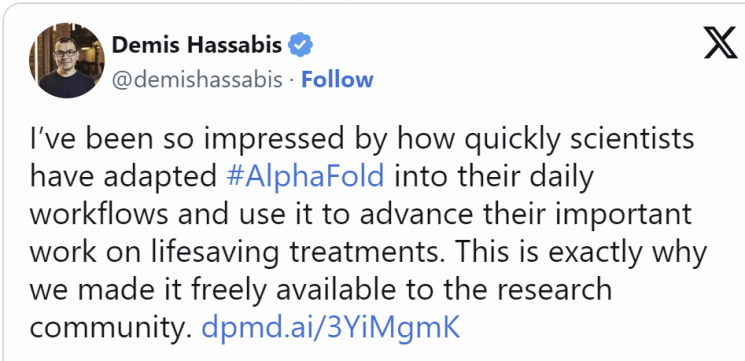 Professor James Rabbit of Stanford University, who can kill liver cancer cells using AlphaFold, said in January, "AlphaFold is an artificial intelligence technology...
Regarding this research, Hassabis welcomed the demonstration of AI’s power. He was impressed by how quickly scientists applied AlphaFold to research, saying, "That is why we provide AI to the research community for free."
Of course, some believe it is still premature to award a Nobel Prize to AI developers. Traditionally, the Nobel Prize has evaluated decades of research results. AI research is recent, and applying AI to scientific research is a completely new field, which may be a burden for the conservative Nobel Prize selection committee.
Professor Inga Strumke of the Norwegian University of Science and Technology pointed out, "AI performs calculations and provides answers that no human could, but it is clumsy in explaining why those answers are correct."
However, change has already begun. David Pendlebury, a Clarivate researcher, stated that computer-based research has already become mainstream in research fields and predicted, "Within 10 years, research supported by AI will win a Nobel Prize."
© The Asia Business Daily(www.asiae.co.kr). All rights reserved.



















