Currently Used Mainly to Criticize the Biden Administration's Incompetence
Social Media is Suffering from Reckless Fake Photos
Hurricane 'Earlene' struck the southern United States, including Florida, causing significant damage, and a photo of a girl affected by the hurricane's flooding spread widely on social networking services (SNS) and online communities. However, it was later revealed that this photo was an image generated by artificial intelligence (AI), sparking controversy.
On the 6th (local time), the New York Post reported that a photo that caused a sensation on social networking services (SNS) was a fake image created by AI. The photo shows a girl wearing a life jacket due to recent hurricane damage, crying while holding a puppy on a boat.
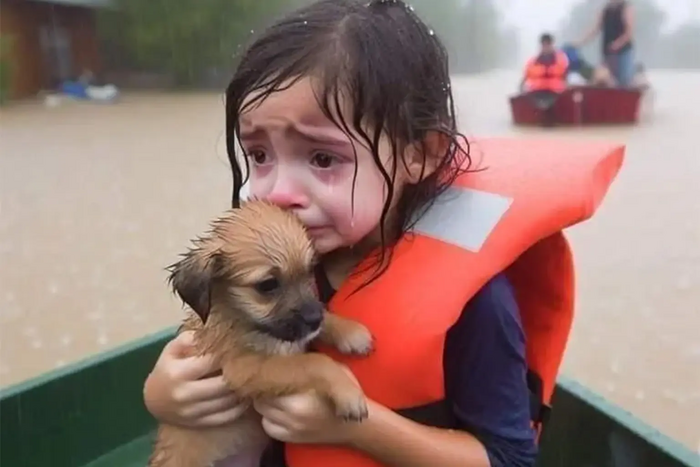 The post reported that a photo that went viral on social networking services (SNS) was an AI-generated fake image. The photo shows a girl wearing a life jacket holding a puppy and crying on a boat, following recent hurricane damage.
 [Photo by X (X)]
This photo was mainly used by those criticizing the current Biden administration, sharing the AI-generated image as a symbol of the government's incompetence. Among those who shared the photo was Senator Mike from Utah. After it was revealed that the photo was fake, he reportedly deleted it soon after. Currently, X (formerly Twitter) classifies the photo as an AI-generated image. Recently, fake photos created for political purposes have increasingly circulated as if they were real on social media. Previously, fake photos claiming to show civilian casualties in the Gaza Strip also spread widely.
Surge in Fake Information Circulation Due to AI-Generated Images Amid AI Boom
While the convenience brought by AI is raising expectations, concerns are also growing. Earlier in May, a research team from Google and Duke University analyzed 136,000 fact-check cases verified by the fact-checking media Snopes from 1995 to November 2023. They found that the spread of a fake photo of Pope Francis wearing a white long padded jacket emphasizing his waist in March last year marked a turning point. The photo was shared on SNS and online communities, garnering millions of views. It attracted global attention with comments like "The Pope's fashion sense" and "The Pope hired a new stylist." Notably, no one suspected the photo was fake until it was revealed to have been created by the generative AI 'Midjourney,' as it looked very natural. After it was exposed as fake, countless AI-generated fake photos were shared on SNS as if they were real.
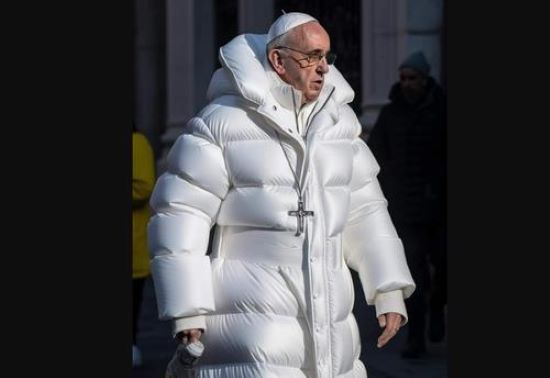 Last May, a research team from Google and Duke University analyzed 136,000 fact-check cases from 1995 to November 2023, verified by the fact-checking media Snopes. They concluded that the period when a fake photo of Pope Francis wearing a white long padding emphasizing his waist spread on social media in March last year became a turning point.
 [Photo source=Reddit]
Above all, as the use of AI-generated images increases, social media platforms are also suffering. Fake images of celebrities that attract people's attention are flooding, leading to serious defamation issues, especially the creation and spread of pornographic content, which has become a hot topic. The misuse of deepfake technology?a sophisticated manipulation technique that synthesizes videos, images, and voices based on AI?can cause unimaginable harm. Most importantly, it is very difficult for the naked eye to distinguish fake content, deceiving the public. Particularly, as the number of creators and distributors of sexually explicit deepfake content increases, calls to strengthen AI-related legal regulations are growing louder. Earlier this year, malicious deepfake pornographic videos synthesizing the face of the world-famous American female singer Taylor Swift were distributed online, and in March, a photo showing former President Donald Trump handcuffed and surrounded by police officers while being dragged also circulated.
© The Asia Business Daily(www.asiae.co.kr). All rights reserved.
![User Who Sold Erroneously Deposited Bitcoins to Repay Debt and Fund Entertainment... What Did the Supreme Court Decide in 2021? [Legal Issue Check]](https://cwcontent.asiae.co.kr/asiaresize/183/2026020910431234020_1770601391.png)

















