A 300ha 'Village of Nature Lovers in the Mountains': Middle-Aged and Retired People Settle in Rural Mountain Villages
On the 7th, North Gyeongsang Province announced the ‘4060+ K-Sanchon Dream’ strategy in the provincial government briefing room as part of the Forest Transformation Project to support the stable settlement of middle-aged and retired individuals relocating to mountain villages.
This pilot project aims to create “mountain villages that people want to visit and live in” by utilizing local forest resources to provide jobs, housing, and leisure opportunities. It presents three models?income-generating, nature-based, and wellness-based?for middle-aged individuals preparing for their second act in life, and offers spaces where they can actually experience mountain village living.
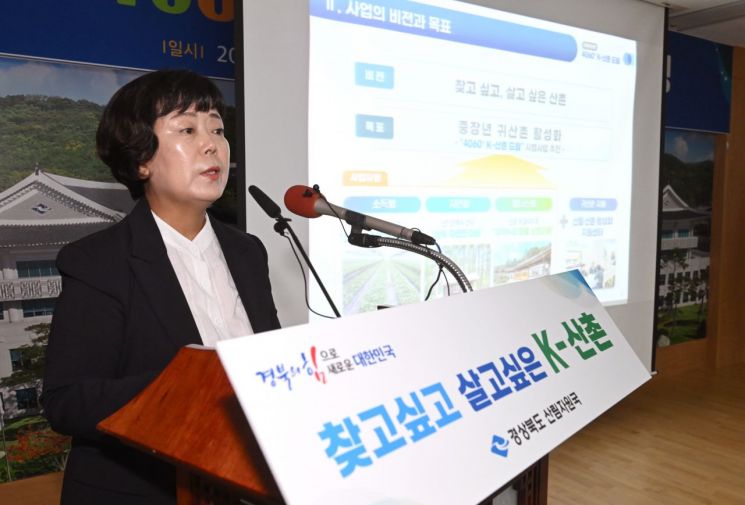 Hyunae Cho, Director of the Forest Resources Bureau of Gyeongbuk Province, is announcing plans such as the establishment of rental-type mountain village smart farms to enable middle-aged retirees from the city to move into mountain villages and settle down stably.
North Gyeongsang Province ranks first nationwide with 910,000 hectares of private forest land and 340,000 private forest owners. It is also the largest production area for forest products such as persimmons, jujubes, walnuts, omija, pine mushrooms, yams, and cnidium.
However, 108 towns and villages in the province, where over 70% of the area is forest, are facing severe aging and population decline due to the outflow of local residents.
Recently, as the baby boomer generation ages, the proportion of middle-aged residents in large cities continues to rise. Last year, more than half of those relocating to mountain villages were middle-aged, indicating strong interest among retirees in living in rural mountain areas.
Accordingly, to attract nationwide demand for mountain village relocation to North Gyeongsang Province, the region will implement a “Gyeongbuk-style Mountain Village Relocation Strategy for Middle-aged Individuals,” supporting everything from experiencing mountain village life to stable settlement by utilizing abundant local forest resources.
For those hesitant to relocate due to initial investment costs and communication barriers with local residents, various programs will be provided, allowing them to enjoy mountain village life by paying only rent, without investment costs. The programs include job opportunities, housing, and building networks with local residents.
North Gyeongsang Province plans to launch the first pilot project in Yeongyang, a representative mountain village area with over 80% forest coverage. The project will actively utilize excellent tourism resources such as the nationally renowned birch forest and the region’s status as the largest producer of wild vegetables like cnidium and cnidium officinale to create three types of villages.
First, the income-generating model will establish the “Wild Vegetable Smart Farm Innovation Complex.”
By 2027, 12 billion KRW will be invested in Ilwol-myeon, Yeongyang-gun, to create the nation’s first rental-type wild vegetable smart farm and build 20 modular rental houses.
Twenty middle-aged individuals wishing to relocate to mountain villages and earn high income from forest products will be able to rent a smart farm (0.2ha) for cultivating wild vegetables such as cnidium, along with one rental house, for up to five years.
In collaboration with experienced wild vegetable farmers, new residents will receive training in advanced cultivation techniques. A joint brand and distribution/sales system will be established with local forest businesses, creating an environment where residents can settle stably in local cultivation complexes even after the rental period ends.
Additionally, a forest biomass energy self-sufficient village will be created nearby, utilizing biomass fuel from forest management activities. This will supply heating to the smart farms and establish a virtuous cycle in forest management, while also creating new forest-related jobs.
Second, the nature experience model will create the “Mountain Nature Village.”
In about 300 hectares of public forest in the Ilwolsan area, the main production area for wild vegetables, a “Mountain Nature Village” will be established where 20 middle-aged individuals wishing to experience a nature-based lifestyle can live.
Each resident will be able to rent a 5?10 hectare plot of public forest and one house in the woods for up to three years, allowing them to live in the mountains while cultivating and harvesting short-term forest products such as wild vegetables, aralia shoots, and mushrooms to generate income.
The project will focus on providing training in cultivation techniques, supporting sales channels for forest products, and building networks to foster social relationships with local residents, enabling successful adaptation to mountain village life and culture during the rental period.
Third, the wellness model will create the “Jajaknuri Premium Mountain Village.”
Utilizing the country’s largest birch forest in Jukpa-ri, Subi-myeon, a local cooperation-type mountain village wood stay with short-term accommodation and office space, as well as a shared “forest office” for workation, will be established.
Twenty middle-aged individuals seeking a dual life in the mountains or a 4-days-in-the-city, 3-days-in-the-village healing lifestyle will be offered spaces for short-term stays ranging from six months to one year.
Through forest recreation and healing programs linked to national and public facilities such as the birch forest, residents can enjoy a wellness lifestyle and move a step closer to settling in mountain villages through local resident-mentor programs.
Plans also include creating a birch-themed street, operating a local food market, promoting corporate workation programs, and supporting spaces for startups and creative work as part of various local cooperation projects.
Finally, a Forest and Mountain Village Revitalization Support Center will be operated to serve as the control tower for the pilot project.
The center will recruit participants, provide education, and support jobs, housing, and settlement for new residents. It will also support private forest owners through wood utilization projects and forest management experience programs to generate additional income and promote sustainable forest management.
With the completion of the pilot villages in 2027, participants will be selected, and the “4060+ K-Sanchon Dream” pilot project will be fully implemented starting in 2028.
North Gyeongsang Province expects that, with the successful settlement of this project, the living population of Yeongyang-gun will increase, new jobs will be created, the forest industry will be revitalized, and the local economy will be invigorated, transforming the region into a vibrant mountain village.
Jo Hyunae, Director of Forest Resources at North Gyeongsang Province, stated, “Through the forest transformation, we are striving to turn over 70% of the province’s land into ‘profitable forests’ and create mountain villages that people want to visit and live in. Through this pilot project, we aim to make the dream of middle-aged individuals who wish to leave the bustle of the city and live in harmony with the forest a reality, establishing a successful model for mountain village relocation.”
© The Asia Business Daily(www.asiae.co.kr). All rights reserved.

















