A nano-delivery system optimized for gene lung disease treatment has been developed domestically.
KAIST announced on the 7th that Professor Jiho Park's research team from the Department of Bio and Brain Engineering developed an ionizable lipocomplex (ionizable lipocomplex, hereinafter referred to as iLPX) to complement the limitations of existing mRNA vaccine delivery systems.
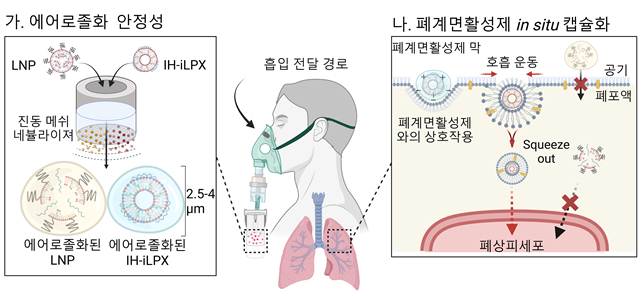 Schematic diagram of mRNA inhalation delivery strategy using inhalation-optimized lipid nano-complexes. Provided by KAIST
mRNA vaccines and therapeutics have attracted attention as next-generation treatments to prepare for respiratory diseases such as lung diseases following the COVID-19 pandemic.
Currently, lipid nanoparticles (lipid nanoparticle, hereinafter referred to as LNP) are commercialized and mainly used as delivery vehicles for mRNA therapeutics. After intravenous injection, the polyethylene glycol on the particle surface is exchanged with serum proteins in the blood, delivering mRNA into cells.
However, this method shows limitations such as instability during the aerosolization process of LNPs and low delivery efficiency in the lung microenvironment. Aerosolization refers to a spraying technique that disperses aqueous solutions into fine particles.
As a way to complement this, interest in inhalation delivery of mRNA therapeutics is increasing, but there are currently no clinically used cases. This created the need for research on mRNA delivery systems that can overcome the limitations of existing inhaled mRNA therapeutics.
Above all, mRNA-based inhalation therapy can be applied not only to infectious diseases such as COVID-19 but also to various intractable diseases requiring gene therapy, such as asthma, cystic fibrosis, and idiopathic pulmonary fibrosis, increasing the necessity for development.
The iLPX developed by the research team is significant in that it addresses the previously identified limitations. First, iLPX is a form in which mRNA is bound to the exterior of ionizable liposomes, providing the advantage of maintaining particle structure during the aerosolization process.
Thanks to this, it is easy to deliver via inhalation and induces interaction with pulmonary surfactants in the lung microenvironment, enabling mRNA delivery to lung cells through respiratory movements.
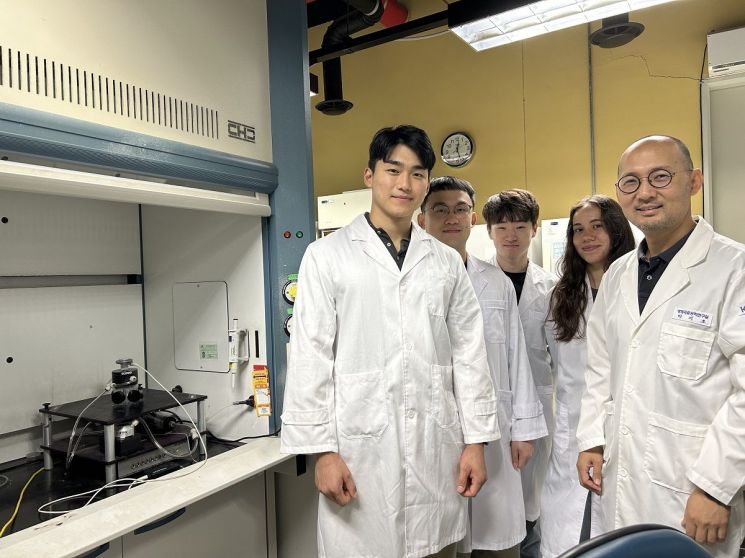 (From left) Jang Min-cheol, PhD candidate; Han Jun-hee, PhD candidate; Yeom Kyung-hwan, PhD candidate; Erinn Fagan, master's candidate; Professor Park Ji-ho. Provided by KAIST
Additionally, the research team optimized the components of iLPX through a multidimensional screening process based on protein expression in mimicked environments considering inhalation delivery and the lung microenvironment, as well as in mouse lungs, completing the inhalation-optimized mRNA delivery system (Inhalation optimized-iLPX, hereinafter IH-iLPX).
In this process, the research team demonstrated the superior aerosolization stability of IH-iLPX by comparing particle size, uniformity, and mRNA loading rate before and after aerosolization.
In particular, the team emphasized that mice administered with IH-iLPX showed 26 times higher protein expression than those administered with LNP delivery.
The research team confirmed that IH-iLPX delivered via inhalation specifically expresses proteins in the lungs of animal models and effectively delivers mRNA to alveolar epithelial cells (air sacs about 0.1?0.2 mm in diameter composed of simple squamous epithelium) and bronchial epithelial cells.
Furthermore, based on blood biochemical analysis and histological examination, the team confirmed that IH-iLPX is non-toxic in lung and blood environments, explaining that it ensures not only mRNA expression within the lungs but also high biocompatibility.
Professor Park said, “By breaking the fixed idea that mRNA must be loaded inside, and presenting a new particle composition, we have opened the path for inhalable gene therapy that was previously impossible. The inhalable gene delivery system developed by our team, which carries mRNA encoding therapeutic proteins, will be applied to lung diseases and play a role in expanding the scope of gene lung disease treatment.”
Meanwhile, this research was conducted with support from the Mid-Career Researcher Support Program of the National Research Foundation of Korea. The results of this study, with PhD candidate Mincheol Jang from KAIST’s Department of Bio and Brain Engineering as the first author, were also published in the September 3 issue of the international nanotechnology journal ‘ACS Nano.’
© The Asia Business Daily(www.asiae.co.kr). All rights reserved.
![Clutching a Stolen Dior Bag, Saying "I Hate Being Poor but Real"... The Grotesque Con of a "Human Knockoff" [Slate]](https://cwcontent.asiae.co.kr/asiaresize/183/2026021902243444107_1771435474.jpg)












