'2024 Seoul International Didimdol Income' Forum Held
Achievements in Reducing Dependency Rate, Income Growth, and Education Reinvestment
"Helps Alleviate Inequality, Will Increase Social Mobility"
Among households receiving Seoul Didimdol Income support for the second consecutive year, the rate of those who no longer need to receive the Didimdol Income nearly doubled. This indicates that Seoul Didimdol Income is serving as a stepping stone toward economic independence, with the number of households whose earned income increased also rising by 10 percentage points compared to the first year.
On the 7th, the Seoul Metropolitan Government revealed these achievements of Seoul Didimdol Income at the '2024 Seoul International Didimdol Income Forum' held at DDP, engaging in policy discussions with domestic and international experts in the fields of income disparity and inequality.
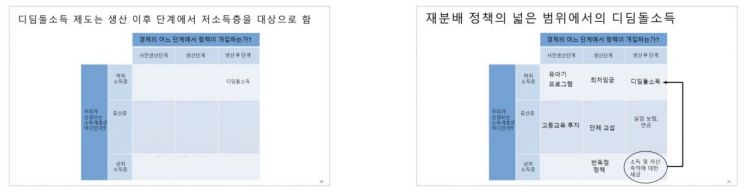
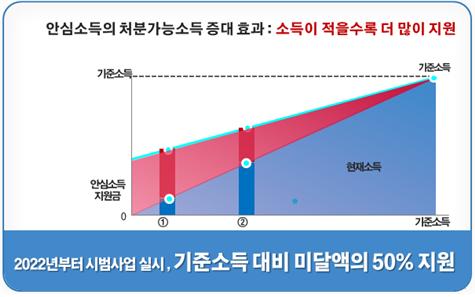
Seoul Mayor Oh Se-hoon's flagship welfare policy, 'Seoul Didimdol Income,' differs from universal basic income, which provides a fixed amount equally to all citizens, by supporting a certain percentage of the income shortfall relative to the median income, providing more support to households with lower income. Eligibility is maintained even if income exceeds the set threshold, so benefits are automatically paid even if income suddenly decreases. Additionally, it is designed to increase household income as work increases, thus not discouraging the motivation to work.
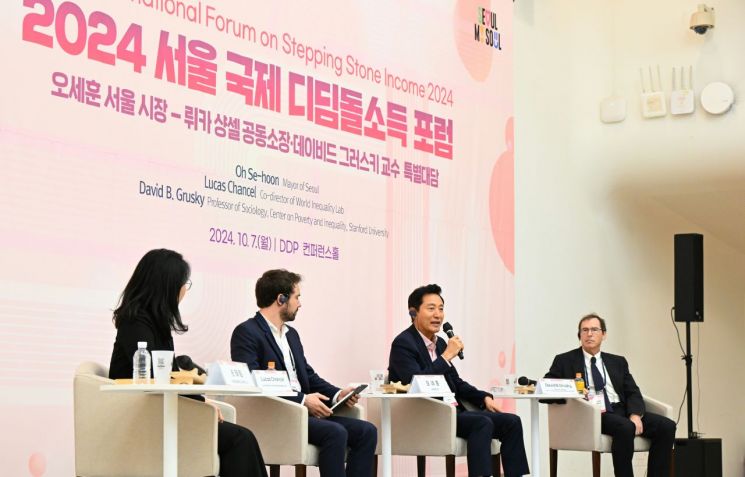 Seoul Mayor Oh Se-hoon attended the '2024 Seoul International Didimdol Income Forum' held at DDP on the 7th, where he engaged in policy discussions with domestic and international experts in the fields of income disparity and inequality.
 [Photo by Seoul City]
Didimdol Income Second-Year Exit Rate 8.6%... "Stepping Stone to Economic Independence"
At the forum, the tangible achievements of Seoul Didimdol Income were shared. The exit rate of recipients in the second year of Seoul Didimdol Income was 132 households, accounting for 8.6%. This is a 3.8 percentage point increase from 23 households (4.8%) in the first year. This higher exit rate compared to the current system can be interpreted as Didimdol Income serving as a foundation for independence.
Notably, 31.1% (476 households) of the supported households saw an increase in earned income. This is 9.3 percentage points higher than the 21.8% (104 households) in the first year, addressing the weakness of the current system, which has a weak incentive to work.
The incentive effect was also observed among so-called 'non-working households.' Among households not working, the rate of starting work after receiving Didimdol Income was 3.6 percentage points higher than that of the comparison group. Additionally, households receiving Didimdol Income were found to be utilizing the support funds according to their circumstances. Households with elderly members or preschool children tended to reduce working hours slightly and devote that time to caregiving. This tendency was more pronounced when the household head was female, indicating that Didimdol Income significantly helped households that lacked caregiving due to economic pressure.
Long-term investments in human resources that can enhance labor productivity also increased, such as spending 72.7% more on education and training expenses compared to the comparison group. This aligns with Seoul's policy goal of serving as a ladder for social mobility.
Savings amounts were also 11.1% higher than those of the comparison group, confirming preparation for the future through asset formation. Although the current system converts assets into income and partially deducts benefits, which can discourage asset formation, Didimdol Income does not let assets affect benefit amounts, thus increasing the desire to save.
Following last year, households receiving Didimdol Income this year also spent more on essential goods such as medical expenses and groceries compared to the comparison group. Mental health improvement effects were also higher. The mental health improvement effect was more pronounced in households with higher work incentives, especially those who usually did not work, confirming the close relationship between work and mental health.
The analysis covered 1,523 households in the first phase of Seoul Didimdol Income (below 50% of median income) (484 supported households, 1,039 comparison group households) and 3,588 households in the second phase (below 85% of median income) (1,100 supported households, 2,488 comparison group households), increasing both scale and duration compared to the first-year survey, thereby enhancing the reliability of the experiment.
Oh Se-hoon: "Existing Cash Support Systems Should Be Integrated and Linked with Didimdol Income"
At the forum, policy evaluations by world-renowned scholars were also conducted. This year's forum theme was 'Exploring Measures to Alleviate Poverty and Income Disparity - Paradigm Shift in Income Security,' bringing together income disparity experts from major advanced countries such as the United States and France to share insights.
The forum opened with a special dialogue titled 'Possibilities of Income Security Systems to Eliminate Welfare Blind Spots,' featuring Mayor Oh, Lucas Chancel, Director of the World Inequality Lab, and David Grusky, Professor of Sociology at Stanford University.
The dialogue was chaired by Professor Son Hye-rim of the University of Seoul. Director Lucas Chancel stated, "Since the 1980s, when neoliberalism became mainstream, inequality has deepened globally, and wealth inequality is more severe than income inequality," suggesting Seoul Didimdol Income as a solution to inequality but emphasizing the need to consider funding methods if expanded nationwide. In response, Mayor Oh said, "If existing cash support systems are integrated and linked with Seoul Didimdol Income to secure funding, the additional burden would not be significant," adding, "We are conducting a separate coherence study to analyze the entire social security system meticulously, prepare restructuring plans, and review funding procurement methods."
Professor David Grusky added, "In highly developed capitalist societies like the United States, opportunities are traded in the market like commodities, and poverty can lead to deprivation of opportunities," emphasizing the need to consider whether cash-based income security systems can address this issue. Mayor Oh responded, "In Korea, educational opportunity gaps based on parental income are widening, solidifying class and deepening inequality," noting, "Many households receiving Seoul Didimdol Income use the support funds for their children's education, which will help improve social mobility in the long term."
In the keynote speech, Director Lucas Chancel presented his stance on redistribution policies under the theme 'The Fight Against Inequality in the 21st Century,' and Professor Lee Jung-min of Seoul National University mentioned the 'Second-Year Achievements of the Seoul Didimdol Income Pilot Project' in the keynote presentation. The panel discussion, chaired by Park Ki-sung, President of the Safe Income Society, included Mayor Oh, Professor David Grusky, Research Professor Pasi Moisio of the Finnish National Institute for Health and Welfare, and Professor Son Hye-rim of the University of Seoul, engaging in an in-depth discussion on the achievements of Seoul Didimdol Income.
Based on the results of this forum, the Seoul Metropolitan Government plans to seek future development directions through a detailed analysis of 'Seoul Didimdol Income,' a representative model of K-welfare. Mayor Oh stated, "Seoul Didimdol Income has proven positive and meaningful effects in increasing income and motivating work," adding, "It can serve as a stepping stone to embrace citizens in need without blind spots, helping them overcome difficult situations and move toward the future."
© The Asia Business Daily(www.asiae.co.kr). All rights reserved.



















