Selected Four Cities and Counties for ESG-Based RE100 Energy Self-Sufficient Park Project
Project Necessity Focused on Renewable Energy Production and Usage Plans
ESG Implementation with Eco-Friendly Construction Methods and Equipment...Utilizing Surplus Power for Public Benefit
Low-Carbon Development and Support for Energy-Vulnerable Groups Using Surplus Power for Public Purposes
Advisory Committee Composed of Residents and Experts Participates from Development Planning Stage
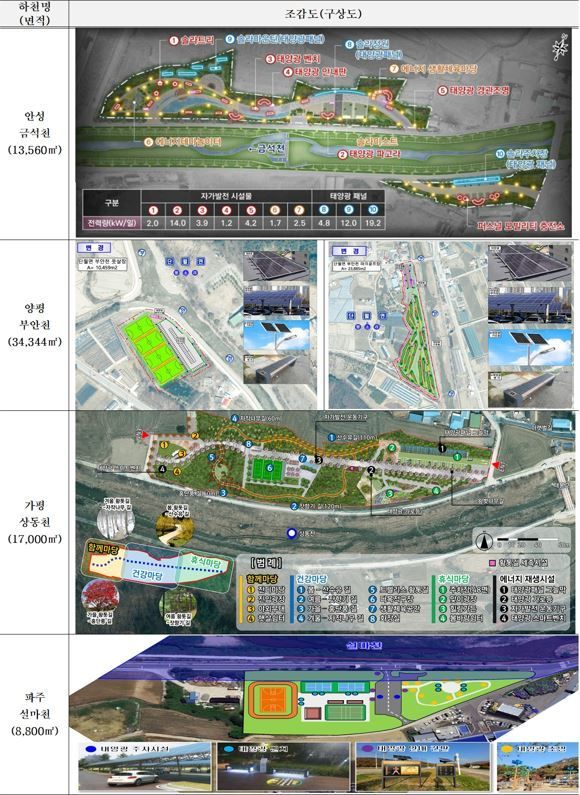 Gyeonggi-do has decided to create a citizen-experience type RE100 park utilizing abandoned riverbed sites along riversides and has finalized the selection of four cities and counties as project targets. The photo shows aerial views of the four cities and counties.
 Gyeonggi Province announced on the 7th that it has finalized the selection of four cities and counties as project sites to create citizen-experience RE100 parks utilizing abandoned riverbed areas along rivers.
The RE100 park creation project using abandoned riverbed sites is a plan to establish energy self-sufficient parks where residents can directly experience RE100 in their daily lives by utilizing abandoned riverbed areas that are hydraulically safe.
Since May, the province publicly recruited cities and counties interested in participating, and recently held an evaluation committee meeting to confirm Anseong City (Geumseokcheon), Yangpyeong County (Buancheon), Gapyeong County (Sangdongcheon), and Paju City (Seolmachon) as the four park development sites.
These riverbed sites will be equipped with facilities such as solar-powered parking lots, benches, and streetlights, allowing residents to directly experience RE100 in their daily lives. The electricity generated will be 100% used to cover the power consumption within the parks, and any surplus electricity will be utilized for supporting energy-vulnerable groups or for public purposes in surrounding areas, thereby contributing to the local community.
Going forward, the province plans to form an advisory committee consisting of city and county officials, residents, and members of the Local River Advisory Committee to complete the park construction by December next year.
Gyeonggi Province secured design costs for the low-carbon waterfront park project through this year’s supplementary budget and plans to further reduce carbon emissions at construction sites by introducing environmentally friendly materials, construction methods, and equipment during the construction phase.
Kang Seong-seup, Director of the Gyeonggi Province Construction Bureau, stated, “The RE100 park creation project is significant in fulfilling the promises of the 8th local government administration and returning abandoned riverbed areas, which have been used as private spaces, to public use.” He added, “By installing facilities incorporating the province’s key policy of RE100 in riverside parks frequently used by residents, we expect to raise awareness of eco-friendly energy. We will also strive to expand ESG in Gyeonggi Province’s construction projects through subsequent public contests such as the low-carbon waterfront park project.”
© The Asia Business Daily(www.asiae.co.kr). All rights reserved.

















