Hyundai Motor Company and Kia's new car sales in Singapore have more than doubled this year. Singapore is where Hyundai Motor Group established its Global Innovation Center (HMGICS). It is the first base where the group tries new manufacturing methods on a group-wide scale.
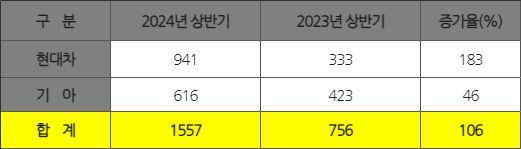
According to data compiled by the Singapore Land Transport Authority, the number of new car registrations for Hyundai and Kia in the first half of this year was 1,557, a 106% increase compared to the same period last year. Hyundai's registrations increased by about 183% to 941 units, while Kia's rose 46% to 616 units.
A Hyundai Motor Group official said, "Considering that the cost of purchasing a new car in Singapore is among the highest in the world due to urban pollution and traffic congestion, we performed well in the local market."
In Singapore, you must purchase a Certificate of Entitlement (COE) to buy a new car. COEs can only be bought and sold at auctions held twice a month. Cars with engines over 1600cc are traded at around 100,000 Singapore dollars (approximately 113 million Korean won). In addition, various taxes such as registration tax and road usage tax must be paid.
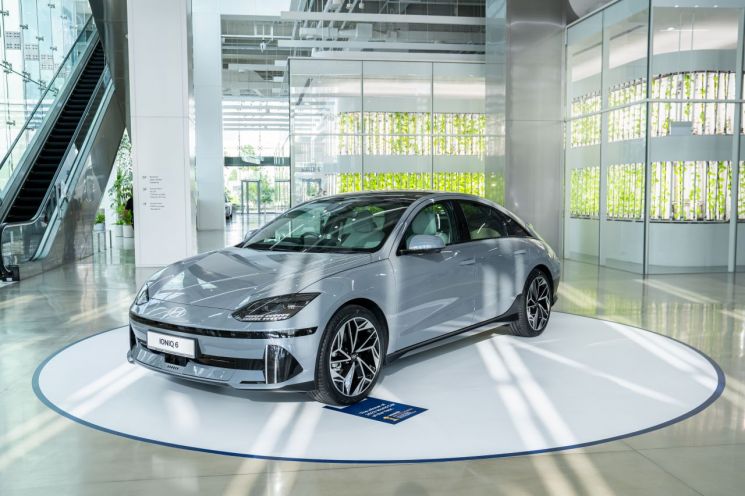
Hyundai Motor Group has been producing the electric vehicle Ioniq 5 locally since July this year, following the Ioniq 5. HMGICS handles research and development as well as electric vehicle manufacturing. The Ioniq 5 used by Pope Francis during his recent visit was also made here.
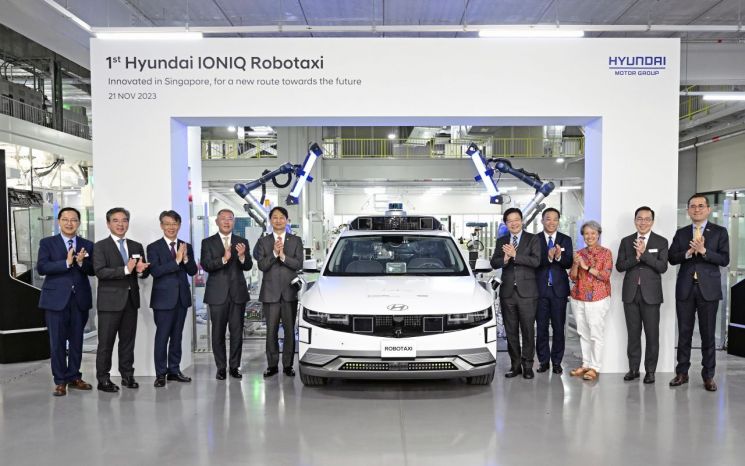 At the HMGICS completion ceremony last November, Hyundai Motor Group Chairman Chung Eui-sun (fourth from the left) along with Hyundai Motor Group executives, then Chief Trade Negotiator Ahn Deok-geun, and Singapore government officials are taking a commemorative photo in front of the locally produced 'Ioniq 5 Autonomous Driving Robotaxi No. 1'.
 [Photo by Hyundai Motor Group]
Kia launched the electric sports utility vehicle (SUV) EV9 locally in January this year, followed by the multipurpose vehicle Carnival Hybrid in August. The company also said it is working to build electric vehicle infrastructure by signing agreements with 17 local charging operators.
Singapore has decided to convert all vehicles to eco-friendly cars such as electric and hydrogen vehicles by 2040. By 2030, half of the 6,000 diesel public buses will be replaced with electric buses. Starting next year, new registrations of diesel vehicles and diesel taxis will be banned.
© The Asia Business Daily(www.asiae.co.kr). All rights reserved.



















