Launch Near Air Force Base Located at Hangar
Israel's multilayered missile defense system has recently shown some vulnerabilities in the face of a massive ballistic missile attack from Iran, according to claims.
On the 4th (local time), the Wall Street Journal (WSJ) reported that satellite image analysis revealed that up to 32 missiles launched by Iran on the 1st fell on roads around the Nevatim Airbase in southern Israel.
The Nevatim Airbase houses hangars for Israel Air Force's most advanced fighter jets, including the F-35 Lightning stealth fighter.
Earlier, CNN reported that two of the missiles launched by Iran missed the hangar by 12 meters.
However, experts point out that even if the missiles did not hit their targets, the fact that Iran's missiles approached so close to their targets is itself problematic.
Dr. Jeffrey Lewis, a nonproliferation expert at the Middlebury Institute of International Studies, said, "32 missiles is an enormous number," adding, "People have illusions about the performance of missile defense systems."
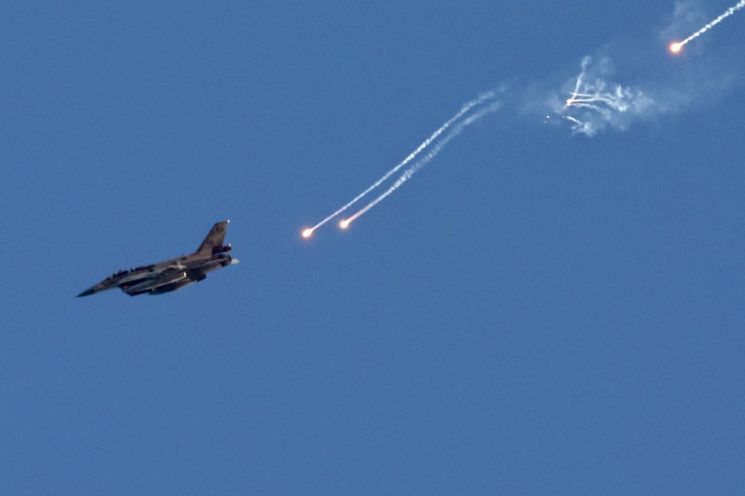 On August 25th (local time), an Israeli fighter jet fired flares over the airspace near the Israel-Lebanon border. [Image source=Yonhap News]
Israel's missile defense system is considered one of the most dense in the world.
The top-tier defense system, known as the "Arrow-3," Israel's version of THAAD (Terminal High Altitude Area Defense), along with "David's Sling," deployed operationally in 2017, handles the interception of medium-range missiles.
Additionally, the Iron Dome, first introduced in March 2011, has an interception altitude of 4 to 70 km and is equipped with 3 to 4 launchers per battery, each capable of firing 20 interceptor missiles.
It is especially regarded as the world's best at intercepting short-range rockets.
In April, when Iran launched a "swarm attack" using over 300 aerial weapons including cruise missiles, drones, and surface-to-surface missiles, the Israeli military was able to intercept 99% of them.
However, during the attack on the 1st, Iran used faster missiles such as the hypersonic missile Fateh-1, allowing it to partially penetrate Israel's missile defense system.
Ulrich Kuhn, head of the disarmament division at the Institute for Peace Research and Security Policy (IPRSP) in Hamburg, Germany, pointed out, "It is obvious that the faster the missile, the harder it is to stop," adding, "If a large number of missiles are launched toward a specific target, the missile defense system can be overwhelmed."
© The Asia Business Daily(www.asiae.co.kr). All rights reserved.

















