A Complex System Where the Top Vote-Getter Can Lose
The Electorate Consists of 538 Members... The Majority '270' Is the 'Magic Number'
One month remains until the U.S. presidential election on November 5. Neither the Democratic nor the Republican party can confidently claim victory in this tight race. Although some polls show Vice President Harris slightly ahead, the margin is within the margin of error. Trump supporters are already saying, "If we lose, it will be due to voter fraud," expressing distrust in the election results. The reason for such talk is that the U.S. presidential election system is so complex that even Americans find it difficult to understand. In South Korea, the candidate with the most votes wins, even if by just one vote. However, the U.S. presidential election has a unique structure where the candidate with the most popular votes can still lose.
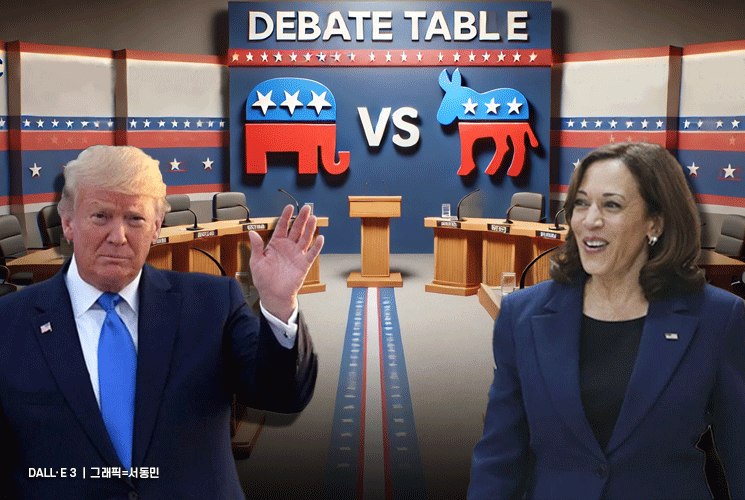
The Candidate with the Most Votes Can Still Lose
The U.S. uses an indirect election system where each state first elects electors through direct voting, and these electors then represent the people's will to choose the president. The United States is a federal country composed of 50 states and the capital Washington D.C. (District of Columbia). Each state is under the central government but maintains an independent character. Because the election system reflects the autonomy of each state, it inevitably becomes complex. The Washington Post describes the U.S. election system as "too complicated and confusing." Even American media find the U.S. presidential election hard to understand.
In past U.S. presidential elections, there have been several instances where the candidate with fewer total votes won. In 2016, Democratic candidate Hillary Clinton received about 3 million more popular votes than Republican Donald Trump but lost. The problem lies in the winner-takes-all system, where the candidate with the most votes in each state takes all the electors assigned to that state.
The total number of electors is 538. This includes 100 senators, 435 representatives allocated based on population, and 3 electors assigned to the District of Columbia. Except for Maine and Nebraska, which use a different method, the other 48 states and Washington D.C. use the winner-takes-all system, where the candidate with the highest vote share in a state sweeps all the electors assigned to that state. Securing a majority of 270 or more out of 538 electors means victory. The "magic number" is 270. During the vote count broadcast on November 5, anchors and reporters will repeatedly mention this number while reporting the results.
The number of electors varies by state. Each state's electors are determined by adding its two senators and the number of representatives allocated according to population. California, with a population of about 39 million, has the most electors at 54. Alaska, with a small population, has only 3 electors. Theoretically, winning in just about the top 10 states can secure victory regardless of other results.
Unlike South Korea, where the president is directly elected by popular vote on election day, the U.S. has an indirect election system where electors from each state vote for the presidential candidate. In other words, the election held over 24 hours from the Northeast to Alaska on November 5 is technically an election to choose the electors (The Electoral College) who will vote for the candidates. The electors meet on the Monday following the second Wednesday of December to elect the next president based on the voters' will. Although nominally a formality, this is the real presidential election.
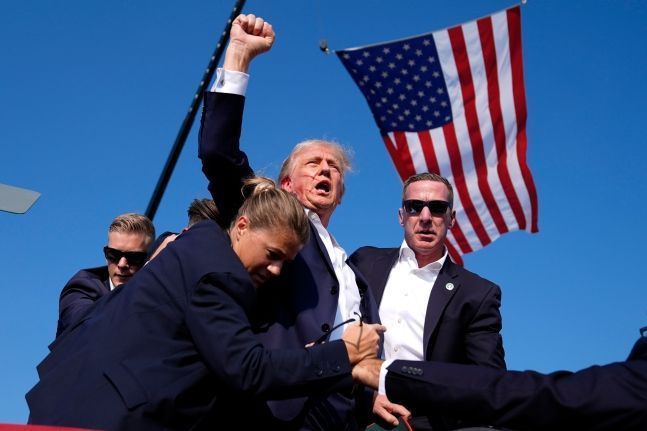 On the 13th (local time), former President Trump, who was shot during a campaign rally in Butler, Pennsylvania, USA, is seen descending from the stage while raising his fist above his head. This photo was taken by Evan Vucci, an AP photographer who won the Pulitzer Prize in 2021. [Image source=AP Yonhap News]
Different Election Methods by State
Each state has its own election method. With 50 states, there are essentially 50 different methods. The Constitution delegates authority to each state, so candidate selection, registration, voting methods and timing, and vote counting vary by state. The rules are determined by each state legislature. Primary election methods include the "caucus," where party members gather to discuss and decide, and the "primary," where general voters can freely participate and vote.
The caucus is derived from the Algonquin language of American Native tribes, meaning a chief's meeting. Registered party members gather at various locations such as gyms or schools across the state to discuss and select their preferred candidate. The primary is a preliminary election held at polling stations set up by the state government. Unlike caucuses, general voters not registered with any party can freely participate in primaries. Because of this, primaries are generally considered to better reflect the preferences of moderate voters. Recently, more states have been holding primaries rather than caucuses.
Voting times also differ. Early voting began on the 20th in three states including Minnesota. Voting hours on election day vary from 12 to 15 hours depending on the state. For example, in Dixville Notch, a mountainous village in New Hampshire, voting starts at midnight, a tradition from the mining era when voters finished voting before heading to work early in the morning. Some polling stations in New York close voting at 9 p.m., encouraging people to vote after work.
During U.S. election broadcasts, a map of the country is shown with colors indicating which party's candidate is leading. Blue represents the Democratic Party, and red represents the Republican Party. States where Democrats lead are called "Blue States," and those where Republicans lead are called "Red States."
Blue States include California, Washington, and Oregon on the West Coast, and New York, New Jersey, Massachusetts, Connecticut, Maryland, and Rhode Island in the Northeast. In contrast, southern states like Texas, Kentucky, and South Carolina are Red States. These areas have many conservative Christian residents and are also called the "Bible Belt." There are also Purple States, where neither party has a clear advantage and the outcome fluctuates depending on the election dynamics and issues. These are also called swing states.
If There Is a Tie, the House Elects the President
If both candidates secure 269 electors each, a tie can occur. While it might seem a revote is needed, the decision goes to the House of Representatives. The 12th Amendment of the U.S. Constitution stipulates that the House elects the president and the Senate elects the vice president. Unlike the Senate where each member has one vote, the House votes by state delegation, with each state having one vote reflecting the federal system. If the vote ties at 25 states, voting continues until one candidate receives at least 26 votes. In U.S. history, this process has been used twice to decide the president. The final step in electing a new president is the joint session of Congress to certify the vote results.
In 2024, 76 countries worldwide will hold elections. More than 4 billion people, half of the world's population, will vote, making it a "year of global elections." South Korea held its general election (National Assembly election) in April. Among these 76 elections, the U.S. presidential election on November 5 is considered the most influential. The results will significantly impact issues such as semiconductor and automobile trade between South Korea and the U.S., as well as diplomatic matters involving North Korea and China.
© The Asia Business Daily(www.asiae.co.kr). All rights reserved.
![From Bar Hostess to Organ Seller to High Society... The Grotesque Con of a "Human Counterfeit" [Slate]](https://cwcontent.asiae.co.kr/asiaresize/183/2026021902243444107_1771435474.jpg)


















