Ssangteukgeom Act, 194 Votes in Favor · 104 Against
Jiyeokhwaepye Law, 187 Votes in Favor · 111 Against
Choo Kyung-ho on Signs of Defection: "The Unified Front Remains Intact"
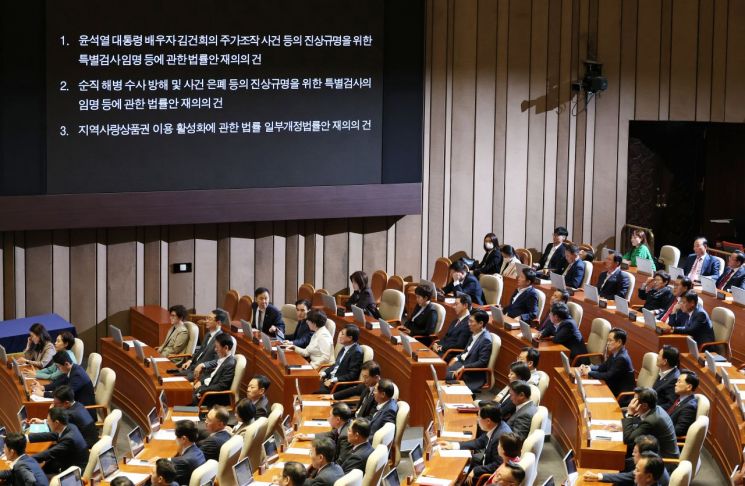
On the 4th, the National Assembly held a re-vote and rejected the so-called Ssangteukgeom Act (Special Prosecutor Act for Kim Geon-hee and Chae Sang-byeong) and the Regional Currency Act (Act on the Promotion of Use of Local Love Gift Certificates), which President Yoon Seok-yeol had exercised his veto power on.
All 300 members of the National Assembly participated in a secret ballot held at 2 p.m. during the plenary session. The Special Prosecutor Act for Mrs. Kim was rejected with 194 votes in favor, 104 against, 1 abstention, and 1 invalid vote out of 300. The Special Prosecutor Act for Chae Sang-byeong was also rejected with 194 votes in favor, 104 against, and 2 invalid votes.
For a law returned to the National Assembly by the president's veto to be passed, a majority of the total members must be present, and at least two-thirds of the members present must vote in favor. The People Power Party held a party meeting in the morning and another just before the plenary session, deciding as a party stance to reject the three bills.
The second bill to be discarded that day, the Special Prosecutor Act for Mrs. Kim (the law concerning the appointment of a special prosecutor to investigate the stock manipulation case involving Kim Geon-hee, spouse of President Yoon Seok-yeol), included investigations into the Deutsche Motors stock manipulation case, allegations of luxury handbag bribery, and suspicions of Mrs. Kim's interference in personnel and candidate nominations. The Special Prosecutor Act for Chae Sang-byeong proposed a third-party recommendation system this time, but gave the opposition party veto power over special prosecutor candidates recommended by the Chief Justice of the Supreme Court.
The People Power Party has pointed out that both special prosecutor acts violate the separation of powers by allowing the opposition party to monopolize investigative and prosecutorial authority. They also argue that the acts are unconstitutional special prosecutor laws aimed at pushing the Yoon Seok-yeol administration into an impeachment crisis to block judicial risks against Lee Jae-myung, leader of the Democratic Party of Korea. On the other hand, the Democratic Party plans to thoroughly verify the allegations related to Mrs. Kim during the upcoming National Assembly audit starting next week and reintroduce the special prosecutor acts in November.
With the rejection of the three bills, including the Special Prosecutor Act for Mrs. Kim, in the re-vote that day, the sequence of 'the ruling opposition unilaterally pushing through contentious bills → presidential veto → National Assembly re-vote leading to rejection' was repeated.
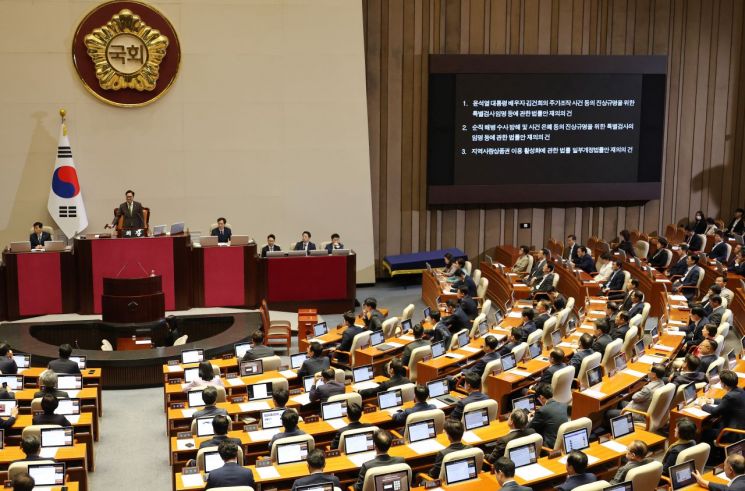
The reconsideration bill on the Regional Currency Act was also rejected in the plenary session re-vote with 187 votes in favor, 111 against, and 2 invalid votes. The core of this bill was to change the financial support necessary for the operation of local love gift certificates by the state and local governments from a discretionary basis to a mandatory one.
The People Power Party opposed the Regional Currency Act, stating, "It effectively institutionalizes a 250,000 won support law for all citizens," and criticized it as "a regional discriminatory gift certificate law that supports wealthy local governments that can issue many gift certificates but does not support poor local governments."
After the plenary session adjourned that day, the Democratic Party planned to hold a rally at the main lobby of the National Assembly building to condemn the rejection of the reconsideration of major bills.
Although the ruling party blocked the passage of the Special Prosecutor Acts for Mrs. Kim and Chae Sang-byeong through two party meetings that day, signs of defections also appeared. Out of 300 members, 108 belong to the People Power Party, and 192 are opposition members including Speaker Woo Won-sik. Therefore, if all abstentions and invalid votes during the special prosecutor acts' reconsideration vote are considered defections within the ruling party, the maximum number of defections can be interpreted as four.
People Power Party lawmaker Kim Yong-tae told reporters after the vote that it was appropriate for the bills to be rejected due to their unconstitutional nature and lack of bipartisan agreement, but he also pointed out, "Politically, Mrs. Kim needs to explain the series of processes to the public once."
Lawmaker Ahn Cheol-soo also said, "The public demands not only that politicians obey the law but also uphold a higher level of morality. Even if the prosecution finds no legal issues and does not indict, if there are moral problems, it is appropriate to apologize," adding, "Didn't all four candidates in the last party leader election say that Mrs. Kim should apologize?"
However, People Power Party floor leader Choo Kyung-ho dismissed concerns about defections within the ruling party after the re-vote, telling reporters, "I cannot specify the exact number of defections, but I think the significance lies in rejecting the reconsideration based on the consensus gathered at today's party meeting," and added, "I do not think the unity has been broken. It has been firmly maintained and will continue to be so."
© The Asia Business Daily(www.asiae.co.kr). All rights reserved.
![User Who Sold Erroneously Deposited Bitcoins to Repay Debt and Fund Entertainment... What Did the Supreme Court Decide in 2021? [Legal Issue Check]](https://cwcontent.asiae.co.kr/asiaresize/183/2026020910431234020_1770601391.png)
















