Commercial Kimchi Temporarily Sold Out on Manufacturers' Online Stores
Monsoon and Record Heatwave Continue to Affect Crop Yields
Napa Cabbage Price Nears 10,000 Won per Head
Stable Supply Expected from Mid-October with Full-Scale Autumn Napa Cabbage Shipment
Due to this year's prolonged rainy season followed by unprecedented heatwaves, cabbage crop yields have declined, signaling a prolonged 'Kimchi crisis.' Although there is still time before the peak kimchi-making season, major manufacturers have halted sales of packaged cabbage kimchi due to supply shortages, making kimchi a 'precious item' on dining tables. The food industry expects kimchi supply to normalize from mid-month when autumn cabbage shipments begin in earnest. However, with the price of one cabbage head still approaching 10,000 won and autumn yields expected to be lower than usual, the situation remains uncertain.
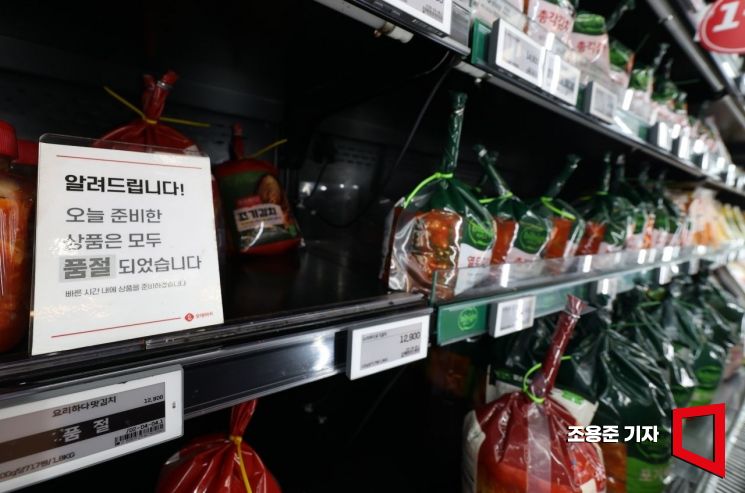 As the fear of a kimchi crisis due to soaring cabbage prices becomes a reality, packaged kimchi sales are also facing an emergency. A sold-out notice is posted at the packaged kimchi section of a large supermarket in Seoul. Photo by Jo Yongjun jun21@
According to the industry on the 4th, Daesang's 'Jongga,' which holds more than one-third of the domestic packaged kimchi market share, temporarily suspended sales of whole cabbage kimchi on its online mall for over two weeks starting from the 19th of last month. Orders for other kimchi products such as white kimchi, nabak kimchi, and green onion kimchi were also blocked.
A Daesang representative said, "We managed to maintain kimchi supply until summer by using reserved cabbage, but poor crop yields due to the rainy season and heatwaves have made it difficult to secure additional quantities. Currently, we are maximizing production of other product lines like young radish kimchi and young summer radish kimchi, which still have some raw material supply capacity." They added, "We expect the situation to improve once autumn cabbage shipments begin in mid-month."
CJ CheilJedang, which produces Bibigo kimchi, also has 41 out of 49 kimchi products listed on its online mall temporarily out of stock, excluding 8 items such as aged kimchi and green onion kimchi. Due to the shortage, products are prioritized for supply to offline channels like large supermarkets, reducing the frequency of online sales.
The government decided to import a total of 1,100 tons of Chinese cabbage from the 26th of last month until the end of this month to ease the supply, but this policy has limited effectiveness for manufacturers producing kimchi for retail sale. An industry insider said, "While this may help the food service industry somewhat, kimchi made for B2C (business-to-consumer) transactions uses only domestically sourced cabbage from across the country. The supply shortage in online orders can only be resolved once autumn cabbage shipments from production areas are secured."
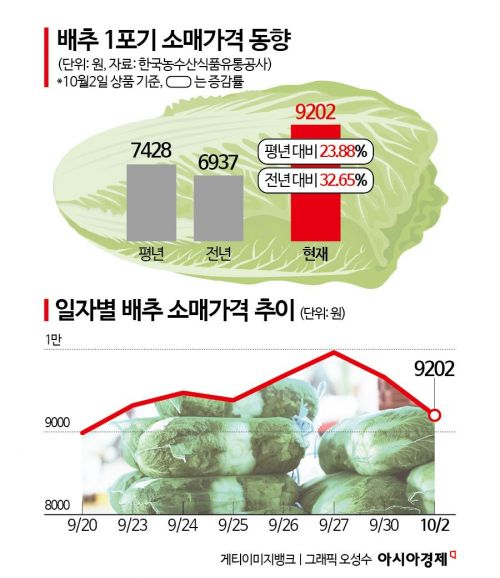
From the consumer's perspective, it is also difficult to purchase cabbage and make kimchi directly. This is because cabbage prices have surged sharply after the Chuseok holiday. According to the Korea Agro-Fisheries & Food Trade Corporation (aT) Agricultural Products Distribution Information (KAMIS), the retail price of one head of cabbage (standard grade) surpassed 9,000 won on the 19th of last month at 9,337 won and approached 10,000 won at 9,963 won on the 27th. The most recent price as of the 2nd of this month was 9,202 won per head, up 33.9% from the previous month and 32.7% from a year ago. Compared to the average price over three years from 2019 to last year, excluding the highest and lowest prices, it is 23.9% more expensive. During the same period, the price of one radish also rose to 3,859 won, up 50.3% year-on-year and 29.7% compared to the average.
The government and industry expect cabbage prices to gradually decline after mid-month, but autumn cabbage crop yields are also expected to be worse than usual. According to the 'Agricultural Outlook October Issue' report recently released by the Korea Rural Economic Institute (KREI), autumn cabbage production is forecasted to decrease by 5.2 to 8.1% from last year to between 1,142,000 and 1,177,000 tons. Additionally, the wholesale price of cabbage (standard grade) this month is expected to rise 38.4% year-on-year to 15,000 won per 10 kg. Compared to the average price, it is 42.9% higher. This is due to reduced production of cabbage in semi-highland areas caused by high temperatures and drought.
An industry representative said, "The situation where cabbage crop yields decline due to the rainy season and heatwaves, causing prices to rise and difficulties in kimchi supply, has happened in the past and is likely to repeat every year in the future. If consumers purchase kimchi in advance while prices are relatively stable before the heatwave begins, it will help them endure until the kimchi-making season."
© The Asia Business Daily(www.asiae.co.kr). All rights reserved.


















